
How does Acadia Healthcare Company Inc. convert its distributed sales and marketing model into steady admissions and referrals?
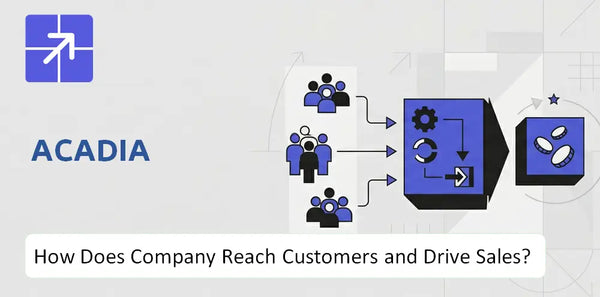
Acadia Healthcare Company Inc. ties clinical quality to referral flows and uses a distributed field sales model across 250+ facilities to drive admissions. In 2025 the network managed ~11,200 beds, supporting scale advantages in payer contracting and institutional referrals.
Prioritize referral retention: align clinical KPIs to partner hospitals and insurers and track bed utilization weekly. See the Acadia BCG Matrix Analysis for product-market fit evidence.
Who Does Acadia Want to Sell To?
Acadia Healthcare Company Inc. primarily sells inpatient and specialty behavioral health services to individual patients with high-acuity psychiatric and substance-use needs, institutional payers (commercial insurers, Medicaid, Medicare), and partnered non-profit health systems via joint ventures. The company wins by focusing on higher-acuity cases, markets with bed shortages, and payer relationships that yield premium reimbursements.
 Core patient segment: high-acuity inpatient cases
Acadia Healthcare Company Inc. targets adults and adolescents needing acute psychiatric hospitalization, intensive substance use disorder treatment, and specialty programs (eating disorders). By 2025 the company emphasized higher-acuity patients who drive higher per-day reimbursements and longer LOS (length of stay), supporting revenue per occupied bed above national averages.
Institutional payers: commercial insurers and government programs
Commercial payers, Medicaid, and Medicare account for the bulk of revenue; in 2025 payer mix trends showed Medicaid remaining a substantial share in many state markets while commercial contracts provided higher margins in select geographies. Acadia customer acquisition relies on negotiated network access, case management relationships, and claims throughput to convert demand into billable stays.
Strategic B2B partners: non-profit health systems and JVs
Acadia Healthcare Company Inc. targets large non-profit health systems for joint ventures and hospital alignment, securing referral pipelines and inpatient placement agreements. These partnerships increase referral volume, improve payer contracting leverage, and serve as a B2B sales channel for enterprise placements.
Market positioning: specialty inpatient leader in supply-constrained regions
Acadia positions itself as a high-acuity inpatient specialist in markets with bed deficits, enabling pricing power and stronger negotiating leverage with local payers. Focused facility placement and service mix optimization aim to sustain higher occupancy and improved revenue per available bed.
Why this positioning works: reimbursement and barriers to entry
Higher-acuity inpatient care yields premium per-diem and case rates; regulatory and capital barriers limit new supply, keeping local bed deficits and referral dependency intact. Acadia demand generation strategies include clinician outreach, payer contracting, and joint-venture referral pathways that convert demand into admissions efficiently.
Sales and marketing tactics: channels and metrics
Acadia Company marketing blends clinician outreach, payer negotiation, digital referral tools, and targeted community provider education. Key metrics in 2025: occupancy rates and revenue per bed drove performance; management cited focus on LOS, admission conversion, and payer mix to lift margins. See a detailed company growth analysis: Growth Outlook of Acadia Company.
Acadia SWOT Analysis
- Complete SWOT Breakdown
- Fully Customizable
- Editable in Excel & Word
- Professional Formatting
- Investor-Ready Format

How Does Acadia Get in Front of Customers?
Acadia Healthcare Company Inc. reaches customers through a multichannel referral network led by field sales, targeted digital lead generation, and strategic joint ventures with health systems to convert clinical demand into admissions.

Referral and Field Sales Network
Acadia Company marketing depends on a specialized field sales force that builds high-touch relationships with hospital emergency departments, primary care physicians, judicial systems, and community organizations to drive referrals and inpatient admissions.
Digital Marketing and Online Reach
For specialty treatment and outpatient services Acadia deploys search-optimized platforms, paid search and SEO to capture direct-to-consumer demand; digital lead generation funnels patients into intake teams and telehealth scheduling.
Partnerships and Joint Ventures
Acadia leverages a Joint Venture model with blue-chip health systems to gain immediate referral pipelines and brand credibility; by March 2026 Acadia Healthcare Company Inc. has operationalized over 22 JV partnerships, lowering acquisition costs and securing market share.
Demand Generation Tactics
Demand generation strategies include clinician outreach programs, CME events, court and community engagement, local awareness campaigns, and targeted digital ads for outpatient services to feed the sales funnel.
Customer Acquisition Efficiency
Joint Ventures and clinical referrals improve Acadia customer acquisition efficiency; management reports lower cost per admission versus broad consumer advertising and faster conversion times from referral to intake.
Most Important Reach Advantage
The strongest reach advantage is the JV and referral network: partnerships supply steady patient flow from general medical beds into specialty units, enabling local market dominance and predictable utilization in 2025/2026.
Read more on company history here: History and Background of Acadia Company
Acadia Business Model Canvas
- One-time Payment
- No Research Needed – Save Hours of Work
- Built by Experts, Trusted by Consultants
- Instant Download, Ready to Use
- 100% Editable, Fully Customizable

How Does Acadia Turn Attention Into Sales?
Acadia Healthcare Company Inc. converts attention into admissions through a 24/7 centralized clinical intake and tight payer contracting, turning referrals into booked stays and then into downstream care within the same network to capture lifetime value.
Centralized Intake and Clinical Sales Model
Acadia Company marketing relies on a centralized intake team that fields referrals and inquiries around the clock to convert interest into admissions; the model is service-led with contract-focused sales to payers and referral partners.
Pricing, Payer Mix, and Monetization Logic
Revenue is primarily fee-for-service governed by payer contracts; for fiscal 2025 ADR grew about 5% – 7% driven by a favorable mix of commercial and diversified payers and negotiated rate increases.
Conversion and Purchase Drivers
Conversion hinges on intake speed, clinical-bed availability, and payer authorization efficiency; quick placement prevents leakage to competitors and improves admission rates, supporting sales funnel optimization and demand generation strategies.
Repeat Revenue, Upsell and Retention via Continuum of Care
Patients shift from inpatient to residential and outpatient within Acadia, creating internal referrals that boost retention and lifetime revenue per patient; this continuum increases average patient lifetime value and reduces customer acquisition costs.
Key metrics: centralized intake converts referrals 24/7; fiscal 2025 ADR growth ~5% – 7%; payer mix tilt to commercial/diversified supported margin and cash collections; internal referral rates materially lift LTV.
Further operational details and revenue mechanics are summarized in this company overview: How Acadia Company Works and Makes Money
Acadia Marketing Mix
- Complete Marketing Mix Analysis
- Effortlessly Communicate Your Business Strategy
- Investor-Ready Format
- 100% Editable and Customizable
- Clear and Structured Layout

How Strong Does Acadia's Commercial Engine Look Going Forward?
Acadia Healthcare Company Inc.'s commercial engine enters mid-2026 with clear momentum: projected 2026 revenue above $3.4 billion, disciplined bed-add guidance of 400 – 600 beds annually, and expanding recurring revenue from opioid-focused Comprehensive Treatment Centers. Main supports are capacity growth, payer pricing power, and better retention; headwinds are clinical labor inflation and regulatory risk.
Capacity expansion and recurring revenue
Annual bed additions of roughly 400 – 600 beds through 2026 underpin volume growth; CTCs for opioid use disorder create a stable, recurring revenue base that smooths acute inpatient cycles and supports Acadia Company marketing and Acadia customer acquisition.
Channel and marketing effectiveness
Multichannel outreach – referral networks, payer partnerships, and targeted digital channels – drives predictable referrals; combined with automation in administrative workflows, this improves lead conversion and sales funnel optimization for Acadia sales strategy.
Risks to commercial performance
Clinical labor inflation remains the largest cost risk, compressing margins if wages rise faster than revenue; regulatory changes to reimbursement or licensing could disrupt demand generation strategies and Acadia B2B sales process and outreach.
Overall sales and marketing outlook
Outlook for 2025/2026 is strong and adaptable: disciplined capacity expansion, robust pricing leverage with payers, and improved retention point to sustained growth and better customer retention tactics; still, margin sensitivity to labor inflation requires ongoing productivity gains and sales funnel optimization.
See corporate culture context in Mission, Vision, and Values of Acadia Company
Acadia Boston Consulting Group Matrix
- Built by Experts, Trusted by Consultants
- Structured for Consultants, Students, and Founders
- 100% Editable in Microsoft Word & Excel
- Instant Digital Download – Use Immediately
- Compatible with Mac & PC – Fully Unlocked

Related Blogs
- What Is the History of Acadia Company and How Did It Evolve?
- What Is the Competitive Landscape of Acadia Company and How Does It Compete?
- What Is the Growth Outlook of Acadia Company and Where Is It Heading?
- How Does Acadia Company Work and What Drives Its Business Model?
- What Do the Mission, Vision, and Core Values of Acadia Company Reveal?
- Who Are the Core Customers in Acadia Company's Target Market?
- Who Owns Acadia Company Today and Who Holds Control?
Frequently Asked Questions
Acadia mainly sells inpatient and specialty behavioral health services to high-acuity patients, institutional payers, and partnered non-profit health systems. The company focuses on adults and adolescents needing psychiatric hospitalization, substance use treatment, and specialty programs, while also relying on commercial insurers, Medicaid, and Medicare for reimbursement.
Disclaimer
All information, articles, and product details provided on this website are for general informational and educational purposes only. We do not claim any ownership over, nor do we intend to infringe upon, any trademarks, copyrights, logos, brand names, or other intellectual property mentioned or depicted on this site. Such intellectual property remains the property of its respective owners, and any references here are made solely for identification or informational purposes, without implying any affiliation, endorsement, or partnership.
We make no representations or warranties, express or implied, regarding the accuracy, completeness, or suitability of any content or products presented. Nothing on this website should be construed as legal, tax, investment, financial, medical, or other professional advice. In addition, no part of this site - including articles or product references - constitutes a solicitation, recommendation, endorsement, advertisement, or offer to buy or sell any securities, franchises, or other financial instruments, particularly in jurisdictions where such activity would be unlawful.
All content is of a general nature and may not address the specific circumstances of any individual or entity. It is not a substitute for professional advice or services. Any actions you take based on the information provided here are strictly at your own risk. You accept full responsibility for any decisions or outcomes arising from your use of this website and agree to release us from any liability in connection with your use of, or reliance upon, the content or products found herein.