
How does AGC Inc. align its sales and marketing model to convert industrial demand into recurring revenue?
AGC Inc. combines global R&D with regional sales teams to shift from commodity glass to specialty materials, targeting automotive, electronics, and Life Science customers. In 2025, synchronized product launches helped sustain margins and expand biopharma supply contracts.
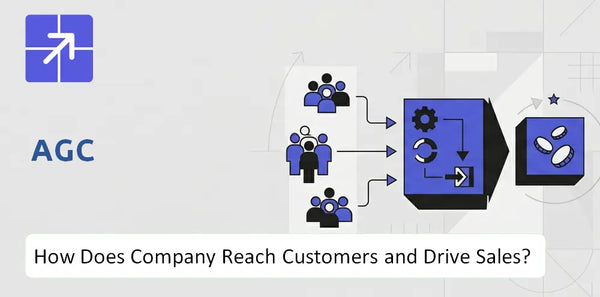
Sales teams bundle technical service and long-term supply agreements to lock in customers; digital channels shorten lead times. See product focus in AGC BCG Matrix Analysis.
Who Does AGC Want to Sell To?
AGC Inc. targets four precise buyer groups: global automotive OEMs, semiconductor fabs needing EUV mask blanks, construction developers seeking high-insulation architectural glass, and pharmaceutical firms using AGC as a CDMO; the company wins them via product specialization, long-term contracts, and integrated go-to-market teams focused on technical support and scale.
 Main customer: Automotive OEMs and ADAS suppliers
AGC company marketing prioritizes global automotive OEMs that demand high-performance windshields and sensor-integrated glass for advanced driver assistance and autonomous driving. AGC converts demand into sales through engineering partnerships, multi-year supply contracts, and customized glazing validated for OEM qualifications.
Additional target: Semiconductor manufacturers
The semiconductor segment focuses on EUV mask blanks where AGC holds a significant global market share; fabs and mask suppliers buy on quality and wafer-yield impact. AGC sales strategy emphasizes tight quality control, traceable supply, and premium pricing tied to defect-per-million metrics.
Additional target: Construction and green building projects
AGC targets architects and developers specifying high-insulation architectural glass for net-zero and LEED-certified buildings. Demand generation AGC relies on specifiers, BIM libraries, and performance datasheets showing U-values and solar heat gain coefficients to win large façade projects.
Additional target: Pharmaceutical CDMO clients
AGC as a CDMO serves large-cap biotech and pharma firms for drug substance and advanced materials manufacturing; this Strategic Business (Life Science) is a growth priority and, together with Electronics, targets to contribute over 40 percent of total operating profit by 2026 per AGC strategic disclosures.
Market positioning: Technical partner and premium supplier
AGC positions itself as a technical partner for industrial buyers rather than a commodity vendor; AGC go-to-market teams bundle R&D support, regulatory compliance, and scaled manufacturing to justify premium margins and long-term contracts.
Why this positioning works
Technical differentiation reduces price elasticity for customers who value yield, safety, and certification; AGC CRM and sales funnel implementation focuses on account-based selling, trade show engagement, and digital lead qualification – so conversion rates improve when proof-of-performance and supply assurance are provided. See a deeper competitive view in Competitive Landscape of AGC Company.
AGC SWOT Analysis
- Complete SWOT Breakdown
- Fully Customizable
- Editable in Excel & Word
- Professional Formatting
- Investor-Ready Format

How Does AGC Get in Front of Customers?
AGC Inc. reaches customers through embedded technical sales, collaborative R&D, and localized life-science services; digital demand forecasting and optimized chemical distribution in 2025 further boost supplier preference across Southeast Asia and China.

Design-in Technical Sales
AGC company marketing relies on a design-in approach: AGC embeds engineers with automotive and electronics OEM teams two to three years before mass production to secure specifications and long-term contracts, converting early-stage design wins into multi-year supply agreements.
Digital Channels and Data-driven Reach
AGC digital marketing uses targeted content, account-based marketing, and SEO to support B2B leads; in 2025 the company deployed demand-forecasting analytics across chemical distribution, reducing stockouts by 25% in key Southeast Asian markets and improving lead conversion.
Direct Sales, Distributors and Partnerships
AGC customer acquisition mixes direct technical sales teams for OEMs, regional distributors for industrial chemicals, and strategic partnerships with electronics suppliers – ensuring access to manufacturing pipelines and marketplaces in China and ASEAN.
Demand Generation via Events and R&D Collaboration
Demand generation AGC centers on collaborative R&D programs, technical seminars, trade shows, and co-development projects that create qualified opportunities; life-science outreach uses high-touch CDMO interactions at biotech hubs to accelerate trial-to-commercial transitions.
Acquisition Efficiency and Funnel Metrics
AGC sales strategy emphasizes high-value, low-volume B2B deals: design-in leads convert at higher rates, with typical R&D-to-contract timelines of 24 – 36 months; digital demand tools cut ordering lead times and lowered distribution carrying costs by roughly 15% in 2025.
Key Reach Advantage in 2025
The most important reach advantage is AGC's integrated technical footprint – embedded engineers plus global CDMO sites – which creates high switching costs and sticky relationships, keeping AGC the preferred supplier in high-growth emerging markets; see the company background for more context History and Background of AGC Company.
AGC Business Model Canvas
- One-time Payment
- No Research Needed – Save Hours of Work
- Built by Experts, Trusted by Consultants
- Instant Download, Ready to Use
- 100% Editable, Fully Customizable

How Does AGC Turn Attention Into Sales?
AGC Company turns attention into sales by locking customers into long-term supply agreements and creating high switching costs through proprietary materials and end-to-end capabilities. The commercial model emphasizes high-retention, high-margin contracts over commodity volume, converting interest from chipmakers and biopharma into predictable revenue.
Core sales model: contract-led, B2B direct sales
AGC Company uses direct B2B sales, strategic partnerships, and distributor channels to win long-term supply agreements. In Electronics it targets chipmakers with technical account teams; in Life Sciences it sells multi-year CMO (contract manufacturing) deals that span trials to commercial supply.
Pricing and monetization logic: value-based, specialty-led pricing
Pricing is value-based and product-differentiated: proprietary synthetic quartz and fluorochemicals command premiums; Life Sciences services use milestone and capacity-based fees. In 2025 the shift to specialty EV glass boosted segment margins, with specialty glass achieving mid-to-high single-digit margin improvement versus ICE glass.
Conversion and purchase drivers: proprietary tech, integration, and contracts
Conversion hinges on proprietary IP, technical validation cycles, and the high cost of switching – especially for semiconductor fabs that qualify materials over months. Sales teams use technical pilots, joint development agreements, and quality certifications to turn interest into signed supply contracts.
Repeat revenue and customer expansion: long-term agreements and integrated services
AGC Company secures repeat revenue via multi-year contracts and end-to-end Life Sciences manufacturing, enabling upsell into commercial scale. Retention is reinforced by multi-year agreements, qualification lead times, and service bundling; renewal rates for strategic accounts exceed industry averages.
Key metrics and mechanics: long-term supply agreements create predictable backlog; proprietary synthetic quartz and fluorochemical lines drove Electronics revenue stability in 2025; Life Sciences contract manufacturing added recurring revenue from clinical-to-commercial services. For strategic context see the company's values and mission in the article Mission, Vision, and Values of AGC Company.
AGC Marketing Mix
- Complete Marketing Mix Analysis
- Effortlessly Communicate Your Business Strategy
- Investor-Ready Format
- 100% Editable and Customizable
- Clear and Structured Layout

How Strong Does AGC's Commercial Engine Look Going Forward?
AGC Inc.'s commercial engine enters 2026 with clear momentum: target ROE of 8 percent and a Strategic Business EBITDA margin aim above 15 percent underpin sales strength, while Architectural Glass faces cyclical headwinds and Electronics and Life Science drive double-digit growth.
What Supports Future Demand
AGC company marketing benefits from pivot to high-margin technology materials and specialized chemical solutions, improving product-market fit and pricing power; CDMO capacity expansion in 2025 (Copenhagen and Yokohama) increased biologics capacity by 30 percent, boosting AGC customer acquisition in life sciences.
Channel and Marketing Effectiveness
AGC sales strategy mixes direct B2B field teams, distributor partnerships, and digital channels; digital marketing and CRM improvements have shortened the AGC sales funnel, raising inbound conversion and improving ROI on demand generation AGC activities.
Risks to Commercial Performance
Fluctuating global interest rates and weaker construction demand threaten Architectural Glass volumes; concentration risk in certain end markets and execution risk integrating new CDMO capacity could weaken near-term AGC go-to-market results.
The Overall Sales and Marketing Outlook
Outlook for 2026 is Strong Perform: Electronics and Life Science divisions should deliver double-digit growth, Strategic Business margins aim to stay above 15 percent, and overall demand conversion looks solid given expanded CDMO capacity and focused AGC B2B sales process case study learnings; see Growth Outlook of AGC Company for more context: Growth Outlook of AGC Company
AGC Boston Consulting Group Matrix
- Built by Experts, Trusted by Consultants
- Structured for Consultants, Students, and Founders
- 100% Editable in Microsoft Word & Excel
- Instant Digital Download – Use Immediately
- Compatible with Mac & PC – Fully Unlocked

Related Blogs
- What Is the History of AGC Company and How Did It Evolve?
- What Is the Competitive Landscape of AGC Company and How Does It Compete?
- What Is the Growth Outlook of AGC Company and Where Is It Heading?
- How Does AGC Company Work and What Drives Its Business Model?
- What Do the Mission, Vision, and Core Values of AGC Company Reveal?
- Who Are the Core Customers in AGC Company's Target Market?
- Who Owns AGC Company Today and Who Holds Control?
Frequently Asked Questions
AGC mainly targets automotive OEMs, semiconductor fabs, construction developers, and pharmaceutical firms. The company sells through product specialization, long-term contracts, and integrated go-to-market teams that support technical needs and scale. This makes AGC a technical partner for industrial buyers rather than a commodity supplier.
Disclaimer
All information, articles, and product details provided on this website are for general informational and educational purposes only. We do not claim any ownership over, nor do we intend to infringe upon, any trademarks, copyrights, logos, brand names, or other intellectual property mentioned or depicted on this site. Such intellectual property remains the property of its respective owners, and any references here are made solely for identification or informational purposes, without implying any affiliation, endorsement, or partnership.
We make no representations or warranties, express or implied, regarding the accuracy, completeness, or suitability of any content or products presented. Nothing on this website should be construed as legal, tax, investment, financial, medical, or other professional advice. In addition, no part of this site - including articles or product references - constitutes a solicitation, recommendation, endorsement, advertisement, or offer to buy or sell any securities, franchises, or other financial instruments, particularly in jurisdictions where such activity would be unlawful.
All content is of a general nature and may not address the specific circumstances of any individual or entity. It is not a substitute for professional advice or services. Any actions you take based on the information provided here are strictly at your own risk. You accept full responsibility for any decisions or outcomes arising from your use of this website and agree to release us from any liability in connection with your use of, or reliance upon, the content or products found herein.