
How does American Vanguard Corporation's sales and marketing model convert niche ag-chem demand into repeat revenue?
American Vanguard Corporation sells high-margin specialty crop protection and biologicals through targeted direct sales, distributor partnerships, and technical agronomy support. This matters because its 2025 Core Plus shift toward biologicals drove revenue mix changes and affected valuation multiples.
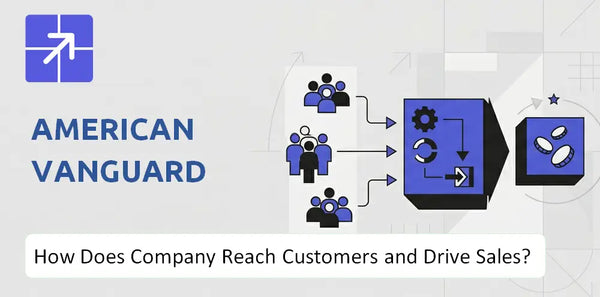
Focus on channel margins and field agronomy impact to improve conversion; monitor 2025 sales mix and regulatory approvals for biologicals. See product positioning: American Vanguard BCG Matrix Analysis
Who Does American Vanguard Want to Sell To?
American Vanguard Corporation targets three clear buyer groups: row-crop and specialty-crop growers, professional pest control operators, and public health/infrastructure managers. The firm wins customers by selling precision pest and soil solutions where yield-per-acre matters more than lowest input cost.
 Primary customers: high-value crop growers
American Vanguard Company marketing focuses on growers of potatoes, citrus, cotton, and other high-value crops that need precision soil health and targeted pest control. These growers value products that protect yield per acre and meet regulatory tolerances; in 2025 the agricultural segment accounted for a majority of the company's North American revenue and drove repeat purchases through season-long programs.
Secondary targets: professional pest control and municipal buyers
Professional pest control operators and municipal/public health officials buy mosquito and vector-control products for endemic and outbreak response. American Vanguard Company sales strategy prioritizes municipal contracts and infrastructure managers in regions with rising vector-borne disease risk, where 2025 public-health channel orders grew notably versus 2024.
Market positioning: niche specificity over broad-spectrum reach
American Vanguard customer acquisition emphasizes specialty and niche pest pressures underserved by large competitors' broad-spectrum chemistries. The go-to-market plan targets regulatory-cleared, high-efficacy solutions that justify premium pricing and drive higher margins per unit in key geographies.
Why this positioning works
Buyers focused on yield-per-acre optimization pay for specificity; American Vanguard sales channels – dealer and distributor network strategy plus direct municipal bids – capitalize on that willingness. The company leverages trade shows, targeted digital advertising, and CRM-driven lead conversion to turn interest into orders, helping explain year – over – year sales conversion improvements reported in 2025.
Competitive Landscape of American Vanguard Company
American Vanguard SWOT Analysis
- Complete SWOT Breakdown
- Fully Customizable
- Editable in Excel & Word
- Professional Formatting
- Investor-Ready Format

How Does American Vanguard Get in Front of Customers?
American Vanguard Corporation gets in front of farmers via a two-track model: field-facing technical sales experts plus a broad third-party distributor network, and it drives locked-in demand through its SIMPAS in-cab digital system that prescribes product use at application time.

Distributor relationships drive scale
American Vanguard Company marketing leans on deep ties with major U.S. distributors such as Nutrien Ag Solutions and Helena Agri-Enterprises to reach thousands of retailers and farm customers; these channel partners account for a substantial share of domestic revenue in 2025.
Digital in-cab prescriptive platform
American Vanguard Company sales strategy centers on SIMPAS (Smart Integrated Multi-Product Adaptive System), a hardware-software integration placing recommendations in the farmer's cab so the product becomes the default at point of application – tightening conversion from interest to purchase.
Multi-channel sales access
American Vanguard Company sales channels include direct technical reps, distributor networks, retail co-ops, and limited e-commerce/wholesale listings; distributors handle order fulfillment and retail placement, boosting reach across row-crop geographies.
Demand generation where decisions happen
Demand is created through field demonstrations, trade shows, targeted agronomic email campaigns, and in-cab prescriptions via SIMPAS; these tactics convert trials into repeat purchases because recommendations align with application timing.
Efficient customer acquisition
American Vanguard customer acquisition is efficient when SIMPAS adoption and distributor placements overlap – sales teams report higher conversion and lower acquisition cost where SIMPAS penetration exceeds 50% of active accounts in a region.
Key reach advantage in 2025
The most important reach advantage is the integrated hardware-software-chemical model: SIMPAS creates a locked-in demand loop so that when application decisions occur, American Vanguard products are prescribed and purchased, scaling distribution impact across dealer networks.
For more on corporate orientation and how this strategy ties to company goals, see Mission, Vision, and Values of American Vanguard Company
American Vanguard Business Model Canvas
- One-time Payment
- No Research Needed – Save Hours of Work
- Built by Experts, Trusted by Consultants
- Instant Download, Ready to Use
- 100% Editable, Fully Customizable

How Does American Vanguard Turn Attention Into Sales?
American Vanguard Company turns attention into sales by selling hardware systems that lock customers into recurring chemical purchases and by pricing enhanced post-patent formulations at a premium; the SIMPAS model raises switching costs and drives repeat revenue, while a growing biologicals mix improves margins and broadens buyer appeal.
System-selling as the Core Sales Model
American Vanguard Company sells precision application hardware plus chemical consumables through direct B2B channels, dealer and distributor networks, and targeted field sales to large growers and cooperatives. The go-to-market mixes contract sales, trade-show deals, and partner-led installations to embed systems on commercial farms.
Pricing and Monetization Logic
Revenue comes from one-time hardware sales and recurring high-margin consumables; post-patent products enhanced with proprietary formulations command a premium over generics. In fiscal 2025, biologicals reached approximately 15 percent of the portfolio, improving blended margins by shifting volume toward lower-regulation, higher-value SKUs.
Conversion and Purchase Drivers
Conversion relies on SIMPAS: once a grower buys application hardware, prescription chemistry becomes sticky due to calibration, warranty terms, and operator training, raising switching costs and driving repeat orders. Sales execution leans on field demos, CRM-driven lead follow-up, and case studies showing yield and cost benefits.
Repeat Revenue and Customer Expansion
Recurring revenue comes from consumable refill cycles and seasonality-driven repurchase; American Vanguard Company deepens wallet share via product bundles, loyalty pricing for cooperatives, and upsells to biologicals and tailored prescriptions. Distributor agreements and service contracts further lock in multi-year demand.
How American Vanguard Company Works and Makes Money
American Vanguard Marketing Mix
- Complete Marketing Mix Analysis
- Effortlessly Communicate Your Business Strategy
- Investor-Ready Format
- 100% Editable and Customizable
- Clear and Structured Layout

How Strong Does American Vanguard's Commercial Engine Look Going Forward?
American Vanguard Company's commercial engine looks stronger heading into 2026, driven by post-de-stocking rebound, SIMPAS ecosystem expansion, and deeper penetration in Brazil and Mexico; these support a projected 5 – 8% revenue growth and improved margins, while commodity volatility and regulatory cycles could weaken near-term sales.
What Supports Future Demand
Product-market fit in specialty biologicals and fumigants plus the SIMPAS agronomy platform drive repeat purchases and prescriptive sales; expanding footprint in Brazil and Mexico should convert regional crop cycles into incremental volume and average selling price gains.
Channel and Marketing Effectiveness
Direct field sales, distributor partnerships, and emerging digital marketing (CRM-driven lead funnels and targeted programmatic ads) enable efficient American Vanguard Company marketing and customer acquisition; SIMPAS adds upsell motion through data-driven recommendations.
Risks to Commercial Performance
Global commodity price swings, regulatory approvals, and dealer inventory restocking cycles remain top risks; concentrated exposure to Latin America crop seasons and currency swings could compress margins despite higher-margin specialty mix.
The Overall Sales and Marketing Outlook
Outlook for 2025/2026 is favorable: management guidance and market signals imply 5 – 8% revenue growth and an EBITDA margin uplift to roughly 12 – 14% as biologicals and specialty soil fumigants scale; sales channels appear adaptable, with CRM and digital tools improving conversion from lead generation to wholesale and retail orders.
For customer segments and market positioning context see Target Customers and Market of American Vanguard Company
American Vanguard Boston Consulting Group Matrix
- Built by Experts, Trusted by Consultants
- Structured for Consultants, Students, and Founders
- 100% Editable in Microsoft Word & Excel
- Instant Digital Download – Use Immediately
- Compatible with Mac & PC – Fully Unlocked

Related Blogs
- What Is the History of American Vanguard Company and How Did It Evolve?
- What Is the Competitive Landscape of American Vanguard Company and How Does It Compete?
- What Is the Growth Outlook of American Vanguard Company and Where Is It Heading?
- How Does American Vanguard Company Work and What Drives Its Business Model?
- What Do the Mission, Vision, and Core Values of American Vanguard Company Reveal?
- Who Are the Core Customers in American Vanguard Company's Target Market?
- Who Owns American Vanguard Company Today and Who Holds Control?
Frequently Asked Questions
American Vanguard targets row-crop and specialty-crop growers, professional pest control operators, and public health or infrastructure managers. The company focuses on buyers who need precision pest and soil solutions, especially where protecting yield per acre matters more than choosing the lowest input cost.
Disclaimer
All information, articles, and product details provided on this website are for general informational and educational purposes only. We do not claim any ownership over, nor do we intend to infringe upon, any trademarks, copyrights, logos, brand names, or other intellectual property mentioned or depicted on this site. Such intellectual property remains the property of its respective owners, and any references here are made solely for identification or informational purposes, without implying any affiliation, endorsement, or partnership.
We make no representations or warranties, express or implied, regarding the accuracy, completeness, or suitability of any content or products presented. Nothing on this website should be construed as legal, tax, investment, financial, medical, or other professional advice. In addition, no part of this site - including articles or product references - constitutes a solicitation, recommendation, endorsement, advertisement, or offer to buy or sell any securities, franchises, or other financial instruments, particularly in jurisdictions where such activity would be unlawful.
All content is of a general nature and may not address the specific circumstances of any individual or entity. It is not a substitute for professional advice or services. Any actions you take based on the information provided here are strictly at your own risk. You accept full responsibility for any decisions or outcomes arising from your use of this website and agree to release us from any liability in connection with your use of, or reliance upon, the content or products found herein.