
How does Bossard Group convert industrial demand into sales through its sales and marketing model?
Bossard Group sells through engineered logistics and on-site services that shift focus from price to Total Cost of Ownership, raising retention and contract value. In 2025 Bossard accelerated digital monitoring rollouts after higher-margin service contracts grew in Europe.
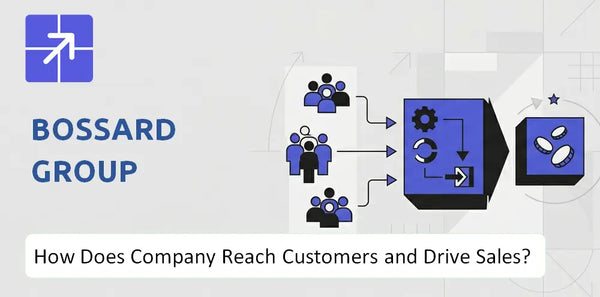
Embed engineering teams at customer sites, use data to reduce downtime, and price for TCO savings; this turns repeat purchases into recurring service revenue. See product analysis: Bossard Group BCG Matrix Analysis
Who Does Bossard Group Want to Sell To?
Bossard Group targets OEMs in high-precision industries – robotics, medical technology, aerospace, and EV infrastructure – focusing on customers with thousands of C-parts and complex assemblies where procurement costs exceed part value. The company wins by offering e-procurement, inventory management, and Smart Factory integration to mid-to-large industrial players seeking measurable productivity gains.
 Main Customer Group: High-Precision OEMs
Bossard Group primarily sells to Original Equipment Manufacturers in robotics, medical devices, aerospace, and electric vehicle infrastructure because these sectors manage large volumes of small parts (C-parts) where administrative procurement costs often exceed part value. Selling to OEM procurement and operations teams lets Bossard deliver supply chain optimization and industrial B2B sales solutions that cut total cost of ownership.
Additional Target Segments: Semiconductor and Renewables
Since early 2026 Bossard Group increased focus on semiconductor equipment manufacturers and renewable energy firms where assembly precision and supply chain reliability are non-negotiable. Secondary targets include mid-to-large-scale industrial manufacturers transitioning to Smart Factory operations and contract manufacturers requiring Kanban, JIT (just-in-time) delivery, and technical consulting.
Market Positioning: Integrated C-parts and Smart Factory Partner
Bossard Group positions itself as a value-added partner offering e-procurement and online ordering for OEMs, inventory management (Kanban), and engineering support to drive supply chain optimization. The company combines distribution logistics, data analytics, and digital sales platform capabilities to convert demand into sales across long-tail SKUs.
Why the Positioning Works: Measurable Productivity and Reliability
Bossard wins on measurable productivity gains – clients report lower procurement overhead and reduced assembly downtime through Bossard inventory management Kanban and JIT solutions. With 2025 service expansion into semiconductor and renewable segments and offerings like technical consulting, Bossard customer acquisition and retention improve via targeted demand generation for manufacturing and proven after-sales support. Read a sector overview in Competitive Landscape of Bossard Group Company
Bossard Group SWOT Analysis
- Complete SWOT Breakdown
- Fully Customizable
- Editable in Excel & Word
- Professional Formatting
- Investor-Ready Format

How Does Bossard Group Get in Front of Customers?
Bossard Group reaches customers through technical consultants, on-site IoT systems (SmartBins/weighing), and a digital e-shop with EDI – entering product design early via Assembly Technology Experts to build demand and lock-in long-term workflows.

Field Technical Consulting as the Primary Acquisition Channel
Bossard sales strategy centers on Assembly Technology Expert services that join customers in the design phase, creating high-barrier entry. Technical consultants convert design influence into specification wins and recurring orders.
Digital Marketing and Online Reach via E-shop and EDI
Bossard digital sales platform and eProcurement solutions capture demand through a sophisticated e-shop and EDI integrations with OEMs and distributors, supporting online ordering and catalog access for repeat buyers.
Sales Channels: On-site Logistics and Distribution
Direct sales teams, Smart Factory Logistics deployments, and partner resellers give Bossard Group distribution logistics and delivery model depth; SmartBins at customer sites generate continuous replenishment orders.
Demand Generation Tactics Focused on Embedded Solutions
Bossard demand generation strategies for manufacturers prioritize demonstration projects, engineering workshops, and pilot SmartBin installs rather than mass advertising, turning pilots into enterprise rollouts.
Customer Acquisition Efficiency Driven by High-Ticket, Low-Churn Accounts
Acquisition costs are offset by long contract lifetimes from integrated services; Smart Factory Logistics reduces order frequency friction and increases share-of-wallet with existing clients.
Most Important Reach Advantage: On-site IoT Presence
SmartBins and IoT-enabled weighing systems create a constant factory-floor brand presence. As of 2025, Bossard Group monitors over 1.6 million data points globally, converting real-time visibility into automated replenishment and recurring revenue.
Technical consulting targets design-in opportunities; Smart Factory Logistics and e-procurement convert usage into orders. See related corporate context in Mission, Vision, and Values of Bossard Group Company
Bossard Group Business Model Canvas
- One-time Payment
- No Research Needed – Save Hours of Work
- Built by Experts, Trusted by Consultants
- Instant Download, Ready to Use
- 100% Editable, Fully Customizable

How Does Bossard Group Turn Attention Into Sales?
Bossard Group turns attention into sales by proving measurable reductions in assembly time and procurement complexity, then migrating customers from transactional buying to managed inventory and Smart Factory Logistics contracts; this raises switching costs and converts one-off orders into recurring revenue.
Core sales model: consultative direct and contract-led selling
Bossard sales strategy relies on field sales engineers, technical consulting, and long-term contracts for managed inventory (Kanban/JIT) and Smart Factory Logistics, combined with a digital sales platform for eProcurement and online ordering for OEMs.
Pricing and monetization logic: product sales plus recurring service fees
Revenue mixes one-time product sales (fasteners, engineered components) with recurring fees for inventory management, implementation, and value-added services; in FY2025 Smart Factory Logistics grew materially as a share of sales, stabilizing margins versus volatile steel prices.
Conversion and purchase drivers: measurable TCO reduction and trust
Conversion hinges on demonstrating a 15 percent to 25 percent reduction in total cost of ownership (TCO) through assembly-time cuts and procurement simplification; trust from technical validation, case studies, and trained sales teams converts leads into orders in B2B sales.
Repeat revenue and customer expansion: upsell within logistics contracts
Bossard increases share-of-wallet by upselling higher-spec engineered fasteners and modular assembly units into existing logistics contracts, reducing acquisition cost per sale and creating high switching costs that drive retention and steady recurring revenue growth in FY2025.
Bossard customer acquisition mixes demand generation for manufacturing (technical workshops, digital lead gen, and channel partners), supply chain optimization proofs, and data analytics to justify moving customers from spot buys to full-service logistics; see more on Ownership and Control of Bossard Group Company Ownership and Control of Bossard Group Company.
Bossard Group Marketing Mix
- Complete Marketing Mix Analysis
- Effortlessly Communicate Your Business Strategy
- Investor-Ready Format
- 100% Editable and Customizable
- Clear and Structured Layout

How Strong Does Bossard Group's Commercial Engine Look Going Forward?
Bossard Group's commercial engine looks resilient into 2026/2027, supported by near-shoring, automation, and strong pricing power. Key supports include diversified end-markets and integrated logistics, while slower European machinery demand is the main downside risk.
What Supports Future Demand
Bossard Group benefits from global near-shoring and automated manufacturing adoption, driving demand for fasteners and assembly solutions; 2025 net sales reached CHF 1.18 billion, showing resilient market fit. Its engineering services, e-procurement platform, and inventory management (Kanban/JIT) strengthen product-market fit and customer retention.
Channel and Marketing Effectiveness
Bossard sales strategy mixes direct B2B sales, digital eProcurement, and distribution logistics to reach OEMs and tier suppliers; the digital sales platform accelerates Bossard customer acquisition and demand generation for manufacturing. Integrated value-added services and technical consulting convert leads into orders and boost after-sales success.
Risks to Commercial Performance
Primary risk is a slowdown in traditional European machinery markets that could compress volumes despite an EBIT margin around 11.5 percent in 2025. Currency swings and supply-chain disruptions remain secondary risks to Bossard distribution logistics and pricing quoting process stability.
The Overall Sales and Marketing Outlook
Outlook for 2026 is positive: professional judgment forecasts 5 – 7 percent organic growth as North American aerospace and Asian electronics show double-digit expansion, offsetting Europe. Bossard demand generation strategies for manufacturers and data analytics-driven pricing should keep the commercial engine adaptable and growth-oriented.
Further operational detail and revenue model context available in this piece: How Bossard Group Company Works and Makes Money
Bossard Group Boston Consulting Group Matrix
- Built by Experts, Trusted by Consultants
- Structured for Consultants, Students, and Founders
- 100% Editable in Microsoft Word & Excel
- Instant Digital Download – Use Immediately
- Compatible with Mac & PC – Fully Unlocked

Related Blogs
- What Is the History of Bossard Group Company and How Did It Evolve?
- What Is the Competitive Landscape of Bossard Group Company and How Does It Compete?
- What Is the Growth Outlook of Bossard Group Company and Where Is It Heading?
- How Does Bossard Group Company Work and What Drives Its Business Model?
- What Do the Mission, Vision, and Core Values of Bossard Group Company Reveal?
- Who Are the Core Customers in Bossard Group Company's Target Market?
- Who Owns Bossard Group Company Today and Who Holds Control?
Frequently Asked Questions
Bossard Group focuses on OEMs in high-precision industries like robotics, medical technology, aerospace, and EV infrastructure. It also targets semiconductor equipment makers, renewable energy firms, and mid-to-large industrial manufacturers that need better handling of C-parts, assembly precision, and supply chain reliability.
Disclaimer
All information, articles, and product details provided on this website are for general informational and educational purposes only. We do not claim any ownership over, nor do we intend to infringe upon, any trademarks, copyrights, logos, brand names, or other intellectual property mentioned or depicted on this site. Such intellectual property remains the property of its respective owners, and any references here are made solely for identification or informational purposes, without implying any affiliation, endorsement, or partnership.
We make no representations or warranties, express or implied, regarding the accuracy, completeness, or suitability of any content or products presented. Nothing on this website should be construed as legal, tax, investment, financial, medical, or other professional advice. In addition, no part of this site - including articles or product references - constitutes a solicitation, recommendation, endorsement, advertisement, or offer to buy or sell any securities, franchises, or other financial instruments, particularly in jurisdictions where such activity would be unlawful.
All content is of a general nature and may not address the specific circumstances of any individual or entity. It is not a substitute for professional advice or services. Any actions you take based on the information provided here are strictly at your own risk. You accept full responsibility for any decisions or outcomes arising from your use of this website and agree to release us from any liability in connection with your use of, or reliance upon, the content or products found herein.