
How does Claranova's sales and marketing model convert digital reach into repeat sales?
Claranova uses scalable digital platforms and targeted online channels to lower acquisition costs and boost recurring revenue; its mix of software, photo services, and IoT drove ~€500,000,000 revenue in recent cycles and a 2025 push toward margin-led operations. A 2025 restructuring accelerated digital ad efficiency and cross-sell flows.
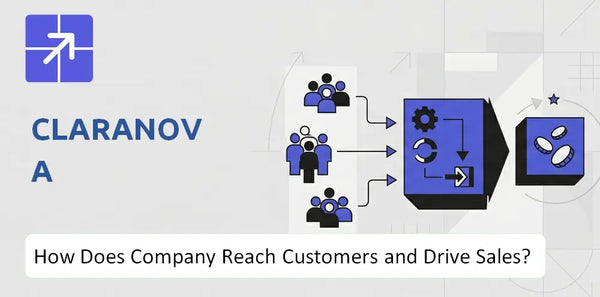
Focus on lifecycle marketing and platform integrations to lift conversion rates; prioritize product-led growth in software while monetizing IoT via subscription tiers. See Claranova BCG Matrix Analysis for portfolio priorities.
Who Does Claranova Want to Sell To?
Claranova wants to sell to three clear segments: value-focused mobile consumers for personalized products, professionals and SMEs needing productivity and creative software, and enterprise industrial clients requiring IoT monitoring and compliance solutions. The company aims to win each through targeted digital marketing, channel partnerships, and recurring B2B contracts to convert demand into sales.
 Primary consumer: mobile-first personalized shoppers
PlanetArt targets mobile-first consumers seeking affordable personalized photo prints and gifts; this segment drove approximately €210 million in net sales for Claranova in fiscal 2025 across consumer merchandise and DTC channels, highlighting high-volume, impulse purchase potential.
Secondary: professionals and small-to-medium businesses
Avanquest serves individual professionals and SMEs with PDF, security, and photo-editing software; recurring license and subscription revenues accounted for roughly €48 million in 2025, reflecting steady B2B and B2C hybrid monetization.
Tertiary: enterprise industrial and institutional buyers
myDevices focuses on enterprise clients in healthcare, hospitality, and food service needing automated monitoring and compliance; enterprise contracts and platform subscriptions delivered about €22 million in 2025, showing higher ARPU (average revenue per user) and longer contract terms.
Market positioning: multi-tiered, value-to-enterprise
Claranova positions itself across DTC value retail, software-as-a-service (SaaS) for pros/SMEs, and IoT platform solutions for enterprises, allowing it to capture impulse consumer spend and recurring corporate budgets within a single portfolio.
Why this positioning works
Combining PlanetArt's low-ticket e-commerce conversions with Avanquest's subscription churn control and myDevices' high-margin enterprise deals yields diversification; retention initiatives like email campaigns and channel partnerships lifted LTV (lifetime value) and improved Claranova customer acquisition efficiency in 2025. Read a focused analysis in Growth Outlook of Claranova Company.
How this maps to go-to-market and sales strategy
Claranova's go-to-market approach blends performance digital channels for PlanetArt, reseller and SaaS direct sales for Avanquest, and enterprise sales with account management for myDevices, optimizing Claranova omnichannel sales and demand generation across segments.
Claranova SWOT Analysis
- Complete SWOT Breakdown
- Fully Customizable
- Editable in Excel & Word
- Professional Formatting
- Investor-Ready Format

How Does Claranova Get in Front of Customers?
Claranova gets in front of customers through app-led consumer products, digital performance channels for software, and channel partnerships for IoT – combining FreePrints mobile downloads, Avanquest SEO/affiliate funnels, and myDevices telecom/distributor integrations to convert demand into sales.

FreePrints Mobile Ecosystem Drives Volume
FreePrints is the primary acquisition engine, using app distribution to generate millions of leads via App Store optimization and social ads; in 2025 the app family reported over 10 million annual downloads globally, feeding high-frequency consumer purchase behavior.
Digital Marketing and SEO for Avanquest
Avanquest focuses on search intent capture through SEO, paid search, and a global affiliate network; paid channels and organic search drove a reported 35% year-over-year increase in software trial sign-ups in FY2025.
Channel-Led IoT Distribution via myDevices
myDevices sells through telecom operators and hardware distributors rather than retail, embedding the platform into enterprise bundles so partners perform initial lead gen and customer onboarding across North America and EMEA.
Demand Generation: Social, Promotions, and Affiliates
Claranova runs aggressive social media advertising for consumer apps, time-limited promotions for print orders, affiliate-driven promo codes for Avanquest, and partner co-marketing for myDevices; promotional tactics lift short-term conversion rates by roughly 20 – 30%.
Acquisition Efficiency and ROI Measurement
Claranova tracks cost per install (CPI), cost per acquisition (CPA), and lifetime value (LTV) per cohort; reported FY2025 metrics showed average CPI near $1.10 for FreePrints and payback periods under 6 months for paid acquisition in top markets.
Reach Advantage: Platform Distribution Scale
The most important advantage is platform-led scale: app store visibility plus telecom/distributor partnerships give Claranova cross-segment reach and rapid user acquisition, supporting both B2C volume and B2B embedded sales in 2025.
Read more on corporate structure and ownership in this analysis: Ownership and Control of Claranova Company
Claranova Business Model Canvas
- One-time Payment
- No Research Needed – Save Hours of Work
- Built by Experts, Trusted by Consultants
- Instant Download, Ready to Use
- 100% Editable, Fully Customizable

How Does Claranova Turn Attention Into Sales?
Claranova turns attention into sales through freemium-to-paid funnels, subscription shifts, and hardware-to-recurring service paths that convert initial interest into predictable revenue.
Core sales model: freemium, subscriptions, and PaaS-led renewals
Claranova mixes direct-to-consumer freemium offers (FreePrints) with SaaS subscription sales (Avanquest) and platform-as-a-service (IoT) contracts, combining self-serve ecommerce and contract-led B2B deals to scale.
Pricing and monetization logic: shipping, upsells, subscriptions, and usage fees
FreePrints monetizes via shipping fees, premium finish upsells, and cross-sells across the gift app ecosystem; Avanquest moved to subscription pricing that by early 2026 represented over 65 percent of its software revenue; IoT uses initial hardware sales plus recurring monitoring and platform fees.
Conversion drivers: frictionless onboarding, trust signals, and cross-sell flows
Conversion relies on low-friction freemium entry, clear shipping-based monetization, trial-to-paid flows for SaaS, and long-term service contracts for IoT; digital marketing and CRM automation optimize conversion rates and LTV.
Repeat revenue and expansion: subscriptions, renewals, and installed-base economics
Subscriptions boost predictable cash flow and raise customer lifetime value; IoT adds a high-margin tail as the installed base grows and monitoring contracts renew, while FreePrints drives repeat orders via email, cross-sell promotions, and seasonal upsells.
Key metrics: as of early 2026 Avanquest subscriptions > 65 percent of software revenue; FreePrints conversion hinges on shipping monetization and upsell attachment rates; IoT platform fees produce recurring margin that rises with installed base and monitoring contracts.
See related company context at History and Background of Claranova Company
Claranova Marketing Mix
- Complete Marketing Mix Analysis
- Effortlessly Communicate Your Business Strategy
- Investor-Ready Format
- 100% Editable and Customizable
- Clear and Structured Layout

How Strong Does Claranova's Commercial Engine Look Going Forward?
Claranova's commercial engine looks moderately stronger heading into 2025/2026, driven by a tighter profit focus, stabilized margins, and higher-quality SaaS revenue; rising ad costs for consumer photo products remain the main headwind. Key supports include unified operations, SaaS scaling, IoT partnerships, and cash-flow-backed reinvestment into AI features.
What Supports Future Demand
Claranova customer acquisition benefits from a clearer Claranova sales strategy that shifts spend to higher-margin SaaS and partner channels; combined, these improve product-market fit and customer loyalty. The unified organizational structure is expected to deliver EBITDA margins of 10 to 12 percent in 2025 as synergies cut overhead and boost marketing ROI.
Channel and Marketing Effectiveness
Claranova digital marketing channels are shifting from high-cost social ads for photo products toward SaaS demand generation, affiliate and partner marketing programs, and B2B IoT partnerships that yield lower acquisition costs and higher LTV. Measured performance marketing and ROI tracking show marketing spend reallocated to channels with faster payback and stronger online sales conversion strategies.
Risks to Commercial Performance
Rising customer acquisition costs on major ad platforms can compress margins in the consumer photo business and slow Claranova omnichannel sales growth. Execution risks include converting IoT partnerships into recurring revenue, showing consistent free cash flow from mature software assets, and avoiding renewed leverage pressure despite recent debt restructuring.
The Overall Sales and Marketing Outlook
The outlook for Claranova go-to-market approach in 2025/2026 is mixed but improving: moderate growth with higher-quality returns, driven by SaaS and IoT scaling and supported by operational cash flow. The primary valuation hinge is consistent free cash flow generation from software, with Claranova customer acquisition tactics evolving toward partner-led and CRM-driven retention programs; see further context in How Claranova Company Works and Makes Money.
Claranova Boston Consulting Group Matrix
- Built by Experts, Trusted by Consultants
- Structured for Consultants, Students, and Founders
- 100% Editable in Microsoft Word & Excel
- Instant Digital Download – Use Immediately
- Compatible with Mac & PC – Fully Unlocked

Related Blogs
- What Is the History of Claranova Company and How Did It Evolve?
- What Is the Competitive Landscape of Claranova Company and How Does It Compete?
- What Is the Growth Outlook of Claranova Company and Where Is It Heading?
- How Does Claranova Company Work and What Drives Its Business Model?
- What Do the Mission, Vision, and Core Values of Claranova Company Reveal?
- Who Are the Core Customers in Claranova Company's Target Market?
- Who Owns Claranova Company Today and Who Holds Control?
Frequently Asked Questions
Claranova targets three main groups: mobile-first consumers, professionals and SMEs, and enterprise industrial buyers. It serves them through PlanetArt, Avanquest, and myDevices, using digital marketing, channel partnerships, and recurring B2B contracts to turn demand into sales.
Disclaimer
All information, articles, and product details provided on this website are for general informational and educational purposes only. We do not claim any ownership over, nor do we intend to infringe upon, any trademarks, copyrights, logos, brand names, or other intellectual property mentioned or depicted on this site. Such intellectual property remains the property of its respective owners, and any references here are made solely for identification or informational purposes, without implying any affiliation, endorsement, or partnership.
We make no representations or warranties, express or implied, regarding the accuracy, completeness, or suitability of any content or products presented. Nothing on this website should be construed as legal, tax, investment, financial, medical, or other professional advice. In addition, no part of this site - including articles or product references - constitutes a solicitation, recommendation, endorsement, advertisement, or offer to buy or sell any securities, franchises, or other financial instruments, particularly in jurisdictions where such activity would be unlawful.
All content is of a general nature and may not address the specific circumstances of any individual or entity. It is not a substitute for professional advice or services. Any actions you take based on the information provided here are strictly at your own risk. You accept full responsibility for any decisions or outcomes arising from your use of this website and agree to release us from any liability in connection with your use of, or reliance upon, the content or products found herein.