
How does CLP Holdings convert market outreach into sales across its regulated and competitive channels?
CLP Holdings blends regulated Hong Kong tariffs with competitive retail offers and B2B decarbonization services to capture demand and protect margins. This matters because its 2025 shift toward renewables and customer energy services affects revenue mix and permitted returns under regulation.
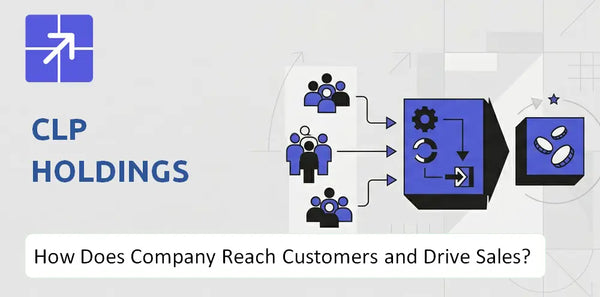
CLP emphasizes bundled offerings, digital meters, and corporate PPA deals to lock customers and monetize capacity; recent 2025 asset reallocation data shows rising renewables share, boosting long-term sales visibility. See CLP Holdings BCG Matrix Analysis
Who Does CLP Holdings Want to Sell To?
CLP Holdings wants to sell to three clear groups: Hong Kong's captive residential and business base where reliability is king, Australian retail and business customers via EnergyAustralia who are price-sensitive, and large state-owned grids plus Commercial & Industrial off-takers across Mainland China, India, and Southeast Asia seeking high-volume, low-carbon supply.
 Primary target: Hong Kong captive customers
CLP Holdings targets roughly 2.8 million residential and business customers in Hong Kong – over 80% of the population – selling reliability, outage-minimization, and regulated supply through strong CLP Holdings customer engagement and smart meter rollout.
Additional targets: Australia retail and business accounts
Via EnergyAustralia, CLP Holdings pursues about 2.4 million retail and business accounts in a competitive, price-sensitive market – focusing on CLP Holdings sales strategy, targeted pricing and tariff strategies for demand conversion, and CLP digital marketing channels to win switchers.
Additional targets: C&I and state-owned grids in Asia
In Mainland China, India, and Southeast Asia CLP Holdings sells to state-owned grid enterprises and large C&I off-takers that buy baseload and renewable energy certificates (RECs); contracts emphasize volume, low-carbon attributes, and long-term offtake to meet 2030 – 2050 carbon neutrality mandates.
Market positioning: reliability, scale, and decarbonization
CLP Holdings positions itself as a reliable incumbent in Hong Kong, a competitive retailer via EnergyAustralia, and a large-scale clean-energy supplier in Asia – backing offers with asset scale, long-term PPAs, and CLP corporate customer programs to capture high-volume demand.
Why this positioning works
Reliability sells to Hong Kong's captive base; low tariffs and digital customer engagement drive conversions in Australia; and long-term, low-carbon contracts appeal to grids and C&I buyers – supported by CLP smart meter adoption impact, data analytics, and demand-response programs that increase sales conversion.
Further reading on CLP competitive context
See the company positioning and rivals in the Competitive Landscape of CLP Holdings Company article for context on CLP customer acquisition strategies Hong Kong and CLP marketing campaigns for renewable energy customers.
CLP Holdings SWOT Analysis
- Complete SWOT Breakdown
- Fully Customizable
- Editable in Excel & Word
- Professional Formatting
- Investor-Ready Format

How Does CLP Holdings Get in Front of Customers?
CLP Holdings gets in front of customers through a mix of infrastructure-linked touchpoints, digital channels, and B2B dealmaking. In Hong Kong it owns direct network access to buildings and runs the CLP App with over 1,000,000 active users; in Australia and Mainland China/India it pairs digital acquisition with PPAs and partner channels to convert demand into sales.

Direct network access in Hong Kong
Every building in CLP Holdings' Hong Kong service area connects to its grid, providing embedded awareness and the simplest route to sell tariffs, demand-response offers, and meter upgrades. That infrastructure link drives high conversion for residential and commercial customers.
Digital marketing and the CLP App
CLP leverages search, paid media, email, social and the CLP App for demand-side management; the app has over 1,000,000 active users and supports targeted notifications, bill pay, and energy-saving nudges to boost sales conversion.
Retail and partner distribution in Australia
In Australia's competitive retail market CLP relies on digital-first acquisition, price-comparison visibility, and strategic retail and corporate partnerships to win and retain customers through competitive tariffs and bundled services.
Business development for PPAs in China and India
Specialized B2B teams secure long-term PPAs with governments and multinationals, using CLP Holdings' 120-year operating history to win multi-decade contracts for renewable and wholesale supply.
Demand-generation campaigns and incentives
CLP runs targeted campaigns, time-of-use pricing pilots, rebates for smart meters and rooftop PV, and community outreach to stimulate switching and uptake of higher-margin services such as demand response.
Customer acquisition efficiency and metrics
Efficiency combines low marginal cost in Hong Kong (network reach) with higher CAC in Australia where price-comparison channels dominate; CLP reports digital engagement and app adoption as core levers to lower churn and cost-to-serve.
Most important reach advantage in 2025
The strongest advantage is CLP Holdings' regulated network footprint in Hong Kong plus the CLP App user base (1,000,000+), which together convert smart-meter data and direct access into scalable sales opportunities across tariffs, demand-response, and energy-efficiency programs.
See additional operational context in How CLP Holdings Company Works and Makes Money
CLP Holdings Business Model Canvas
- One-time Payment
- No Research Needed – Save Hours of Work
- Built by Experts, Trusted by Consultants
- Instant Download, Ready to Use
- 100% Editable, Fully Customizable

How Does CLP Holdings Turn Attention Into Sales?
CLP Holdings turns attention into sales by converting infrastructure investment and customer interest into predictable revenue through regulated returns in Hong Kong and commercial pricing, contracts, and bundled energy solutions in competitive markets.
Core Sales Model: regulated returns plus market contracts
In Hong Kong CLP Holdings customer engagement relies on the Scheme of Control where capital expenditure converts to revenue via an 8.4 percent permitted return on average net fixed assets; in Australia and other markets sales come from direct contracts, retail tariffs, and partner-led installations of solar and batteries.
Pricing and Monetization Logic: tiered tariffs, PPAs, and services
Revenue mixes include regulated tariff pass-through in Hong Kong, tiered retail pricing and time-of-use rates, long-term fixed-price power purchase agreements (PPAs) for corporates, and recurring fees from value-added services like EV charging and energy audits.
Conversion and Purchase Drivers: trust, regulation, and bundled value
Trust from regulated returns, competitive pricing, and convenience from integrated offerings drive purchases; CLP digital marketing channels and corporate customer programs convert leads into contracts, while smart meter adoption improves billing accuracy and upsell timing.
Repeat Revenue and Customer Expansion: ecosystem bundles and analytics
As of 2025 CLP Holdings uses data analytics heavily in Australia to bundle solar, battery storage, and grid power, raising customer lifetime value and reducing churn; upsells include EV charging and energy management subscriptions, increasing recurring revenue and retention.
For context on company purpose and governance see Mission, Vision, and Values of CLP Holdings Company
CLP Holdings Marketing Mix
- Complete Marketing Mix Analysis
- Effortlessly Communicate Your Business Strategy
- Investor-Ready Format
- 100% Editable and Customizable
- Clear and Structured Layout

How Strong Does CLP Holdings's Commercial Engine Look Going Forward?
CLP Holdings' commercial engine looks defensively strong entering 2026, led by regulated Hong Kong earnings and growth from renewables and green hydrogen in Mainland China; Australian retail margins remain a pressure point. Key supports: a HK52.9 billion five-year Hong Kong investment plan, disciplined capital allocation, and scaling renewable sales to C&I clients.
What Supports Future Demand
Regulated Hong Kong returns backed by a HK52.9 billion five-year plan drive predictable earnings and CLP Holdings customer engagement, while Mainland China investments in green hydrogen and energy storage expand CLP corporate customer programs and CLP marketing campaigns for renewable energy customers.
Channel and Marketing Effectiveness
Digital channels and account portals, plus pilot smart meter rollouts, support CLP digital marketing channels and online account management and bill payment conversion; targeted pricing and tariff strategies for demand conversion focus on C&I contracts where margins are higher.
Risks to Commercial Performance
Australian retail faces regulatory price caps and wholesale volatility that compress margins and threaten CLP energy customer acquisition; delays in green hydrogen project scaling or storage deployments would weaken growth offset assumptions and hurt near-term sales conversion.
The Overall Sales and Marketing Outlook
Outlook for 2025/2026 is mixed but resilient: defensive strength in Hong Kong preserves cash flow and dividends, while renewable sales expansion – driven by CLP customer acquisition strategies Hong Kong and Mainland China corporate programs – offers upside if execution and permitting stay on schedule; see related analysis on Target Customers and Market of CLP Holdings Company.
CLP Holdings Boston Consulting Group Matrix
- Built by Experts, Trusted by Consultants
- Structured for Consultants, Students, and Founders
- 100% Editable in Microsoft Word & Excel
- Instant Digital Download – Use Immediately
- Compatible with Mac & PC – Fully Unlocked

Related Blogs
- What Is the History of CLP Holdings Company and How Did It Evolve?
- What Is the Competitive Landscape of CLP Holdings Company and How Does It Compete?
- What Is the Growth Outlook of CLP Holdings Company and Where Is It Heading?
- How Does CLP Holdings Company Work and What Drives Its Business Model?
- What Do the Mission, Vision, and Core Values of CLP Holdings Company Reveal?
- Who Are the Core Customers in CLP Holdings Company's Target Market?
- Who Owns CLP Holdings Company Today and Who Holds Control?
Frequently Asked Questions
CLP Holdings mainly sells to Hong Kong's captive residential and business customers, Australian retail and business accounts through EnergyAustralia, and large state-owned grids and C&I off-takers in Mainland China, India, and Southeast Asia. The article says each group is approached with different offers based on reliability, price, scale, and low-carbon supply.
Disclaimer
All information, articles, and product details provided on this website are for general informational and educational purposes only. We do not claim any ownership over, nor do we intend to infringe upon, any trademarks, copyrights, logos, brand names, or other intellectual property mentioned or depicted on this site. Such intellectual property remains the property of its respective owners, and any references here are made solely for identification or informational purposes, without implying any affiliation, endorsement, or partnership.
We make no representations or warranties, express or implied, regarding the accuracy, completeness, or suitability of any content or products presented. Nothing on this website should be construed as legal, tax, investment, financial, medical, or other professional advice. In addition, no part of this site - including articles or product references - constitutes a solicitation, recommendation, endorsement, advertisement, or offer to buy or sell any securities, franchises, or other financial instruments, particularly in jurisdictions where such activity would be unlawful.
All content is of a general nature and may not address the specific circumstances of any individual or entity. It is not a substitute for professional advice or services. Any actions you take based on the information provided here are strictly at your own risk. You accept full responsibility for any decisions or outcomes arising from your use of this website and agree to release us from any liability in connection with your use of, or reliance upon, the content or products found herein.