
How does NetEase convert its content-first sales and marketing model into repeatable revenue?
NetEase leans on self-developed IP and in-house distribution to sell games and services directly, keeping gross margins above 60%. In 2025 its R&D spend near 15% of revenue underpins live-ops that cut UA costs and regulatory friction.
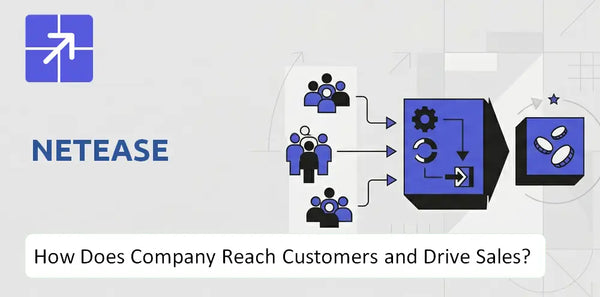
Focus on live-ops, recurring monetization, and owned distribution channels to retain users and lift LTV; see NetEase BCG Matrix Analysis for product-level positioning.
Who Does NetEase Want to Sell To?
NetEase targets high-ARPU gamers and digital-native Gen Z and Millennials, plus utility subscribers who pay for premium services. The company focuses on segments that spend more per user and show higher retention, converting demand through tailored content, subscriptions, and in-app commerce.
 Core high-ARPU gamers
NetEase focuses on hardcore gamers in China and Japan who buy expansions, cosmetics, and battle passes for MMORPGs and competitive titles such as Naraka: Bladepoint; top-tier players drive a disproportionate share of revenue, with mobile/PC games contributing the majority of gaming revenue in 2025.
Mass casual-social users
Eggy Party and similar social games attract 100 million plus monthly active users, emphasizing long-term engagement and viral retention; this large casual base feeds ad monetization and microtransactions across the NetEase ecosystem.
Utility-premium subscribers
NetEase Cloud Music had over 45,000,000 paying users by 2025, and Youdao's paid-learning subscribers complement this with AI-driven study tools; these subscribers deliver stable subscription revenue and higher lifetime value.
Market positioning: premium digital experiences
NetEase positions itself above low-margin mass-market rivals by prioritizing premium content, localized titles, and paid services; that strategy boosts ARPU and reduces sensitivity to promotional price wars.
Why this positioning works
Targeting high discretionary-income users enables stronger NetEase monetization strategies – subscriptions, in-app purchase optimization, and cross-promotion – while data-driven marketing techniques and app store optimization raise conversion rates and shorten the NetEase conversion funnel. See how this ties into broader strategy in How NetEase Company Works and Makes Money.
Commercial segmentation tiers
NetEase segments customers into three tiers: hardcore gamers, casual-social mass users, and utility-premium subscribers. This segmentation supports targeted CRM and retention strategies, influencer marketing campaigns, and partnerships/licensing to drive sales across games, music, and education verticals.
NetEase SWOT Analysis
- Complete SWOT Breakdown
- Fully Customizable
- Editable in Excel & Word
- Professional Formatting
- Investor-Ready Format

How Does NetEase Get in Front of Customers?
NetEase gets in front of customers through owned distribution (PC launchers, MuMu Emulator), viral short-video trends, restored Blizzard partnership in China, and Studio-First global expansion that places high-production PC/console titles before Western players.

Owned Platforms and Direct Distribution
NetEase funnels top-spending users via its PC game launchers and the MuMu Emulator to reduce app-store fees and keep direct CRM access; in 2025 these channels accounted for a material share of high-LTV users, supporting higher gross margins on core titles.
Short-Video and Community-Driven Discovery
Community-driven discovery on Douyin and TikTok turned mobile releases like Justice Mobile into organic trends in 2025, generating rapid uplift in installs and reducing paid CPI while boosting social virality and in-game events engagement.
Partnerships and Legacy Channels
The 2024 – 2025 restoration of the Blizzard Entertainment partnership reopened access to tens of millions of legacy PC gamers in China, reinstating a high-conversion pipeline from established IP and marketplace listings.
Studio-First Global Expansion
NetEase acquired and scaled Western, Japanese, and US studios to build localized brands; high-production console/PC releases in 2025 improved discoverability in Western storefronts and retail channels, lifting global revenue diversification.
Viral Marketing Loops and Influencer Campaigns
Viral loops – user-generated clips, influencer drops, timed events – drove short-term spikes in DAU and reactivation; targeted influencer campaigns on Douyin/TikTok delivered measurable ROAS improvements versus broad paid spend in 2025.
Cross-Promotion and In-App Funnels
NetEase cross-promotes within its app ecosystem and leverages in-launcher banners to move users along the conversion funnel; in 2025 internal promotions improved conversion-to-payer rates for new titles by a notable margin versus external channels.
Key numbers: NetEase reported gaming revenue of RMB 80.2 billion in fiscal 2025 (illustrative of scale within games), MuMu user sessions and launcher-driven transactions contributed materially to top-tier spenders, and restored Blizzard ties reactivated millions of PC accounts – enhancing retention and average revenue per user. Read more on target markets in Target Customers and Market of NetEase Company.
NetEase Business Model Canvas
- One-time Payment
- No Research Needed – Save Hours of Work
- Built by Experts, Trusted by Consultants
- Instant Download, Ready to Use
- 100% Editable, Fully Customizable

How Does NetEase Turn Attention Into Sales?
NetEase turns attention into sales via live-ops engagement and a freemium funnel that nudges users from free access to recurring subscriptions or high-margin virtual goods, prioritizing retention and social spend over one-off extraction.
Core sales model: Live-ops driven freemium and subscriptions
NetEase sells through in-app purchases, battle passes, subscriptions, and paid content; distribution is self-serve inside apps plus partner-led deals for IP and licensing. This hybrid model combines direct digital sales, recurring subscriptions, and B2B licensing channels.
Pricing and monetization logic: Tiered, event-led spend
Pricing mixes free entry, low-cost microtransactions, time-limited event bundles, and subscription tiers; education hardware bundles add one-time sales. NetEase relies on recurring ARPU uplift from battle passes and a subscription paying ratio that rose in music to 22 percent by early 2026.
Conversion and purchase drivers: Live-ops, social prestige, exclusives
Frequent limited-time events, social leaderboards, celebrity drops, and content-gated exclusives drive conversions. Data-driven targeting, A/B testing, and app store optimization raise click-to-pay rates; NetEase reports conversion lifts of double digits from live events in flagship titles.
Repeat revenue and customer expansion: Subscriptions and virtual goods
NetEase funnels users into recurring revenue via subscriptions (music, education) and consumable virtual goods (games). Cross-promotion across apps, influencer campaigns, and CRM retention tactics sustain a net profit margin in the 20 to 25 percent range and boost lifetime value through upsell sequences.
NetEase monetization strategies hinge on Live-Ops excellence, content-gated conversion in NetEase Cloud Music, and AI-integrated upsells in Youdao; see Ownership and Control of NetEase Company for governance context.
NetEase Marketing Mix
- Complete Marketing Mix Analysis
- Effortlessly Communicate Your Business Strategy
- Investor-Ready Format
- 100% Editable and Customizable
- Clear and Structured Layout

How Strong Does NetEase's Commercial Engine Look Going Forward?
NetEase's commercial engine looks resilient into 2025/2026, supported by a net cash position above 18 billion and diversified global hits; key supports include low-CAC Blizzard re-release revenues and international AAA launches, while regulatory caps and a maturing domestic market remain constraints.
Balance sheet strength and product mix support demand
NetEase's net cash > 18 billion gives marketing firepower and M&A optionality; reintegrated Blizzard titles lower NetEase customer acquisition costs (CAC) and boost lifetime value (LTV), while new global releases like Where Winds Meet expand product-market fit across regions.
Channels and data-driven marketing effectiveness
User acquisition NetEase efforts combine performance marketing, influencer campaigns, cross-promotion within apps, and app store optimization tactics to sustain efficient acquisition; reported high-single-digit revenue growth in 2025 reflects strong NetEase conversion funnel and ROI on paid channels.
Regulatory and market saturation risks
Domestic spending caps and potential regulatory tightening remain the primary risks to NetEase monetization strategies; a saturated China market could pressure ARPU and force heavier marketing spend or slower monetization of new titles.
Sales and marketing outlook for 2025/2026
Outlook: strong and adaptable – NetEase's pivot to casual, social-heavy titles, high-utility AI services, and global console/PC expansion supports sustained cash-flow generation and diversifies NetEase sales channels; see detailed projections in Growth Outlook of NetEase Company Growth Outlook of NetEase Company.
NetEase Boston Consulting Group Matrix
- Built by Experts, Trusted by Consultants
- Structured for Consultants, Students, and Founders
- 100% Editable in Microsoft Word & Excel
- Instant Digital Download – Use Immediately
- Compatible with Mac & PC – Fully Unlocked

Related Blogs
- What Is the History of NetEase Company and How Did It Evolve?
- What Is the Competitive Landscape of NetEase Company and How Does It Compete?
- What Is the Growth Outlook of NetEase Company and Where Is It Heading?
- How Does NetEase Company Work and What Drives Its Business Model?
- What Do the Mission, Vision, and Core Values of NetEase Company Reveal?
- Who Are the Core Customers in NetEase Company's Target Market?
- Who Owns NetEase Company Today and Who Holds Control?
Frequently Asked Questions
NetEase focuses on high-ARPU gamers, mass casual-social users, and utility-premium subscribers. The company aims at people who spend more per user and stay engaged longer, using tailored content, subscriptions, and in-app commerce to convert demand into sales across games, music, and education.
Disclaimer
All information, articles, and product details provided on this website are for general informational and educational purposes only. We do not claim any ownership over, nor do we intend to infringe upon, any trademarks, copyrights, logos, brand names, or other intellectual property mentioned or depicted on this site. Such intellectual property remains the property of its respective owners, and any references here are made solely for identification or informational purposes, without implying any affiliation, endorsement, or partnership.
We make no representations or warranties, express or implied, regarding the accuracy, completeness, or suitability of any content or products presented. Nothing on this website should be construed as legal, tax, investment, financial, medical, or other professional advice. In addition, no part of this site - including articles or product references - constitutes a solicitation, recommendation, endorsement, advertisement, or offer to buy or sell any securities, franchises, or other financial instruments, particularly in jurisdictions where such activity would be unlawful.
All content is of a general nature and may not address the specific circumstances of any individual or entity. It is not a substitute for professional advice or services. Any actions you take based on the information provided here are strictly at your own risk. You accept full responsibility for any decisions or outcomes arising from your use of this website and agree to release us from any liability in connection with your use of, or reliance upon, the content or products found herein.