
How does Equitable Holdings convert its sales and marketing model into recurring fee revenue?
Equitable Holdings aligns advisory distribution with in-house product manufacturing to convert client demand into recurring fees and protection sales. This matters as the 2025 shift to capital-light operations raised free cash flow and tightened margins on legacy blocks. Equitable Holdings BCG Matrix Analysis
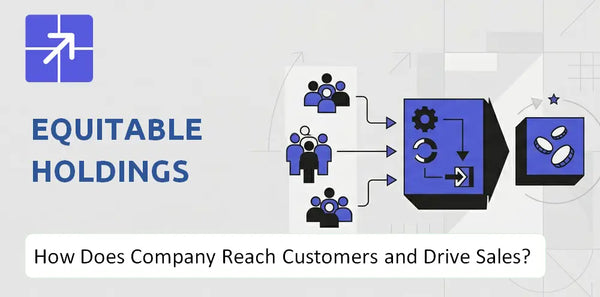
Drive advisors with targeted digital marketing and product shelf optimization to boost retention and fee growth; in 2025, advisor-led flows outpaced retail channels, signaling durable demand for managed solutions.
Who Does Equitable Holdings Want to Sell To?
Equitable Holdings wants to sell to three core groups: mass-affluent and high-net-worth retail clients needing tax-deferred growth and guaranteed lifetime income; public K-12 educators in the 403(b) market; and global institutional investors seeking alpha, ESG integration, and private-market exposure. The company wins via advisor networks, direct digital distribution, and AllianceBernstein's institutional platform.
 Main retail customers: Mass-affluent and HNW individuals
Equitable Holdings targets individuals aged 45 – 75 who need retirement solutions: annuities, variable annuities, and life insurance for tax-deferred growth and guaranteed lifetime income. In 2025 annuity deposits remained a core revenue driver, with annuity net flows and reserves supporting fee and spread income across retail channels.
Additional segments: K-12 educators and institutional investors
Equitable is a dominant 403(b) provider focused on public school employees; it targets plan sponsors and administrators for scale in educator retirement plans. Institutional efforts through AllianceBernstein target sovereign wealth funds, pension plans, and insurers seeking active management, ESG strategies, and private assets exposure.
Market positioning: Trusted multi-channel provider
Equitable positions itself as a multichannel retirement and asset-management platform: distribution through financial advisors, direct digital channels, and B2B2C 403(b) relationships, plus AllianceBernstein for institutional mandates. This mix supports both retail annuity sales and institutional asset-gathering.
Why this positioning works
The message – guaranteed lifetime income, advisor support, and institutional alpha – matches buyer needs and reduces churn. Equitable leverages Equitable Holdings marketing and sales strategy: advisor training, CRM-driven lead conversion, digital onboarding, and fintech partnerships to turn demand into sales. See more on Ownership and Control of Equitable Holdings Company Ownership and Control of Equitable Holdings Company.
Equitable Holdings SWOT Analysis
- Complete SWOT Breakdown
- Fully Customizable
- Editable in Excel & Word
- Professional Formatting
- Investor-Ready Format

How Does Equitable Holdings Get in Front of Customers?
Equitable Holdings gets in front of customers through a multi-channel distribution network: a direct advisory force, third-party wholesale partners, institutional sales, and an optimized digital lead-generation platform that uses predictive analytics to convert awareness into actionable demand.

Direct advisory network drives core acquisition
The Equitable Advisors branch of Equitable Holdings marketing comprises over 7,300 licensed financial professionals who deliver face-to-face and virtual holistic financial planning, making it the primary acquisition channel for high-value retail clients and cross-sell opportunities.
Digital marketing and predictive lead generation
Equitable digital distribution expanded in 2025 with upgraded predictive analytics in its lead-generation platform, improving lead-to-client conversion by targeting cross-sell matches between life insurance protection and wealth management services across search, paid media, email, and app channels.
Wholesale and institutional distribution access
Equitable Holdings sales strategy places products via major wirehouses, independent broker-dealers, and banks; AllianceBernstein serves institutional clients with a global sales force and consultant relations teams for B2B2C reach.
Demand generation through advisor enablement and campaigns
Demand generation tactics combine national marketing campaigns, advisor training programs, targeted events, and digital content to drive appointments and conversions; incentives and analytics guide advisors to high-propensity prospects.
Customer acquisition efficiency and ROI focus
Equitable customer acquisition shows improved efficiency after 2025 platform upgrades; the firm measures advisor-sourced lifetime value and uses CRM and sales automation to shorten onboarding and lift conversion rates per lead.
Scale advantage: advisor network plus analytics
The most important reach advantage is the combined scale of a 7,300+ advisor network and data-driven digital distribution, enabling targeted cross-sell and distribution into institutional channels; see Growth Outlook of Equitable Holdings Company for context.
Equitable Holdings Business Model Canvas
- One-time Payment
- No Research Needed – Save Hours of Work
- Built by Experts, Trusted by Consultants
- Instant Download, Ready to Use
- 100% Editable, Fully Customizable

How Does Equitable Holdings Turn Attention Into Sales?
Equitable Holdings turns attention into sales by pairing aggressive product innovation – especially in Registered Index-Linked Annuities (RILA) – with a push to fee-based advisory relationships that convert transactional buyers into recurring revenue clients.
Core Sales Model: advisor-led, multichannel distribution
Equitable Holdings sells through a hybrid advisor-led and digital distribution model: tied agents, independent advisors, and direct digital channels. The firm leans on Equitable Advisors and institutional partners to move customers from product interest to advice-led solutions.
Pricing and Monetization Logic: fee shift plus product spreads
Revenue mixes include upfront product charges and insurance spreads on annuities, plus advisory fees that are recurring and asset-based. By 1Q 2026 advisory AUM hit a record, increasing predictable fee revenue versus commission volatility.
Conversion and Purchase Drivers: innovation, protection, advisor trust
RILA Structured Capital Strategies convert market uncertainty into sales by offering downside protection with capped upside – appealing in volatile markets. Strong advisor distribution, targeted Equitable Holdings marketing, and CRM-driven lead nurturing raise close rates.
Repeat Revenue and Customer Expansion: funneling transactional buyers to advisory AUM
The Equitable Advisors Funnel migrates insurance purchasers into long-term wealth clients, boosting retention and cross-sell. As of 1Q 2026 advisory AUM reached $230 billion (record level), shifting revenue toward recurring fees and increasing lifetime value.
Key mechanics: product-led demand (RILA innovation), advisor conversion (Equitable financial advisors sales and training), and back-end CRM and analytics to convert leads into advisory relationships; see a market review in Competitive Landscape of Equitable Holdings Company.
Equitable Holdings Marketing Mix
- Complete Marketing Mix Analysis
- Effortlessly Communicate Your Business Strategy
- Investor-Ready Format
- 100% Editable and Customizable
- Clear and Structured Layout

How Strong Does Equitable Holdings's Commercial Engine Look Going Forward?
Equitable Holdings' commercial engine looks durable through 2026, driven by a targeted 12 percent to 15 percent non-GAAP operating EPS growth and a favorable interest rate backdrop that lifts Individual Retirement spreads; volatility in global equities and fee pressure pose the main downside.
What Supports Future Demand
Strong advisor distribution and Equitable Holdings marketing plus expanded product mix via AllianceBernstein boost demand for yield-focused and private-market solutions; continued net flows into retirement products and alternatives should sustain AUM growth and fee revenue.
Channel and Marketing Effectiveness
Equitable Holdings sales strategy leverages a multichannel mix – financial advisors, digital distribution, and B2B2C partnerships – supported by CRM and sales automation; digital marketing channels and advisor training appear to keep customer acquisition cost manageable and conversion rates stable.
Risks to Commercial Performance
Asset-based fee sensitivity to global equity volatility, potential margin compression in core retirement spreads if rates fall, and execution risks in scaling private markets via AllianceBernstein could reduce revenue growth or AUM momentum.
The Overall Sales and Marketing Outlook
The sales and marketing outlook for 2025/2026 looks strong and adaptable: management targets 60 percent to 70 percent free cash flow conversion and 12 – 15 percent EPS growth, implying an efficient sales-to-capital-return machine that benefits from Equitable customer retention, lead generation strategies for advisors, and growing alternative-investment channels. Read more on structural drivers in How Equitable Holdings Company Works and Makes Money.
Equitable Holdings Boston Consulting Group Matrix
- Built by Experts, Trusted by Consultants
- Structured for Consultants, Students, and Founders
- 100% Editable in Microsoft Word & Excel
- Instant Digital Download – Use Immediately
- Compatible with Mac & PC – Fully Unlocked

Related Blogs
- What Is the History of Equitable Holdings Company and How Did It Evolve?
- What Is the Competitive Landscape of Equitable Holdings Company and How Does It Compete?
- What Is the Growth Outlook of Equitable Holdings Company and Where Is It Heading?
- How Does Equitable Holdings Company Work and What Drives Its Business Model?
- What Do the Mission, Vision, and Core Values of Equitable Holdings Company Reveal?
- Who Are the Core Customers in Equitable Holdings Company's Target Market?
- Who Owns Equitable Holdings Company Today and Who Holds Control?
Frequently Asked Questions
Equitable Holdings focuses on three core groups: mass-affluent and high-net-worth retail clients, public K-12 educators in the 403(b) market, and global institutional investors. Its products and platform are built around retirement income, tax-deferred growth, ESG strategies, and private-market exposure across those segments.
Disclaimer
All information, articles, and product details provided on this website are for general informational and educational purposes only. We do not claim any ownership over, nor do we intend to infringe upon, any trademarks, copyrights, logos, brand names, or other intellectual property mentioned or depicted on this site. Such intellectual property remains the property of its respective owners, and any references here are made solely for identification or informational purposes, without implying any affiliation, endorsement, or partnership.
We make no representations or warranties, express or implied, regarding the accuracy, completeness, or suitability of any content or products presented. Nothing on this website should be construed as legal, tax, investment, financial, medical, or other professional advice. In addition, no part of this site - including articles or product references - constitutes a solicitation, recommendation, endorsement, advertisement, or offer to buy or sell any securities, franchises, or other financial instruments, particularly in jurisdictions where such activity would be unlawful.
All content is of a general nature and may not address the specific circumstances of any individual or entity. It is not a substitute for professional advice or services. Any actions you take based on the information provided here are strictly at your own risk. You accept full responsibility for any decisions or outcomes arising from your use of this website and agree to release us from any liability in connection with your use of, or reliance upon, the content or products found herein.