
How does Etsy's sales and marketing model convert its curated marketplace traffic into repeat purchases and higher take rates?
Etsy sells a capital-light, curation-first marketplace that leans on seller storytelling, search relevance, and paid placements to drive transactions. This matters because in 2025 Etsy pushed its effective take rate toward 22%, signaling rising monetization of seller services amid stable active seller counts.
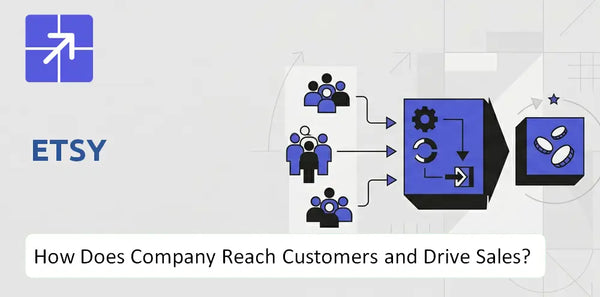
Etsy boosts conversion via targeted ads, personalized email flows, and marketplace SEO; prioritize conversion lift per ad dollar. See Etsy BCG Matrix Analysis for product-level monetization signals.
Who Does Etsy Want to Sell To?
Etsy targets habitual buyers who favor unique, sustainable items and creative entrepreneurs who need easy digital storefronts; it prioritizes the 6.5 million habitual shoppers within a total active buyer base of approximately 91 million (early 2026), focusing marketing and product features to convert repeat demand into sales.
 Main customer: Habitual Buyers
The highest-value segment is the Habitual Buyer: about 6.5 million customers who spend over $200 annually and shop on six or more days each year. Etsy targets them with curated feeds, personalized recommendations, and retention tactics to optimize the Etsy conversion funnel and boost lifetime value.
Additional targets: Creative Entrepreneurs and Gifting Shoppers
On supply, Etsy courts creative entrepreneurs – artisans, makers, and vintage sellers – offering turnkey storefronts and Etsy SEO for sellers tools to drive traffic. It also chases the global gifting market (~$200 billion) by serving shoppers seeking special items for milestones, weddings, and holidays.
Market positioning: Distinct, curated marketplace
Etsy positions itself as the premier destination for unique and sustainable gifts, differentiating from mass-market platforms through handmade curation, listing optimization to boost conversions, and integrated Etsy advertising and promotions that blend paid ads with strong organic search traffic.
Why this positioning wins
The message of authenticity and sustainability resonates: most habitual buyers are female and prioritize special, non-generic items, so Etsy drives higher conversion rates via personalized email marketing for Etsy shops, social media strategies for sellers, and data-driven product recommendations that improve retention.
For operational and monetization context, see How Etsy Company Works and Makes Money which details fees, advertising revenue, and seller-growth tactics that support Etsy customer acquisition and seller success.
Etsy SWOT Analysis
- Complete SWOT Breakdown
- Fully Customizable
- Editable in Excel & Word
- Professional Formatting
- Investor-Ready Format

How Does Etsy Get in Front of Customers?
Etsy reaches customers through a multi-channel funnel: AI-driven discovery, paid search and social performance marketing, seller-driven organic sharing, and brand TV/digital video that sustain awareness and drive purchase intent.

Gift Mode: AI as the Primary Acquisition Engine
Gift Mode, Etsy's AI discovery tool, captures high-intent shoppers by translating vague queries into product matches; in 2025 it accounted for a material share of search-driven orders and improved conversion on discovery sessions by double-digit percentages versus baseline search.
Performance Marketing and Paid Search Reach
Etsy relies heavily on Google Product Listing Ads and Meta integrations to capture long-tail queries; paid channels plus partnerships formed roughly 21 percent of revenue in marketing spend for 2025, with paid search driving a large share of new-buyer acquisition.
Seller Network as Distributed Distribution
Millions of independent shops act as decentralized marketers using built-in social sharing and email tools; seller-driven organic traffic remains a top source of repeat visits and contributes meaningfully to Etsy customer acquisition and seller growth tactics.
Demand Generation: Brand and Seasonal Campaigns
Etsy sustains brand awareness with targeted TV and digital video emphasizing purchases from people not warehouses, and runs seasonal promotions, influencer campaigns, and holiday advertising that boost conversion rates and basket size during peak windows.
Customer Acquisition Efficiency and Funnel Metrics
Etsy's funnel shows efficient paid-to-organic halo effects: paid ads acquire new buyers while Gift Mode and SEO for sellers improve on-site conversion; in 2025 customer acquisition cost trends were offset by higher average order value and improved retention.
Key Reach Advantage: Distributed Seller Base plus AI
The strongest scale advantage in 2025 combines Gift Mode's AI discovery with the promotional power of millions of sellers sharing listings – this mix amplifies search relevance, lowers marginal paid acquisition needs, and strengthens marketplace customer retention strategies; see Ownership and Control of Etsy Company for governance context: Ownership and Control of Etsy Company
Etsy Business Model Canvas
- One-time Payment
- No Research Needed – Save Hours of Work
- Built by Experts, Trusted by Consultants
- Instant Download, Ready to Use
- 100% Editable, Fully Customizable

How Does Etsy Turn Attention Into Sales?
Etsy turns attention into sales by combining friction-minimized checkout, prominent trust signals, and paid discovery to move browsers to buyers; high adoption of seller services and targeted ads lifts take rates and average order values.
Core Sales Model: Marketplace with Self-Serve and Platform Services
Etsy operates a two-sided marketplace where sellers use self-serve tools to list items and buy advertising; sales are primarily direct retail transactions between independent sellers and end customers, supported by platform-led services like payments and shipping. The model scales with volume: more listings and active buyers increase ad inventory and seller services usage, which in turn funds platform investment in search and discovery.
Pricing and Monetization Logic: Tiered Fees, Ads, and Seller Services
Etsy monetizes via a 6.5 percent base transaction fee, listing fees, promoted listings (Etsy Ads), and Seller Services such as Etsy Payments and discounted shipping labels. By Q1 2026 the marketplace take rate reached 21.8 percent, reflecting strong uptake of Etsy advertising and ancillary paid services that are priced per use or percentage-based.
Conversion and Purchase Drivers: Trust, Relevance, and Low Friction Checkout
Search and Discovery algorithms, increasingly powered by large language models, match queries to relevant items across ~120 million listings, raising click-through relevance and reducing browsing friction. The Star Seller program delivers data-driven trust signals that lower buyer hesitation; Etsy Payments processes over 90 percent of platform volume, providing a seamless checkout that shortens the Etsy conversion funnel.
Repeat Revenue and Customer Expansion: Services and Retention Tools
Repeat sales are driven by seller-led retention (discounted shipping, couponing), platform features like saved favorites and email remarketing, and seller adoption of Etsy Ads to re-engage customers. Seller Services create recurring revenue streams as shops scale usage of Etsy Payments, shipping labels, and promoted listings; higher lifetime value supports further investment in Etsy customer acquisition and marketing strategy.
Mission, Vision, and Values of Etsy Company
Etsy Marketing Mix
- Complete Marketing Mix Analysis
- Effortlessly Communicate Your Business Strategy
- Investor-Ready Format
- 100% Editable and Customizable
- Clear and Structured Layout

How Strong Does Etsy's Commercial Engine Look Going Forward?
The commercial engine of Etsy looks solid but shifting to disciplined, mid-single-digit growth; GMS is expected to stabilize near $13.6 billion in 2025/2026, supported by a 28% Adjusted EBITDA margin and strong positioning in personalized gifting and home decor, while competition on low-cost goods and the need for AI-driven search remain key headwinds.
What Supports Future Demand
Brand strength in handcrafted and personalized items, a growing Insider loyalty program, and higher advertising yield are likely to support future sales; Etsy customer acquisition benefits from a clear product-market fit and strong repeat purchase economics.
Channel and Marketing Effectiveness
Etsy's multi-channel mix – organic search, paid ads, email, social, and marketplace SEO – continues to drive efficient acquisition and conversion; investment in advertising products raised revenue per buyer in 2025, and listing optimization and Etsy SEO for sellers remain high-impact tactics.
Risks to Commercial Performance
Competition from ultra-low-cost platforms like Temu pressures lower-tier craft supplies and price-sensitive cohorts; failure to improve AI-driven search, decline in ad yield, or stagnating buyer growth could compress margins and slow Etsy seller growth tactics.
The Overall Sales and Marketing Outlook
The outlook is mixed-to-strong: revenue-per-buyer gains via Insider and ad monetization make Etsy marketing strategy efficient even as buyer growth trends linear; Etsy conversion funnel improvements and targeted retention programs should sustain cash-flow generation and defend its special-category moat. Read more on target customers and market dynamics Target Customers and Market of Etsy Company
Etsy Boston Consulting Group Matrix
- Built by Experts, Trusted by Consultants
- Structured for Consultants, Students, and Founders
- 100% Editable in Microsoft Word & Excel
- Instant Digital Download – Use Immediately
- Compatible with Mac & PC – Fully Unlocked

Related Blogs
- What Is the History of Etsy Company and How Did It Evolve?
- What Is the Competitive Landscape of Etsy Company and How Does It Compete?
- What Is the Growth Outlook of Etsy Company and Where Is It Heading?
- How Does Etsy Company Work and What Drives Its Business Model?
- What Do the Mission, Vision, and Core Values of Etsy Company Reveal?
- Who Are the Core Customers in Etsy Company's Target Market?
- Who Owns Etsy Company Today and Who Holds Control?
Frequently Asked Questions
Etsy focuses on habitual buyers, creative entrepreneurs, and gifting shoppers. The highest-value audience is the habitual buyer segment, while the supply side includes artisans, makers, and vintage sellers. Etsy also targets people looking for unique, sustainable items and special gifts for milestones, weddings, and holidays.
Disclaimer
All information, articles, and product details provided on this website are for general informational and educational purposes only. We do not claim any ownership over, nor do we intend to infringe upon, any trademarks, copyrights, logos, brand names, or other intellectual property mentioned or depicted on this site. Such intellectual property remains the property of its respective owners, and any references here are made solely for identification or informational purposes, without implying any affiliation, endorsement, or partnership.
We make no representations or warranties, express or implied, regarding the accuracy, completeness, or suitability of any content or products presented. Nothing on this website should be construed as legal, tax, investment, financial, medical, or other professional advice. In addition, no part of this site - including articles or product references - constitutes a solicitation, recommendation, endorsement, advertisement, or offer to buy or sell any securities, franchises, or other financial instruments, particularly in jurisdictions where such activity would be unlawful.
All content is of a general nature and may not address the specific circumstances of any individual or entity. It is not a substitute for professional advice or services. Any actions you take based on the information provided here are strictly at your own risk. You accept full responsibility for any decisions or outcomes arising from your use of this website and agree to release us from any liability in connection with your use of, or reliance upon, the content or products found herein.