
How does Flight Centre Travel Group's sales and marketing model mix retail agents and digital channels to convert travel demand into bookings?
Flight Centre Travel Group pairs high-touch retail agents with scalable digital platforms to capture varied customer segments and upsell ancillaries. This matters as the group projects AU$26 billion Total Transaction Value in fiscal 2025, signaling strong channel integration and cross-sell leverage.
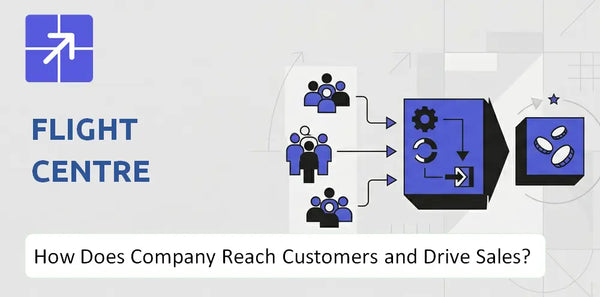
Physical stores build trust for complex itineraries, while online funnels lower acquisition cost and speed fulfilment. Practical insight: optimize agent-assisted digital checkout to lift ancillary attach rates; see Flight Centre BCG Matrix Analysis.
Who Does Flight Centre Want to Sell To?
Flight Centre Travel Group sells primarily to two buyer cohorts: high-yield corporate clients and value-seeking or luxury leisure travelers, with a growing focus on SME corporate accounts to stabilize revenue and margins across cycles.
 Primary corporate clients
FCM Travel targets large multinationals needing managed travel and duty-of-care services, while Corporate Traveller serves small-to-medium enterprises (SMEs). These B2B segments deliver recurring bookings and high retention; by FY2025 corporate TTV contributed a material share as the group shifted emphasis toward SME accounts for better margins.
Leisure and premium travelers
Flight Centre moved away from low-margin mass-market commoditization to focus on bleisure and luxury travelers via Scott Dunn, and independent travelers through Envoyage. Higher average transaction values and targeted promotions raise per-booking yield and lifetime value.
Market positioning
Flight Centre positions itself as an omnichannel travel retailer combining retail stores, franchise networks, digital channels, and specialist brands to capture both convenience-led and high-touch buyers. The mix supports Flight Centre customer acquisition through retail referrals, paid search, SEO, social media, and corporate sales teams.
Why this positioning works
The dual focus captures stable corporate recurring revenue and higher-margin leisure spend; SME corporate accounts offer superior margins compared with global enterprise deals, helping hit a balanced TTV split between corporate and leisure. This approach improves conversion rates across channels and strengthens demand generation for travel agencies.
Growth Outlook of Flight Centre Company
Flight Centre SWOT Analysis
- Complete SWOT Breakdown
- Fully Customizable
- Editable in Excel & Word
- Professional Formatting
- Investor-Ready Format

How Does Flight Centre Get in Front of Customers?
Flight Centre Travel Group reaches customers via an omni-channel mix: physical retail stores, proprietary digital platforms, and targeted B2B sales, converting awareness into bookings through exclusive inventory, personalized pricing, and data-driven retargeting.

Retail footprint as the primary acquisition channel
Retail stores act as visible trust-builders and conversion hubs in Australia, the United Kingdom, and South Africa; in 2025 Flight Centre Travel Group operated over 1,800 retail locations globally, driving high-margin face-to-face sales and walk-in leads.
Digital marketing and online reach
SEO, paid search (PPC), email, apps, and content marketing power digital acquisition; Flight Centre's aggressive SEO and paid search reduced cost-per-acquisition for leisure bookings by double-digit percentages in 2025, while the FCM Platform centralizes the corporate user experience.
Sales channels and distribution access
Global B2B sales teams, franchise partners, and the TP Connects-enabled content hub (NDC-enabled) provide exclusive inventory and personalized pricing for corporate clients; corporate travel revenue contributed approximately 30% of group sales in FY2025.
Demand generation tactics
Circle-of-conquest retargeting uses first-party data to re-engage past leisure customers with tailored cruise and tour offers; seasonal promotions, email campaigns, and local store events further boost short-term demand and shoulder-season bookings.
Customer acquisition efficiency
Integrated omni-channel attribution and analytics lower CAC by blending high-trust retail leads with lower-cost digital retargeting; Flight Centre reported improving marketing ROI in 2025 as digital mix increased and conversion rates rose for FCM corporate accounts.
Most important reach advantage in 2025/2026
The combined effect of a global retail network plus NDC-enabled exclusive inventory via TP Connects gives Flight Centre Travel Group a distribution moat – physical trust plus access to content meta-search engines cannot price or personalize – driving scalable reach and higher booking yields. Read more on the Competitive Landscape of Flight Centre Company Competitive Landscape of Flight Centre Company
Flight Centre Business Model Canvas
- One-time Payment
- No Research Needed – Save Hours of Work
- Built by Experts, Trusted by Consultants
- Instant Download, Ready to Use
- 100% Editable, Fully Customizable

How Does Flight Centre Turn Attention Into Sales?
Flight Centre Travel Group turns attention into sales by pairing consultant-led expertise with tech-enabled self-service, converting interest through packaged bundles and contract-backed corporate bookings that lift revenue per transaction.
Core sales model: omnichannel retail plus expert consultation
Flight Centre customer acquisition uses retail stores, call centres, a mobile app and web self-service to capture demand. Complex itineraries move to consultant-led sales while simple bookings use digital self-serve, creating a tiered omnichannel travel sales approach.
Pricing and monetization logic: bundled margins and service fees
Leisure pricing bundles flights with high-margin land products (tours, hotels, transfers) that typically carry margins 3 – 4x airfares; corporate revenue relies on multi-year contracts, management fees and negotiated commissions.
Conversion and purchase drivers: consultant productivity and AI pricing
Conversion hinges on consultant expertise, upsells during booking and real-time pricing optimisations via AI. Automating back-office functions raised efficiency and helped lift underlying EBITDA margin to approximately 2.0% of TTV by early 2026, ensuring immediate, bookable options.
Repeat revenue and customer expansion: loyalty, contracts, and cross-sell
Flight Centre loyalty programs, seasonal promotions and targeted email marketing campaigns drive repeat bookings; corporate travel sees low churn via integrated policy compliance and bundled managed services that reduce booking leakage and increase wallet share.
Key mechanics: bundle-focused leisure sales increase per-transaction margin, digital self-serve preserves consultant time for high-value upsells, and corporate contracts plus travel policy tools lock in recurring revenue. See a summary of the company's origins here: History and Background of Flight Centre Company
Flight Centre Marketing Mix
- Complete Marketing Mix Analysis
- Effortlessly Communicate Your Business Strategy
- Investor-Ready Format
- 100% Editable and Customizable
- Clear and Structured Layout

How Strong Does Flight Centre's Commercial Engine Look Going Forward?
Flight Centre Travel Group's commercial engine enters 2025/2026 with clear momentum driven by a leaner cost base, stronger US/UK corporate penetration, and digital-first distribution that preserves retail strength; continued growth depends on controlled labor inflation and resilient discretionary leisure demand.
What Supports Future Demand
Brand recognition, franchise reach, and the Grow to Win strategy fuel Flight Centre customer acquisition; corporate sales pipeline and NDC integration increase win rates and provide a defensive moat, supporting 7 – 9% TTV growth guidance for 2026.
Channel and Marketing Effectiveness
Omnichannel travel sales combine retail stores, corporate sales teams, paid search, social media, email and mobile app activity to convert leads; digital ad spend shifted to performance channels has improved CAC and conversion rates in 2025, especially in North America and UK markets.
Risks to Commercial Performance
Labor cost inflation and wage pressure could compress margins; softer discretionary leisure spend or macro shocks would hit high-touch experiences, while competitors without NDC may still undercut on price in some segments.
The Overall Sales and Marketing Outlook
Outlook is strong and adaptable: Flight Centre sales strategy leverages both retail and digital channels, supported by corporate growth and NDC-led inventory access; projected 2026 revenue momentum and sustained profitability indicate likely market outperformance into 2026. Read more on corporate alignment and values in Mission, Vision, and Values of Flight Centre Company
Flight Centre Boston Consulting Group Matrix
- Built by Experts, Trusted by Consultants
- Structured for Consultants, Students, and Founders
- 100% Editable in Microsoft Word & Excel
- Instant Digital Download – Use Immediately
- Compatible with Mac & PC – Fully Unlocked

Related Blogs
- What Is the History of Flight Centre Company and How Did It Evolve?
- What Is the Competitive Landscape of Flight Centre Company and How Does It Compete?
- What Is the Growth Outlook of Flight Centre Company and Where Is It Heading?
- How Does Flight Centre Company Work and What Drives Its Business Model?
- What Do the Mission, Vision, and Core Values of Flight Centre Company Reveal?
- Who Are the Core Customers in Flight Centre Company's Target Market?
- Who Owns Flight Centre Company Today and Who Holds Control?
Frequently Asked Questions
Flight Centre mainly sells to two groups: corporate clients and leisure travelers. Its corporate focus includes large multinationals through FCM Travel and SMEs through Corporate Traveller, while leisure growth centers on bleisure and luxury travelers, plus independent travelers through specialist brands. This mix supports recurring bookings and higher-value sales.
Disclaimer
All information, articles, and product details provided on this website are for general informational and educational purposes only. We do not claim any ownership over, nor do we intend to infringe upon, any trademarks, copyrights, logos, brand names, or other intellectual property mentioned or depicted on this site. Such intellectual property remains the property of its respective owners, and any references here are made solely for identification or informational purposes, without implying any affiliation, endorsement, or partnership.
We make no representations or warranties, express or implied, regarding the accuracy, completeness, or suitability of any content or products presented. Nothing on this website should be construed as legal, tax, investment, financial, medical, or other professional advice. In addition, no part of this site - including articles or product references - constitutes a solicitation, recommendation, endorsement, advertisement, or offer to buy or sell any securities, franchises, or other financial instruments, particularly in jurisdictions where such activity would be unlawful.
All content is of a general nature and may not address the specific circumstances of any individual or entity. It is not a substitute for professional advice or services. Any actions you take based on the information provided here are strictly at your own risk. You accept full responsibility for any decisions or outcomes arising from your use of this website and agree to release us from any liability in connection with your use of, or reliance upon, the content or products found herein.