
How does Gulfport Energy Corporation's sales and marketing model convert midstream logistics and hedging into realized revenue?
Gulfport Energy Corporation sells output via optimized midstream routes, hedging, and market access rather than retail channels. This matters because 2025 LNG demand growth and pipeline takeaways tightened Utica and SCOOP netbacks, pressuring margin capture and requiring precise logistics execution.
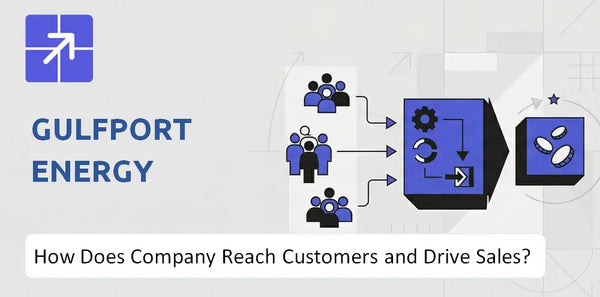
Gulfport focuses commercial effort on routing volumes to highest-priced markets, using hedges and firm transportation; operational discipline cut per-unit cash costs in 2025. See Gulfport Energy BCG Matrix Analysis for product positioning insight.
Who Does Gulfport Energy Want to Sell To?
Gulfport Energy Corporation targets large institutional buyers – regional utilities, midstream aggregators, industrial hubs, and Gulf Coast LNG exporters – seeking long-term, high-volume purchases of natural gas, NGLs, and condensate; it wins them by offering scale, pipeline connectivity, and contract certainty from its Utica and SCOOP production.
 Main customer group: Regional utilities and LNG exporters
Regional utilities in the Midwest and Northeast and Gulf Coast LNG exporters represent the highest-volume buyers; Gulfport Energy marketing targets these groups with firm offtake contracts and pipeline-linked delivery from Utica and SCOOP production. In 2025 Gulfport reported annual marketed gas production volumes supporting sales contracts exceeding 1.2 Bcf/d capacity across its assets.
Additional target segments: Midstream aggregators and industrial hubs
Midstream aggregators and large industrial manufacturers seeking steady, high-volume energy inputs are secondary targets; Gulfport Energy sales strategy emphasizes multi-year deliveries and tailored pricing to industrial buyers. The company focuses on customers able to commit to volumes of 10 – 100+ MMcf/d to smooth cashflow and reserve demand.
Market positioning: Scale supplier with pipeline connectivity
Gulfport Energy positions itself as a scale upstream supplier with direct pipeline access from Utica (Ohio) and SCOOP (Oklahoma) into Midwest, Northeast, and Gulf Coast export corridors. Its 2025 asset footprint and takeaway capacity prioritize buyers needing reliable baseload supply and export-ready molecules, aiding Gulfport Energy customer acquisition.
Why the positioning works: Long-term volume commitments and delivery certainty
The pitch – long-term volume commitments, firm transport, and predictable pricing – resonates with utilities, aggregators, and LNG buyers focused on security of supply. Gulfport Energy sales channels and distribution methods emphasize offtake agreements, and in 2025 the company cited a portfolio of multi-year contracts covering a significant portion of projected production, improving revenue visibility.
Ownership and Control of Gulfport Energy Company
Gulfport Energy SWOT Analysis
- Complete SWOT Breakdown
- Fully Customizable
- Editable in Excel & Word
- Professional Formatting
- Investor-Ready Format

How Does Gulfport Energy Get in Front of Customers?
Gulfport Energy Corporation reaches customers mainly through its midstream footprint and commercial contracts rather than consumer advertising, using firm transportation, offtake deals, and spot-market sales to place production at key hubs and buyers.

Firm transportation to trading hubs
Gulfport Energy marketing depends on firm transportation agreements to move gas to Henry Hub, Chicago Citygate, and TCO, making production visible to major traders and utilities. Securing capacity reduces basis risk and improves realized prices.
Limited digital marketing; focus on commercial outreach
Gulfport Energy digital marketing strategies for energy buyers are minimal; the company uses investor communications, RFP portals, email, and direct relationships rather than broad consumer channels to reach B2B buyers.
Bilateral contracts and spot market access
Sales teams execute long-term bilateral offtake agreements with utilities and aggregators and transact in daily spot auctions to optimize timing and price realization across Gulfport Energy sales channels and distribution methods.
Demand generation via commercial relationships
Demand generation for energy companies here means building creditworthy buyer networks, using negotiated price ladders, seasonal hedges, and index-linked contracts to convert interest into binding purchases.
Acquisition efficiency driven by infrastructure
Customer acquisition efficiency is effectively high because the front end is physical access: by 2025 Gulfport had secured takeaway capacity that lets it offer gas at competitive hubs, lowering selling friction and counterparty search costs.
Key reach advantage: diversified takeaway footprint
The most important reach advantage is takeaway diversity – access to multiple pipeline paths to Henry Hub, Chicago Citygate, and TCO – so Gulfport Energy customer acquisition and Gulfport Energy sales strategy can target buyers where basis differentials maximize revenue. See how the company operates in detail: How Gulfport Energy Company Works and Makes Money
Gulfport Energy Business Model Canvas
- One-time Payment
- No Research Needed – Save Hours of Work
- Built by Experts, Trusted by Consultants
- Instant Download, Ready to Use
- 100% Editable, Fully Customizable

How Does Gulfport Energy Turn Attention Into Sales?
Gulfport Energy Corporation converts market attention into sales by locking prices via hedges, optimizing NGL and condensate mix, and delivering reliably to utility and industrial buyers, turning geologic output into predictable margin per Mcfe.
Core sales model: Contract-based B2B offtake and merchant sales
Gulfport Energy marketing centers on long-term and short-term contracts with utilities, industrial buyers, and midstream partners plus direct merchant sales of physical gas, liquids, and condensate from SCOOP and STACK acreage.
Pricing and monetization logic: Hedged realized prices minus midstream fees
Conversion equals realized prices less gathering, processing, and transportation costs; Gulfport hedges 50 – 70% of production 12 – 18 months out and pursues higher-margin NGL/condensate sales to lift netbacks.
Conversion and purchase drivers: Price certainty, product mix, and delivery reliability
Demand generation for energy companies is driven here by hedging that stabilizes cash flow, optimizing NGL barrel mix (ethane, propane, butane) and SCOOP condensate yields, and operational uptime that sustains a high netback per Mcfe and repeat purchases.
Repeat revenue and customer expansion: Offtake renewals and pipeline connectivity
Gulfport Energy sales strategy secures repeat revenue via multi-year supply contracts, offtake tie-ins to midstream infrastructure, and upsell of higher-margin liquids; in 2025 focus on condensate lifted liquids revenue share and improved margins.
Key 2025 metrics: hedge coverage maintained at 50 – 70% of projected volumes, SCOOP condensate contribution increased net liquids realization by a reported mid-single-digit percent, and stable delivery performance preserved netbacks near guidance per Mcfe; see Mission, Vision, and Values of Gulfport Energy Company for corporate context: Mission, Vision, and Values of Gulfport Energy Company
Gulfport Energy Marketing Mix
- Complete Marketing Mix Analysis
- Effortlessly Communicate Your Business Strategy
- Investor-Ready Format
- 100% Editable and Customizable
- Clear and Structured Layout

How Strong Does Gulfport Energy's Commercial Engine Look Going Forward?
Gulfport Energy Corporation's commercial engine looks solid through 2026, driven by a projected free cash flow yield above 12 percent at current strip pricing and 2025 production of ~1.05 – 1.10 Bcfe/d. Balance-sheet strength, a Net Debt to EBITDAX below 1.0x, and a tilt to higher-margin liquids support durable sales conversion, while regional takeaway constraints are the chief weakening factor.
What Supports Future Demand
Robust cash generation – free cash flow yield > 12 percent – and steady volumes (~1.05 – 1.10 Bcfe/d in 2025) improve Gulfport Energy marketing credibility with buyers and offtakers. The timing aligns with expanded US LNG export capacity, increasing demand for pipeline gas and supporting Gulfport Energy sales strategy and long-term offtake pricing.
Channel and Marketing Effectiveness
Direct sales to utilities, aggregators, and commercial buyers plus contracted offtake link volumes to firm revenues, showing efficient Gulfport Energy customer acquisition and B2B sales process execution. Strategic focus on liquids and selective merchandising increases realized pricing per Mcfe and improves demand generation for energy companies.
Risks to Commercial Performance
Regional pipeline bottlenecks and basis differentials can compress realized prices and impede Gulfport Energy pricing strategy for selling natural gas. Commodity-price swings or slower LNG export ramp-up would reduce free cash flow and stress capital allocation despite a Net Debt to EBITDAX <1.0x.
The Overall Sales and Marketing Outlook
Outlook is strong and adaptable: Gulfport Energy sales channels and distribution methods are supported by solid liquidity and disciplined capex, enabling internal funding of the 2026 drilling program. Continued focus on commercial partnerships, contract negotiation, and targeted customer engagement should sustain efficient conversion of inventory into shareholder returns. Read more on target customers in this piece: Target Customers and Market of Gulfport Energy Company
Gulfport Energy Boston Consulting Group Matrix
- Built by Experts, Trusted by Consultants
- Structured for Consultants, Students, and Founders
- 100% Editable in Microsoft Word & Excel
- Instant Digital Download – Use Immediately
- Compatible with Mac & PC – Fully Unlocked

Related Blogs
- What Is the History of Gulfport Energy Company and How Did It Evolve?
- What Is the Competitive Landscape of Gulfport Energy Company and How Does It Compete?
- What Is the Growth Outlook of Gulfport Energy Company and Where Is It Heading?
- How Does Gulfport Energy Company Work and What Drives Its Business Model?
- What Do the Mission, Vision, and Core Values of Gulfport Energy Company Reveal?
- Who Are the Core Customers in Gulfport Energy Company's Target Market?
- Who Owns Gulfport Energy Company Today and Who Holds Control?
Frequently Asked Questions
Gulfport Energy mainly sells to large institutional buyers. Its core customers are regional utilities, Gulf Coast LNG exporters, midstream aggregators, and industrial hubs that need long-term, high-volume supply of natural gas, NGLs, and condensate. The company wins these buyers with scale, pipeline connectivity, and contract certainty.
Disclaimer
All information, articles, and product details provided on this website are for general informational and educational purposes only. We do not claim any ownership over, nor do we intend to infringe upon, any trademarks, copyrights, logos, brand names, or other intellectual property mentioned or depicted on this site. Such intellectual property remains the property of its respective owners, and any references here are made solely for identification or informational purposes, without implying any affiliation, endorsement, or partnership.
We make no representations or warranties, express or implied, regarding the accuracy, completeness, or suitability of any content or products presented. Nothing on this website should be construed as legal, tax, investment, financial, medical, or other professional advice. In addition, no part of this site - including articles or product references - constitutes a solicitation, recommendation, endorsement, advertisement, or offer to buy or sell any securities, franchises, or other financial instruments, particularly in jurisdictions where such activity would be unlawful.
All content is of a general nature and may not address the specific circumstances of any individual or entity. It is not a substitute for professional advice or services. Any actions you take based on the information provided here are strictly at your own risk. You accept full responsibility for any decisions or outcomes arising from your use of this website and agree to release us from any liability in connection with your use of, or reliance upon, the content or products found herein.