
How does HITT Contracting's sales and marketing model convert relationships into repeat commercial wins?
HITT Contracting pairs decentralized business development with centralized pricing controls to win large interior fit-outs and base-building work. This matters because projected 2025 revenue exceeded 6.8 billion, signaling scale in both volume and high-margin specialties.
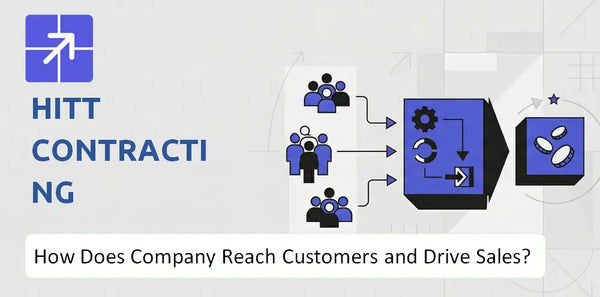
Focus field teams pursue repeat clients while a corporate BD team targets strategic sectors; combine this with standardized safety and quality playbooks to shorten sales cycles. See HITT Contracting BCG Matrix Analysis
Who Does HITT Contracting Want to Sell To?
HITT Contracting targets institutional owners and corporate occupiers in high-growth, high-complexity sectors where technical expertise beats low-bid pricing, aiming to win repeat, high-LTV projects through zero-defect delivery and strong safety performance.
 Core target: Hyperscale data centers and mission-critical facilities
HITT Contracting focuses on hyperscale data center operators and other mission-critical owners who demand strict uptime, advanced MEP (mechanical, electrical, plumbing) systems, and rigorous quality controls; these clients typically contract projects worth $50M – $500M and generate recurring capex cycles.
Additional targets: Life sciences, healthcare, Fortune 500 workplaces, hospitality
Secondary segments include life sciences firms needing specialized labs, healthcare systems expanding outpatient space, Fortune 500 firms undertaking premium workplace transformations, and hospitality developers building luxury assets; project sizes range from $5M – $200M, offering repeat engagement potential.
Market positioning: Premium technical partner, not low-cost bidder
HITT Contracting positions itself as a specialty contractor emphasizing technical depth, integrated design-build delivery, and a safety culture; this supports winning on value, schedule certainty, and low-defect handovers rather than lowest price.
Why this positioning converts demand into sales
Institutional owners pay premiums for reduced operational risk; HITT's Experience Modification Rate sits significantly below industry average, which, combined with documented repeat business and a focus on lifetime customer value, shortens procurement cycles and raises win rates – consistent with case evidence including projects cited in How HITT Contracting Company Works and Makes Money.
HITT Contracting SWOT Analysis
- Complete SWOT Breakdown
- Fully Customizable
- Editable in Excel & Word
- Professional Formatting
- Investor-Ready Format

How Does HITT Contracting Get in Front of Customers?
HITT Contracting reaches customers through a national-local model: sector-specific business development teams in 14 offices secure early-stage consulting roles, while partnerships with architects, brokers, and PM firms drive lead generation and geographic saturation to convert demand into signed contracts.

Sector-focused business development
Specialized sector leaders (life sciences, corporate, healthcare, federal) act as primary conduits to owners and developers, winning pre-construction engagements and feasibility studies that position HITT Contracting as a strategic partner rather than a vendor.
Digital marketing and online reach
HITT Contracting uses targeted content, project case studies, LinkedIn thought leadership, and local SEO to support business development; digital channels amplify wins and sustainability messaging to ESG-conscious developers.
Sales channels and distribution access
Direct B2B sales through 14 national offices plus strategic partnerships with architects, real estate brokers, and program managers create pipeline access across procurement stages and regions.
Demand generation tactics
Pre-construction consulting, feasibility studies, design-assist work, trade events, and HITT Way training seminars generate qualified leads and early buy-in from decision-makers, shortening procurement timelines.
Customer acquisition efficiency
By focusing on consultative pre-construction roles, HITT Contracting captures higher win rates on pursued projects; internal reporting shows higher close rates for early-engagement leads versus late-stage RFQs.
Most important reach advantage in 2025
14 national offices with sector leaders and integrated partner networks are the biggest scale advantage, enabling regional saturation and repeat client flows that convert demand into sales faster.
HITT Contracting converts pipeline into contracts by capturing early scope through pre-construction fees, leveraging the HITT Way for safety and sustainability credibility, and using referral origination from architects and brokers; see Growth Outlook of HITT Contracting Company for additional context.
HITT Contracting Business Model Canvas
- One-time Payment
- No Research Needed – Save Hours of Work
- Built by Experts, Trusted by Consultants
- Instant Download, Ready to Use
- 100% Editable, Fully Customizable

How Does HITT Contracting Turn Attention Into Sales?
HITT Contracting turns attention into sales by converting inquiries through a strong pre-construction engine that pairs transparent budgeting with risk mitigation, then scales engagements from small service work to large base-building contracts to capture full client portfolios.
Core sales model: contract-led, consultative selling
HITT Contracting uses a direct, consultative sales model focused on negotiated contracts and pre-construction services; business development teams convert leads from owner-operators, REITs, and corporate occupiers into signed projects.
Pricing and monetization logic: mix of GMP and service agreements
Initial work often starts with competitively bid service jobs, then shifts to Guaranteed Maximum Price (GMP) or negotiated lump-sum contracts for larger projects, protecting margins and aligning incentives.
Conversion and purchase drivers: pre-construction, trust, and speed
Conversion depends on a pre-construction engine that delivers transparent budgets, risk registers, value-engineering options, and schedule certainty; trust built in early phases moves deals from bids to negotiated GMPs.
Repeat revenue and account expansion: high retention, portfolio capture
With an 85 percent repeat client rate, HITT minimizes construction customer acquisition costs, shortens sales cycles, and expands revenue by upselling from small service scopes to campus- or portfolio-level base-building programs.
Pre-construction acts as the conversion catalyst: detailed estimating, schedule modeling, and risk allocation convert interest into signed contracts; offering both service-led entries and large-scale delivery lets HITT capture entire life-cycle spend across a client portfolio.
Lead sources include owner referrals, repeat clients, integrated design teams, trade shows, and digital channels; CRM-driven lead nurturing and local SEO improve construction customer acquisition while sales teams pivot bids into negotiated deals that protect margins.
Key metrics that demonstrate the model: 85 percent repeat-client rate; typical sales-cycle shortening by an estimated 30 – 40 percent when projects move from bid to negotiated GMP; and lower customer acquisition cost versus peers due to portfolio capture and repeat business.
Operational levers: standardized pre-construction playbooks, centralized estimating, risk matrices, and GMP templates; one clean example – converting a $2M service contract into a $50M campus build reduces per-project sales cost and increases lifetime value.
For tactical execution, combine lead generation for contractors (trade shows, referral programs), B2B construction sales tactics (owner relationship management), and content-led commercial construction marketing (case studies, technical proposals) to move prospects down the sales funnel.
See more on target markets and client segments in this related piece: Target Customers and Market of HITT Contracting Company
HITT Contracting Marketing Mix
- Complete Marketing Mix Analysis
- Effortlessly Communicate Your Business Strategy
- Investor-Ready Format
- 100% Editable and Customizable
- Clear and Structured Layout

How Strong Does HITT Contracting's Commercial Engine Look Going Forward?
HITT Contracting's commercial engine enters 2025/2026 with strong momentum driven by a record backlog and data-center dominance; industrial, healthcare, and tech now make up over 65 percent of its pipeline, supporting continued sales growth while skilled labor shortages and material-price volatility could weaken near-term conversion rates.
Backlog, Data Centers, and Sector Mix Support Demand
HITT Contracting benefits from a record backlog entering 2025: management reported a backlog exceeding $3.1 billion as of fiscal 2025, driven by data center work tied to the AI infrastructure boom and larger industrial and healthcare projects.
Channel Reach and Commercial Construction Marketing Effectiveness
National scale and established client relationships give HITT superior procurement leverage and repeat-business channels; its construction customer acquisition mixes direct B2B outreach, trade-show wins, and targeted local SEO for commercial construction marketing.
Skilled Labor and Material Cost Risks
Primary risks include persistent skilled labor shortages that can extend project timelines and margin pressure from fluctuating material costs – steel and concrete input volatility affected margins in 2025, with material inflation contributing to a ~2 – 3 percentage point swing in segment margins year-over-year.
Overall Sales and Marketing Outlook for 2025/2026
Outlook is exceptionally strong: management guidance and pipeline composition support a projected double-digit revenue growth rate for 2026, underpinned by diversified revenue streams, high operational liquidity, and robust lead generation for contractors moving from inquiry to signed contract.
Key tactical strengths: a disciplined sales funnel for commercial construction companies, CRM best practices that improve estimating and converting leads in contracting business, and B2B construction sales tactics that prioritize repeat clients and high-value bids; see case studies in the company history for client wins: History and Background of HITT Contracting Company
HITT Contracting Boston Consulting Group Matrix
- Built by Experts, Trusted by Consultants
- Structured for Consultants, Students, and Founders
- 100% Editable in Microsoft Word & Excel
- Instant Digital Download – Use Immediately
- Compatible with Mac & PC – Fully Unlocked

Related Blogs
- What Is the History of HITT Contracting Company and How Did It Evolve?
- What Is the Competitive Landscape of HITT Contracting Company and How Does It Compete?
- What Is the Growth Outlook of HITT Contracting Company and Where Is It Heading?
- How Does HITT Contracting Company Work and What Drives Its Business Model?
- What Do the Mission, Vision, and Core Values of HITT Contracting Company Reveal?
- Who Are the Core Customers in HITT Contracting Company's Target Market?
- Who Owns HITT Contracting Company Today and Who Holds Control?
Frequently Asked Questions
HITT Contracting targets institutional owners and corporate occupiers in complex, high-growth sectors. Its core focus is hyperscale data centers and mission-critical facilities, with additional work in life sciences, healthcare, Fortune 500 workplaces, and hospitality where technical expertise matters more than low-bid pricing.
Disclaimer
All information, articles, and product details provided on this website are for general informational and educational purposes only. We do not claim any ownership over, nor do we intend to infringe upon, any trademarks, copyrights, logos, brand names, or other intellectual property mentioned or depicted on this site. Such intellectual property remains the property of its respective owners, and any references here are made solely for identification or informational purposes, without implying any affiliation, endorsement, or partnership.
We make no representations or warranties, express or implied, regarding the accuracy, completeness, or suitability of any content or products presented. Nothing on this website should be construed as legal, tax, investment, financial, medical, or other professional advice. In addition, no part of this site - including articles or product references - constitutes a solicitation, recommendation, endorsement, advertisement, or offer to buy or sell any securities, franchises, or other financial instruments, particularly in jurisdictions where such activity would be unlawful.
All content is of a general nature and may not address the specific circumstances of any individual or entity. It is not a substitute for professional advice or services. Any actions you take based on the information provided here are strictly at your own risk. You accept full responsibility for any decisions or outcomes arising from your use of this website and agree to release us from any liability in connection with your use of, or reliance upon, the content or products found herein.