
How does Jio Financial Services convert Reliance's ecosystem into sales through its sales and marketing model?
Jio Financial Services uses embedded finance across Reliance's digital channels to lower acquisition costs and scale fast. This matters as 2025 saw Reliance digital platforms exceed pre-verified user engagement benchmarks, boosting cross-sell potential. Jio Financial Services BCG Matrix Analysis
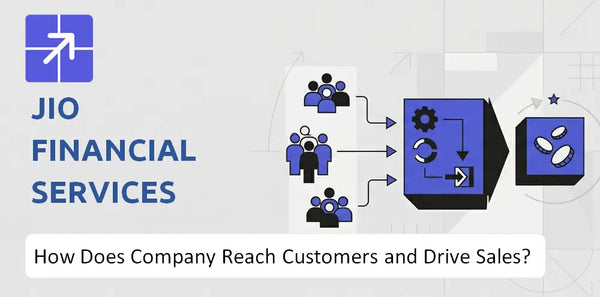
Focus on data-driven offers via app prompts and partner POS to increase conversion; early 2026 pilots show higher loan application completion rates. Use targeted flows to push credit and investment products into active customer journeys.
Who Does Jio Financial Services Want to Sell To?
Jio Financial Services targets three groups: the Jio-fied consumer base (over 485 million mobile subscribers and ~30 million monthly unique Reliance Retail visitors), 12 million SME merchants and kirana owners, and affluent/mass-affluent investors via a BlackRock partnership; it leverages transaction data and digital footprints to drive acquisitions and conversions.
 Core Jio-fied Consumers
Jio Financial Services customer acquisition focuses on retail mobile subscribers and Reliance Retail shoppers who already transact across telecom, retail, and digital services; this group offers high digital engagement and measurable credit propensity through telecom and payments data.
SME and Kirana Merchants
SMEs and ~12 million kirana merchants need supply-chain financing, working capital, and digital payments – Jio Financial Services distribution channels aim to convert these with embedded lending at point-of-sale and merchant-centric onboarding.
Affluent and Mass-Affluent Investors
Through a strategic BlackRock tie-up, the firm targets affluent and mass-affluent clients seeking wealth management and alternatives; the partnership strengthens product offerings and trust for higher-net-worth distribution.
Market Positioning: Embedded, Data-Driven Financial Platform
Jio Financial positions itself as an omnichannel, embedded finance provider that uses Jio platforms to reach customers, combining low-cost digital distribution with offline agent networks to lower customer acquisition cost and accelerate product adoption.
Why This Positioning Works
Existing transaction flows and telecom data enable precision targeting, improving conversion and credit underwriting; tied to Reliance Retail footfall (~30 million monthly uniques) and a 485 million subscriber base, the approach reduces onboarding friction and increases cross-sell rates. See History and Background of Jio Financial Services Company
Jio Financial Services SWOT Analysis
- Complete SWOT Breakdown
- Fully Customizable
- Editable in Excel & Word
- Professional Formatting
- Investor-Ready Format

How Does Jio Financial Services Get in Front of Customers?
Jio Financial Services gets in front of customers via an omnichannel mix: the JioFinance app integrated into the MyJio ecosystem captures digital intent, while >19,000 Reliance Retail stores and expanding point-of-sale terminals provide physical scale for BNPL and consumer finance at purchase.

App-led acquisition through the MyJio ecosystem
The JioFinance app, embedded in MyJio, is the primary acquisition funnel, capturing intent when users pay bills, buy plans, or browse services; this drives high-conversion, low-friction onboarding via single-sign-on and prefilled KYC data.
Digital marketing and platform distribution
Jio Financial Services uses targeted paid search, in-app push, email, social ads, and MyJio placement to reach subscribers; telecom-derived signals enable precise targeting, lowering acquisition cost and improving conversion rates for lending and BNPL offers.
Retail distribution and point-of-sale presence
Physical distribution runs through over 19,000 Reliance Retail stores plus a growing POS-terminal network, enabling on-the-spot BNPL and consumer durable loans at checkout and direct customer conversations via store staff and agents.
Demand generation via promotions and partnerships
Promotional EMI offers, limited-time merchant deals, co-branded campaigns with retailers, and referral incentives drive demand; partnerships with banks, insurers, and fintechs broaden product reach and credibility.
Customer acquisition efficiency and metrics
Early 2025 metrics indicate strong app-driven conversion and lower acquisition cost versus digital-only rivals, with rapid onboarding from prefilled KYC and telecom data; management highlights scalable unit economics as volumes rise.
Most important reach advantage in 2025
The integrated Jio ecosystem – MyJio + JioFinance app – plus a massive Reliance Retail footprint is the core advantage, enabling seamless omnichannel customer journeys from discovery to BNPL conversion both online and offline. Read the Growth Outlook of Jio Financial Services Company for more context.
Jio Financial Services Business Model Canvas
- One-time Payment
- No Research Needed – Save Hours of Work
- Built by Experts, Trusted by Consultants
- Instant Download, Ready to Use
- 100% Editable, Fully Customizable

How Does Jio Financial Services Turn Attention Into Sales?
Jio Financial Services turns attention into sales by using friction-less onboarding and Instant Credit pre-approvals, converting telecom and retail behavior into low-friction, high-volume transactions that feed a laddered upsell into higher-margin products.
Core sales model: high-frequency, low-ticket acquisition then laddered upsell
Jio Financial Services customer acquisition relies on digital self-serve funnels inside Jio apps plus partner-led and agent-assisted offline distribution to drive mass reach. Initial sales are high-volume, low-ticket loans and micro-insurance to build credit history, then the sales team and in-app nudges push customers toward mortgages, LAP, and investment products.
Pricing and monetization logic: transaction fees, interest spread, and asset management fees
Monetization mixes interest income on loans, premiums on insurance, and recurring fees from wealth products; pricing is tiered – low margins on volume micro-loans, higher spreads on home loans and Loan Against Property, and asset management fees on the Jio BlackRock suite.
Conversion drivers: Instant Credit, data-driven pre-approvals, and minimal documentation
Conversion is driven by Instant Credit mechanics that use telecom usage, payment, and retail behavioral data to offer pre-approved limits with minimal KYC, reducing onboarding time to minutes; early 2025 internal metrics show digital onboarding completion under 5 minutes for over 70% of retail applicants. Trust comes from transparent pricing and embedded flows inside Jio platforms.
Repeat revenue and expansion: unified dashboard and laddered product path
Customers start with low-ticket credit, then receive targeted offers – based on CRM personalization and customer segmentation – to upgrade into higher-margin products; this ladder increases customer lifetime value and repeat demand within a single financial dashboard. Cross-sell rates reported in 2025 pilot programs exceeded 18% for eligible micro-loan customers within 12 months.
Target Customers and Market of Jio Financial Services Company
Jio Financial Services Marketing Mix
- Complete Marketing Mix Analysis
- Effortlessly Communicate Your Business Strategy
- Investor-Ready Format
- 100% Editable and Customizable
- Clear and Structured Layout

How Strong Does Jio Financial Services's Commercial Engine Look Going Forward?
Jio Financial Services' commercial engine looks strong entering 2025/2026, driven by a Tier-1 capital adequacy ratio above 20%, a diversifying loan book, and expanding fee income from asset management and insurance broking; key risks include NBFC regulatory shifts and unsecured-credit cycles that could weigh on new-originations and margins.
What Supports Future Demand
Brand strength from Jio platforms, a low Jio Financial Services customer acquisition cost via embedded telecom distribution, and the Jio BlackRock JV scaling AUM support durable fee income and loan cross-sell to the Indian middle class.
Channel and Marketing Effectiveness
Omnichannel reach – app, USSD, large agent network and retail partners – plus targeted Jio Financial digital marketing using telecom data gives high conversion rates and low marginal CAC for new retail lending and payments adoption.
Risks to Commercial Performance
Regulatory tightening of NBFC liquidity/asset rules, a rise in unsecured NPAs, or slower-than-expected monetization of the insurance broking and asset management businesses would weaken sales and marketing ROI.
The Overall Sales and Marketing Outlook
The outlook is strong and adaptable: with projected high double – digit AUM CAGR into 2025/2026, continued low CAC, and diversified fee streams, Jio Financial Services sales strategy should solidify primary-provider status for many Indian households.
Relevant inputs and metrics: Tier – 1 > 20%, management guidance and regulatory filings show AUM and retail loan origination growth targets implying a high double – digit CAGR into 2026; low Jio Financial Services customer acquisition cost comes from in – platform cross – sell and referral programs; joint-venture fee income from Jio BlackRock scales with retail mutual fund distribution; see Mission, Vision, and Values of Jio Financial Services Company for company context: Mission, Vision, and Values of Jio Financial Services Company
Jio Financial Services Boston Consulting Group Matrix
- Built by Experts, Trusted by Consultants
- Structured for Consultants, Students, and Founders
- 100% Editable in Microsoft Word & Excel
- Instant Digital Download – Use Immediately
- Compatible with Mac & PC – Fully Unlocked

Related Blogs
- What Is the History of Jio Financial Services Company and How Did It Evolve?
- What Is the Competitive Landscape of Jio Financial Services Company and How Does It Compete?
- What Is the Growth Outlook of Jio Financial Services Company and Where Is It Heading?
- How Does Jio Financial Services Company Work and What Drives Its Business Model?
- What Do the Mission, Vision, and Core Values of Jio Financial Services Company Reveal?
- Who Are the Core Customers in Jio Financial Services Company's Target Market?
- Who Owns Jio Financial Services Company Today and Who Holds Control?
Frequently Asked Questions
Jio Financial Services primarily targets core Jio-fied consumers, SME and kirana merchants, and affluent or mass-affluent investors. It uses transaction data, telecom signals, and digital footprints to identify these groups and match them with the right financial products, from consumer finance to working capital and wealth offerings.
Disclaimer
All information, articles, and product details provided on this website are for general informational and educational purposes only. We do not claim any ownership over, nor do we intend to infringe upon, any trademarks, copyrights, logos, brand names, or other intellectual property mentioned or depicted on this site. Such intellectual property remains the property of its respective owners, and any references here are made solely for identification or informational purposes, without implying any affiliation, endorsement, or partnership.
We make no representations or warranties, express or implied, regarding the accuracy, completeness, or suitability of any content or products presented. Nothing on this website should be construed as legal, tax, investment, financial, medical, or other professional advice. In addition, no part of this site - including articles or product references - constitutes a solicitation, recommendation, endorsement, advertisement, or offer to buy or sell any securities, franchises, or other financial instruments, particularly in jurisdictions where such activity would be unlawful.
All content is of a general nature and may not address the specific circumstances of any individual or entity. It is not a substitute for professional advice or services. Any actions you take based on the information provided here are strictly at your own risk. You accept full responsibility for any decisions or outcomes arising from your use of this website and agree to release us from any liability in connection with your use of, or reliance upon, the content or products found herein.