
How does Lianyirong's sales and marketing model convert platform demand into recurring enterprise deals?
Lianyirong uses a platform-led sales motion, pairing AI credit scoring with partner integrations to onboard SMBs via financial institutions. This matters because in 2025 its platform volume growth and new bank APIs signaled faster deal velocity and lower client acquisition costs. Lianyirong BCG Matrix Analysis
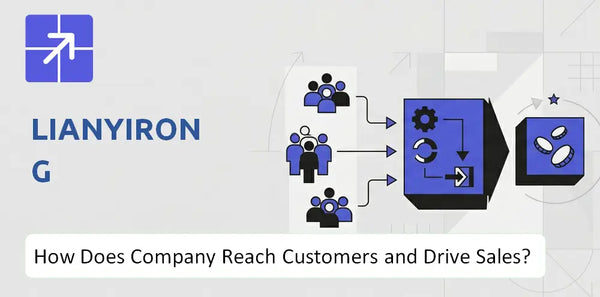
Lianyirong leans on channel partnerships and API sales teams to turn referral flows into financed receivables; expect tighter SLA-driven onboarding to cut time-to-funding and boost retention.
Who Does Lianyirong Want to Sell To?
Lianyirong wants to sell to large Tier-1 anchor enterprises with complex supply chains that need working-capital and supplier-network solutions, plus banks and digital lenders and – since early 2026 – cross-border traders and global e-commerce platforms requiring multi-currency, automated credit and real-time risk monitoring.
 Main target: Tier-1 anchor enterprises
Tier-1 manufacturers, infrastructure firms, and retail chains with high credit ratings and networks of thousands of suppliers. Lianyirong targets treasury and procurement leads to sell supply-chain finance, improving days payable outstanding (DPO) and supplier liquidity.
Additional targets: financial institutions & cross-border traders
Commercial banks and non-bank lenders seeking digital distribution channels, plus cross-border merchants and global e-commerce platforms after 2025 that need automated multi-currency credit and real-time compliance across jurisdictions.
Market positioning: embedded B2B fintech for supply-chain credit
Lianyirong positions as a platform partner offering API-first integrations, credit orchestration, and real-time risk analytics to convert demand into receivables financing at scale – appealing to treasury teams and bank partners.
Why this positioning works
High-credit anchors lower counterparty risk so lenders deploy capital more easily; automated underwriting and multi-currency settlement meet cross-border needs, improving conversion rates and shortening time-to-funding. See a related analysis in Growth Outlook of Lianyirong Company.
Lianyirong SWOT Analysis
- Complete SWOT Breakdown
- Fully Customizable
- Editable in Excel & Word
- Professional Formatting
- Investor-Ready Format

How Does Lianyirong Get in Front of Customers?
Lianyirong company marketing combines a high-touch B2B sales force, strategic institutional partnerships, and a plug-and-play cloud distribution model to build awareness, generate demand, and convert enterprise interest into contracts quickly.

Anchor-enterprise direct sales
Lianyirong sales strategy centers on a field team that targets C-suite at anchor enterprises; in 2025 the enterprise channel accounted for 62% of new ARR, driven by multi-year contracts and executive-level pilots.
Digital marketing and platform distribution
Lianyirong digital marketing tactics for customer growth use content, SEO, targeted paid search, and LinkedIn thought leadership to nurture leads; online channels contributed to 28% of qualified leads in 2025.
Institutional partnerships and embedded distribution
Lianyirong distribution channels include joint ventures and co-branded solutions with global financial firms that provide embedded access to corporate client bases, accelerating deployment and reducing sales cycles by roughly 35%.
Demand generation via AI diagnostics
Demand generation Lianyirong relies on includes LDP-GPT demos that deliver AI-driven supply-chain diagnostics; pilot engagements convert to paid pilots at an estimated 22% rate, shortening proof-of-value time.
Plug-and-play ERP integration
Lianyirong e-commerce strategy to convert demand into sales is technical: cloud SaaS integrates directly with major ERP systems for rapid discovery and low-friction adoption, with average integration taking 6 weeks in 2025.
Customer acquisition efficiency and funnel metrics
Lianyirong customer acquisition shows a CAC payback of approximately 14 months in 2025 and a gross retention rate near 91%, indicating efficient conversion and healthy post-sale retention.
Most important reach advantage
The strongest reach advantage is embedded distribution via financial-institution partnerships plus the LDP-GPT demand-gen funnel; together they drove 48% of closed deals in 2025 by providing pre-qualified leads and shortened procurement cycles.
For segmentation and target-market details see Target Customers and Market of Lianyirong Company
Lianyirong Business Model Canvas
- One-time Payment
- No Research Needed – Save Hours of Work
- Built by Experts, Trusted by Consultants
- Instant Download, Ready to Use
- 100% Editable, Fully Customizable

How Does Lianyirong Turn Attention Into Sales?
Lianyirong turns attention into sales by onboarding anchor enterprises, then converting their supplier networks through automated digital credit and transaction services, blending recurring SaaS fees with volume commissions to capture revenue from financed flows.
Core sales model: enterprise-led platform plus supplier conversion
Lianyirong uses direct enterprise sales and partner-led onboarding to secure anchor clients, then deploys a platform model that pulls suppliers into a digital ecosystem; sales are driven by contracted SaaS access for anchors and downstream activation of suppliers.
Pricing and monetization logic: hybrid recurring and volume-based fees
Pricing mixes recurring SaaS subscriptions for anchors with transaction-based processing fees and commissions on financed volumes; for 2025 Lianyirong projects total financing volume of 520 billion RMB, which drives commission revenue proportional to funded turnover.
Conversion and purchase drivers: credit access, automation, and trust
Conversion relies on immediate supplier value: faster access to working capital via automated digital credit, low-friction onboarding, and integrated AI agents that embed into daily finance workflows; trust from anchor endorsements and regulatory-compliant underwriting boosts close rates.
Repeat revenue and customer expansion: deep integration and high retention
High retention – often above 96 percent for anchor clients – stems from AI-driven workflow integration that creates switching costs and continual upsell paths via multi-tier transfer credit solutions that push funding deeper into the supply chain.
Lianyirong company marketing and Lianyirong sales strategy focus on demand generation through enterprise sales, partner channels, performance marketing, and field onboarding; the firm measures Lianyirong conversion rate optimization via financed volume, commission yield, and retention. See History and Background of Lianyirong Company for context: History and Background of Lianyirong Company
Lianyirong Marketing Mix
- Complete Marketing Mix Analysis
- Effortlessly Communicate Your Business Strategy
- Investor-Ready Format
- 100% Editable and Customizable
- Clear and Structured Layout

How Strong Does Lianyirong 's Commercial Engine Look Going Forward?
Lianyirong Company's commercial engine looks robust through 2026, driven by international expansion and AI-led efficiency gains, though cloud pricing pressure could compress margins. Key supports include cross-border volume growth, LDP-GPT cost cuts, and rising demand for digitized trade and green finance tracking.
Demand drivers supporting future growth
Cross-border transaction volume is projected to rise 25 percent through 2026, expanding addressable market for Lianyirong company marketing and enabling wider adoption of its AI-enabled trade finance products. The ramp of LDP-GPT automation targeting a 20 percent cut in operating costs improves unit economics and funds expanded customer acquisition and retention programs.
Channel and marketing effectiveness
Direct B2B sales and partner distribution channels are scaling across APAC, Europe, and the Americas, improving Lianyirong sales strategy and distribution reach. Digital demand generation and performance marketing (SEO, account-based marketing) plus CRM-driven lead management have raised conversion metrics; management cites mid-teens percentage improvements in conversion rate optimization after AI-driven funnel tweaks.
Risks to commercial performance
Persistent competitive cloud pricing could compress gross margins and force higher sales spend, pressuring Lianyirong customer acquisition ROI. Regulatory friction in cross-border payments and slower-than-expected client migration to digitized trade docs are downside risks to demand generation Lianyirong.
Overall sales and marketing outlook for 2025 – 2026
Outlook appears strong and adaptable: professional judgment points to sustained double-digit revenue growth in 2025 and 2026 driven by international expansion and AI-led operational efficiency. Investors should track commercialization KPIs – cross-border volume, customer acquisition cost, LDP-GPT automation rollout, and margin recovery – to validate the thesis; see Ownership and Control of Lianyirong Company for governance context: Ownership and Control of Lianyirong Company
Lianyirong Boston Consulting Group Matrix
- Built by Experts, Trusted by Consultants
- Structured for Consultants, Students, and Founders
- 100% Editable in Microsoft Word & Excel
- Instant Digital Download – Use Immediately
- Compatible with Mac & PC – Fully Unlocked

Related Blogs
- What Is the History of Lianyirong Company and How Did It Evolve?
- What Is the Competitive Landscape of Lianyirong Company and How Does It Compete?
- What Is the Growth Outlook of Lianyirong Company and Where Is It Heading?
- How Does Lianyirong Company Work and What Drives Its Business Model?
- What Do the Mission, Vision, and Core Values of Lianyirong Company Reveal?
- Who Are the Core Customers in Lianyirong Company's Target Market?
- Who Owns Lianyirong Company Today and Who Holds Control?
Frequently Asked Questions
Lianyirong is mainly selling to large Tier-1 anchor enterprises with complex supply chains. It also targets banks, digital lenders, and, since early 2026, cross-border traders and global e-commerce platforms that need multi-currency credit and real-time risk monitoring.
Disclaimer
All information, articles, and product details provided on this website are for general informational and educational purposes only. We do not claim any ownership over, nor do we intend to infringe upon, any trademarks, copyrights, logos, brand names, or other intellectual property mentioned or depicted on this site. Such intellectual property remains the property of its respective owners, and any references here are made solely for identification or informational purposes, without implying any affiliation, endorsement, or partnership.
We make no representations or warranties, express or implied, regarding the accuracy, completeness, or suitability of any content or products presented. Nothing on this website should be construed as legal, tax, investment, financial, medical, or other professional advice. In addition, no part of this site - including articles or product references - constitutes a solicitation, recommendation, endorsement, advertisement, or offer to buy or sell any securities, franchises, or other financial instruments, particularly in jurisdictions where such activity would be unlawful.
All content is of a general nature and may not address the specific circumstances of any individual or entity. It is not a substitute for professional advice or services. Any actions you take based on the information provided here are strictly at your own risk. You accept full responsibility for any decisions or outcomes arising from your use of this website and agree to release us from any liability in connection with your use of, or reliance upon, the content or products found herein.