
How does Millicom International Cellular's sales and marketing model convert demand into paid subscriptions and upsells?
Millicom International Cellular ties sales teams, digital channels, and retail partners to rapidly monetize infrastructure via targeted fiber, mobile, and B2B offers. This matters as the company shifted in 2025 – 2026 to prioritize ROIC and operational efficiency, aiming for sustained free cash flow above 600,000,000.
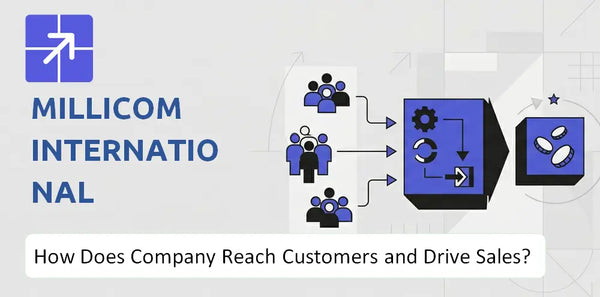
Focus sales on high-margin fiber and B2B segments, use digital self-serve funnels, and reduce cost-to-serve via Project Everest; these moves helped improve ARPU and cut acquisition costs in 2025. See product-level positioning: Millicom International Cellular BCG Matrix Analysis
Who Does Millicom International Cellular Want to Sell To?
Millicom International Cellular targets three commercial pillars: Consumer Mobile (over 40 million subscribers), Home broadband (about 13 million passed homes) and Tigo Business (SMEs and corporates). It also pursues the underbanked via Tigo Money to convert financial service demand into recurring revenue.
 Primary consumer mobile subscribers
Millicom focuses on its > 40 million mobile subscribers across nine Latin American markets, pushing migration from prepaid to postpaid contracts to stabilize monthly recurring revenue and raise average revenue per user (ARPU).
Home broadband households
With roughly 13 million passed homes, Millicom targets upsell to HFC and FTTH packages, bundling fixed broadband with pay-TV and mobile to increase share of wallet and reduce churn.
SMEs and enterprise customers
Tigo Business sells cloud, cybersecurity and managed data services to SMEs and large corporates, aiming for higher-margin B2B contracts and multi-year service agreements to diversify revenue beyond consumer ARPU.
Underbanked consumers via Tigo Money
Millicom targets regions with banking penetration below 50 percent, using Tigo Money to capture payments, remittances and financial services revenue while boosting customer stickiness.
Market positioning
Millicom positions Tigo as an omnichannel digital-first operator that combines retail stores, agent networks and digital onboarding to drive Tigo customer acquisition and conversion across channels.
Why the positioning works
The mix of field sales, retail partnerships, targeted advertising, bundling and Tigo Money differentiates Millicom sales strategy by converting demand into subscriptions and increasing lifetime value through retention programs and analytics-driven CRM.
See analysis of competitors and market context in Competitive Landscape of Millicom International Cellular Company
Millicom International Cellular SWOT Analysis
- Complete SWOT Breakdown
- Fully Customizable
- Editable in Excel & Word
- Professional Formatting
- Investor-Ready Format

How Does Millicom International Cellular Get in Front of Customers?
Millicom International Cellular reaches customers through a dense omnichannel mix: extensive physical points of sale, direct sales teams, and digital apps that convert awareness into subscriptions and upsells.

Flagship Retail and Massive Point-of-Sale Footprint
Millicom's Tigo brand relies on a physical footprint of more than 700,000 points of sale in Central America, from flagship stores to neighborhood kiosks, which drives walk-in conversions and prepaid top-ups.
Apps and Digital Channels for Direct Engagement
Tigo Shop and My Tigo apps handle plan management, eSIM activation, billing, and upgrades; digital channels (search, paid social, email) funnel users into the apps and online conversions.
Field Sales, Door-to-Door, and B2B Direct Teams
Millicom deploys proactive direct-sales and door-to-door teams that use localized fiber rollout data to target neighborhoods, plus a B2B sales force for Home and enterprise customers.
Bundling and FMC Marketing to Stimulate Demand
Fixed-Mobile Convergence bundles (mobile, broadband, pay-TV) and time-limited promotions drive upgrades and ARPU (average revenue per user) expansion across segments.
Customer Acquisition Efficiency and Conversion Metrics
Public 2025 disclosures show Millicom improving churn and revenue per customer via bundle penetration; digital onboarding and kiosks reduce activation time and lower customer acquisition cost.
Scale Advantage: Physical Density Combined with Digital Reach
The dominant reach factor in 2025 is the blend of a 700,000+ point-of-sale network plus digital apps and targeted local sales, enabling rapid conversion after fiber rollouts.
See additional context on corporate strategy in this related piece: Mission, Vision, and Values of Millicom International Cellular Company
Millicom International Cellular Business Model Canvas
- One-time Payment
- No Research Needed – Save Hours of Work
- Built by Experts, Trusted by Consultants
- Instant Download, Ready to Use
- 100% Editable, Fully Customizable

How Does Millicom International Cellular Turn Attention Into Sales?
Millicom International Cellular turns attention into sales by routing prospects into a tiered pricing ladder and a convergence ecosystem; data triggers upsell flows that move users from entry plans to higher – margin bundles. The firm blends dynamic local pricing, retail and digital channels, and Tigo Money to lift ARPU and cut churn.
Core sales model: omnichannel subscriptions and partner-led distribution
Millicom International Cellular sells via retail stores, agent kiosks, field sales, digital self – serve and indirect partners; subscriptions and contracts dominate revenue with device financing and channel commissions supporting acquisition.
Pricing and monetization logic: dynamic ladder and more-for-more
Pricing uses a ladder from basic prepaid/data to premium Unlimited and bundled broadband+Pay – TV; local market elasticity guides marginal price increases that deliver higher speeds or data, converting demand into recurring ARPU uplift.
Conversion and purchase drivers: data analytics and targeted prompts
Millicom uses CRM, real – time analytics and targeted advertising to trigger upsell prompts; retainers include trial upgrades, in – app nudges, SMS/USSD activations and field agent offers that shorten time-to-purchase.
Repeat revenue and expansion: convergence and embedded payments
Convergence (mobile, broadband, Pay – TV) plus Tigo Money increases stickiness; postpaid churn is now below 2.5 percent in key markets while cross – sell lifts ARPU via bundle penetration and value – added services.
Pricing ladder mechanics: advertise entry plans, use data signals to suggest upgrades, apply marginal price steps (more – for – more) – typical tactical moves lifted ARPU by double digits in several Latin American markets in 2025; broadband+Pay – TV bundle take – rates rose where promotions tied to higher speeds were offered. For B2B, Millicom converts basic connectivity into high – margin services (SD – WAN, cloud hosting) through consultative selling and pilot projects, increasing contract size and tenure.
Tigo Money and retention: embedding mobile money into the user journey shortens payment cycles and raises account activity; integrated wallet usage correlates with lower churn and higher lifetime value – management reported Tigo Money transaction growth and deeper engagement across 2025 operations. The company's omnichannel mix – retail, agents, digital self – serve, SMS/USSD and targeted advertising – enables rapid activation; agent network and field sales drive rural reach while eSIM and digital onboarding speed urban conversions.
Execution playbook and metrics: use analytics to score upsell propensity, run time – limited bundles to convert trial users, and dynamically adjust local prices to capture willingness to pay. Key 2025 indicators: postpaid churn 2.5 percent, promotional bundle uptake rates in double digits, and continued ARPU expansion through more – for – more pricing and convergence cross – sell. See related corporate ownership context here: Ownership and Control of Millicom International Cellular Company
Millicom International Cellular Marketing Mix
- Complete Marketing Mix Analysis
- Effortlessly Communicate Your Business Strategy
- Investor-Ready Format
- 100% Editable and Customizable
- Clear and Structured Layout

How Strong Does Millicom International Cellular's Commercial Engine Look Going Forward?
Millicom International Cellular's commercial engine looks robust entering 2025/2026, supported by a leaner cost base, higher postpaid and B2B mix, and network-sharing gains that should boost unit economics; currency swings and competitive pricing remain key downside risks.
What Supports Future Demand
Higher postpaid penetration and B2B contracts raise average revenue per user (ARPU) and reduce churn, while fiber densification increases household take rates; Atlas Luxco-led focus on operational excellence tightens sales ROI. See customer segmentation in Target Customers and Market of Millicom International Cellular Company.
Channel and Marketing Effectiveness
Omnichannel mix – digital acquisition, Tigo agent network, and retail kiosks – drives efficient conversions; digital onboarding (eSIM, CRM-led nurturing) cut acquisition costs and shortened time-to-revenue in 2024 – 2025 pilots, raising conversion rates by low-double digits in test markets.
Risks to Commercial Performance
Currency volatility in Guatemala and Colombia can erode margin; aggressive competitor pricing and slower-than-expected fiber uptake could compress ARPU. Execution risk on network-sharing rollouts and regulatory shifts remain material.
The Overall Sales and Marketing Outlook
Outlook is strong and adaptable: completion of the peak fiber spend lets Millicom prioritize filling the pipes, lifting EBITDA margin toward the 40 percent target and aiming for Net Debt/EBITDA near 2.5x by late 2026, assuming steady FX and continued channel execution.
Millicom International Cellular Boston Consulting Group Matrix
- Built by Experts, Trusted by Consultants
- Structured for Consultants, Students, and Founders
- 100% Editable in Microsoft Word & Excel
- Instant Digital Download – Use Immediately
- Compatible with Mac & PC – Fully Unlocked

Related Blogs
- What Is the History of Millicom International Cellular Company and How Did It Evolve?
- What Is the Competitive Landscape of Millicom International Cellular Company and How Does It Compete?
- What Is the Growth Outlook of Millicom International Cellular Company and Where Is It Heading?
- How Does Millicom International Cellular Company Work and What Drives Its Business Model?
- What Do the Mission, Vision, and Core Values of Millicom International Cellular Company Reveal?
- Who Are the Core Customers in Millicom International Cellular Company's Target Market?
- Who Owns Millicom International Cellular Company Today and Who Holds Control?
Frequently Asked Questions
Millicom International Cellular sells to consumer mobile subscribers, home broadband households, SMEs and corporates through Tigo Business, and underbanked consumers through Tigo Money. The blog says these groups are the company's main commercial pillars, with each segment helping turn demand into recurring revenue and higher customer lifetime value.
Disclaimer
All information, articles, and product details provided on this website are for general informational and educational purposes only. We do not claim any ownership over, nor do we intend to infringe upon, any trademarks, copyrights, logos, brand names, or other intellectual property mentioned or depicted on this site. Such intellectual property remains the property of its respective owners, and any references here are made solely for identification or informational purposes, without implying any affiliation, endorsement, or partnership.
We make no representations or warranties, express or implied, regarding the accuracy, completeness, or suitability of any content or products presented. Nothing on this website should be construed as legal, tax, investment, financial, medical, or other professional advice. In addition, no part of this site - including articles or product references - constitutes a solicitation, recommendation, endorsement, advertisement, or offer to buy or sell any securities, franchises, or other financial instruments, particularly in jurisdictions where such activity would be unlawful.
All content is of a general nature and may not address the specific circumstances of any individual or entity. It is not a substitute for professional advice or services. Any actions you take based on the information provided here are strictly at your own risk. You accept full responsibility for any decisions or outcomes arising from your use of this website and agree to release us from any liability in connection with your use of, or reliance upon, the content or products found herein.