
How does Mohawk Industries' sales and marketing model convert its manufacturing scale into customer demand?
Mohawk Industries pairs localized manufacturing with multi-channel distribution to speed delivery and serve spec-driven commercial clients alongside high-volume residential buyers. Fiscal 2025 net sales of 11.2 billion dollars show scale; a 2026 push into direct-to-contractor digital tools signals tighter channel control.
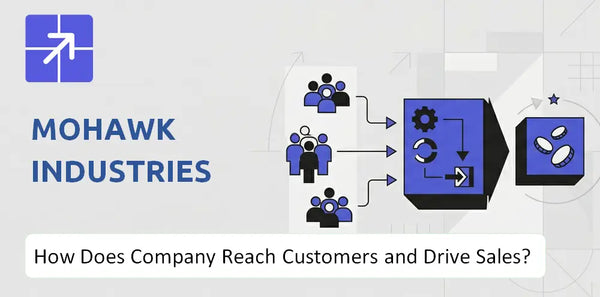
Focus sales on architects, retailers, and contractors via specification teams and regional reps; use digital quoting to shorten lead times. See product positioning in Mohawk Industries BCG Matrix Analysis.
Who Does Mohawk Industries Want to Sell To?
Mohawk Industries wants to sell primarily to middle-to-high-income homeowners undertaking residential remodeling, high-volume national homebuilders in new construction, and commercial specifiers such as architects and facility managers; the company wins them through durable, design-forward products, reliable supply chains, and performance/sustainability credentials.
 Primary: Residential Remodelers
Residential remodelers historically drive over 60 percent of Mohawk Industries revenue, targeting middle-to-high-income homeowners seeking durable, stylish flooring upgrades; Mohawk Industries marketing focuses on trade programs, retailer merchandising, and digital inspiration to convert demand into sales.
Secondary: New Home Builders
Mohawk partners with national homebuilders that need cost-effective flooring packages and dependable fulfillment; Mohawk Industries distribution channels and supply chain management emphasize volume discounts, JIT delivery, and long-term contracts to secure steady B2B sales.
Commercial: Architects, Designers, Facility Managers
For healthcare, hospitality, and education, Mohawk targets specifiers seeking performance metrics and certifications (e.g., LEED, health-safe products); Mohawk Industries sales strategy emphasizes product testing data, sustainability messaging, and specification tools to win projects.
Market Positioning
Mohawk positions itself as a full-spectrum flooring supplier balancing design, durability, and scale – serving retail, contractor, builder, and commercial channels; its omnichannel approach combines dealer networks, e-commerce pilots, and direct B2B contracts to maximize reach.
Why This Positioning Works
Clear value for each segment – stylish durable products for homeowners, cost and logistics reliability for builders, and certified performance for specifiers – backed by Mohawk customer acquisition programs, dealer support, and supply chain efficiencies that improve fulfillment and sales conversion.
Further Reading on Competitive Context
See this analysis for the competitive backdrop that shapes Mohawk Industries sales tactics: Competitive Landscape of Mohawk Industries Company
Mohawk Industries SWOT Analysis
- Complete SWOT Breakdown
- Fully Customizable
- Editable in Excel & Word
- Professional Formatting
- Investor-Ready Format

How Does Mohawk Industries Get in Front of Customers?
Mohawk Industries reaches customers through a multi-tier distribution network: independent dealers, big-box retail partners, and a direct-to-professional Global Ceramic platform. The company builds awareness with in-store merchandising, dealer tools and portals, strategic private-label partnerships, and sales service centers that generate early-stage project leads.

Dealer network as the primary acquisition channel
Mohawk Industries marketing centers on a dominant independent dealer channel that supports thousands of local retailers; dealer-facing programs and the Mohawk Today portal drive consistent product placement and project referrals.
Digital marketing and online reach
Mohawk uses digital catalogs, SEO, paid search, social media inspiration content, and email to feed traffic to dealer partners and company galleries; dealer portals and CRM tools convert online leads into store appointments.
Retail and distribution access
Mohawk Industries sales strategy includes strong partnerships with Home Depot and Lowe's plus thousands of independent dealers; the Global Ceramic Dal-Tile network operates over 300 sales service centers and design galleries for direct professional access.
Demand generation tactics
In-store point-of-purchase displays, private-label programs at big-box chains, trade promotions for contractors, and design gallery events drive purchase intent; targeted seasonal promotions and specifier outreach push project starts.
Customer acquisition efficiency
Integrated dealer support and direct professional channels shorten sales cycles and improve conversion; Mohawk reported a strong gross margin mix from branded and private-label sales in 2025, reflecting efficient channel monetization.
Most important reach advantage in 2025
Scale of the independent dealer network plus Dal-Tile's 300+ direct sales centers gives Mohawk distribution channels and Mohawk B2B and retail partnerships a competitive edge in both residential and commercial markets.
How Mohawk Industries Company Works and Makes Money
Mohawk Industries Business Model Canvas
- One-time Payment
- No Research Needed – Save Hours of Work
- Built by Experts, Trusted by Consultants
- Instant Download, Ready to Use
- 100% Editable, Fully Customizable

How Does Mohawk Industries Turn Attention Into Sales?
Mohawk Industries turns attention into sales by pairing product innovation – notably Luxury Vinyl Tile and waterproof laminate – with a vertically integrated cost base and a tiered pricing model, converting interest into purchases via bundled system sales and strong installer retention.
Core sales model: omnichannel, partner-led, and pro-focused
Mohawk Industries sales strategy mixes B2B distributor/dealer channels, retail partnerships, direct-to-consumer e-commerce, and pro-contractor programs. Trade and installer relationships drive large-ticketorf contracts while retail and online channels capture DIY and design-driven consumers.
Pricing and monetization logic: tiered pricing and bundled systems
The company uses tiered pricing to address value and premium segments and aggressive list/pricing flexibility enabled by vertical integration. Total-solution bundles (flooring, adhesives, underlayment, trim) raise average ticket and capture service margins; warranty-backed system sales support premium pricing.
Conversion and purchase drivers: category mix, installer loyalty, and pricing
In 2025 Mohawk Industries pivoted toward Luxury Vinyl Tile and waterproof laminate, which show conversion rates 15 percent higher than traditional carpet. Conversion relies on product fit, competitive pricing from supply-chain scale, installer program incentives, and bundled-system convenience that shortens specification-to-order cycles.
Repeat revenue and customer expansion: warranties, pro programs, and cross-sell
Mohawk drives repeat and expansion through professional installer loyalty programs, multi-product warranties, and targeted upsell into underlayment/adhesives. Bundling increases average transaction value and strengthens retention among installers prioritizing compatibility and warranty security.
Key 2025 metrics: Mohawk Industries reported accelerated mix shift with Luxury Vinyl Tile and waterproof laminate representing a majority of growth categories; bundled-system sales lifted average transaction value by an estimated 8 – 12 percent, and installer-led conversion improvements contributed to an overall gross-to-net efficiency gain reflected in margin resilience for the year. Read more on company purpose and strategy in this related piece: Mission, Vision, and Values of Mohawk Industries Company
Mohawk Industries Marketing Mix
- Complete Marketing Mix Analysis
- Effortlessly Communicate Your Business Strategy
- Investor-Ready Format
- 100% Editable and Customizable
- Clear and Structured Layout

How Strong Does Mohawk Industries's Commercial Engine Look Going Forward?
Mohawk Industries' commercial engine enters 2026 with constructive momentum: stabilized housing demand and renovation spending should support revenue growth, while margin gains from recent productivity investments strengthen selling flexibility; energy costs in Europe and channel fragmentation remain downside risks.
Product and Sustainability Tailwinds Support Demand
Expanded zero-carbon ceramic lines and high-performance resilient flooring bolster product-market fit and Mohawk Industries marketing, lifting appeal to sustainability-conscious builders and designers. Recent product introductions and brand depth drive repeat purchases and trade-program uptake.
Channel and Marketing Effectiveness
Mohawk Industries distribution channels combine broad dealer networks, B2B and retail partnerships, and growing e-commerce capabilities to sustain Mohawk customer acquisition. Omnichannel efforts linking contractors, retailers, and digital lead flows improve conversion and shorten sales cycles.
Risks to Commercial Performance
Energy price volatility in Europe pressures Flooring ROW margins and could raise unit costs; competing regional manufacturers with low fixed costs may undercut pricing. Distribution disruptions or slower adoption of Mohawk e-commerce strategy for direct-to-consumer flooring sales would weaken fulfillment and satisfaction.
Overall Sales and Marketing Outlook
Outlook for 2026 is constructive: operating margins improved to an estimated 10.8 percent in late 2025 after 450 million dollars in productivity-capital spending, and Mohawk Industries sales strategy should outpace peers as it leverages scale, supply chain management, and dealer recruitment programs to capture share.
For a deeper financial and strategic read, see Growth Outlook of Mohawk Industries Company
Mohawk Industries Boston Consulting Group Matrix
- Built by Experts, Trusted by Consultants
- Structured for Consultants, Students, and Founders
- 100% Editable in Microsoft Word & Excel
- Instant Digital Download – Use Immediately
- Compatible with Mac & PC – Fully Unlocked

Related Blogs
- What Is the History of Mohawk Industries Company and How Did It Evolve?
- What Is the Competitive Landscape of Mohawk Industries Company and How Does It Compete?
- What Is the Growth Outlook of Mohawk Industries Company and Where Is It Heading?
- How Does Mohawk Industries Company Work and What Drives Its Business Model?
- What Do the Mission, Vision, and Core Values of Mohawk Industries Company Reveal?
- Who Are the Core Customers in Mohawk Industries Company's Target Market?
- Who Owns Mohawk Industries Company Today and Who Holds Control?
Frequently Asked Questions
Mohawk Industries primarily targets middle-to-high-income homeowners doing residential remodeling, plus national homebuilders and commercial specifiers. The article says remodelers drive over 60 percent of revenue, while builders and architects, designers, and facility managers are reached with cost, supply, and performance-focused offers.
Disclaimer
All information, articles, and product details provided on this website are for general informational and educational purposes only. We do not claim any ownership over, nor do we intend to infringe upon, any trademarks, copyrights, logos, brand names, or other intellectual property mentioned or depicted on this site. Such intellectual property remains the property of its respective owners, and any references here are made solely for identification or informational purposes, without implying any affiliation, endorsement, or partnership.
We make no representations or warranties, express or implied, regarding the accuracy, completeness, or suitability of any content or products presented. Nothing on this website should be construed as legal, tax, investment, financial, medical, or other professional advice. In addition, no part of this site - including articles or product references - constitutes a solicitation, recommendation, endorsement, advertisement, or offer to buy or sell any securities, franchises, or other financial instruments, particularly in jurisdictions where such activity would be unlawful.
All content is of a general nature and may not address the specific circumstances of any individual or entity. It is not a substitute for professional advice or services. Any actions you take based on the information provided here are strictly at your own risk. You accept full responsibility for any decisions or outcomes arising from your use of this website and agree to release us from any liability in connection with your use of, or reliance upon, the content or products found herein.