
How does Mowi ASA's sales and marketing model convert farmed salmon into branded, high-margin sales?
Mowi ASA sells through integrated channels: direct retail partnerships, foodservice, and branded exports, using traceability and sustainability to command premiums. In 2025 Mowi reported stronger branded volumes in Europe, signaling successful premiumization and channel control.
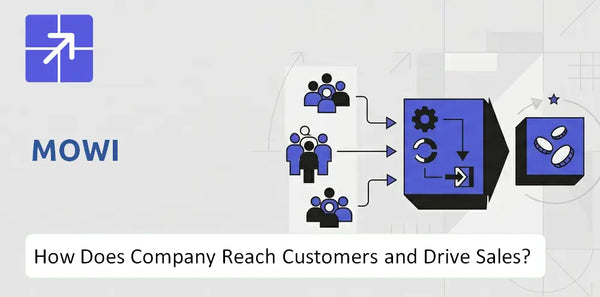
Mowi leans on category management and direct customer teams to secure shelf space and menu placement; focus on sustainability claims lifts willingness to pay. See product context in Mowi BCG Matrix Analysis.
Who Does Mowi Want to Sell To?
Mowi ASA targets three buyer clusters: global Tier-1 retailers for high-volume supply, premium foodservice/Horeca for chefs and restaurants, and health-conscious urban consumers via ready-to-eat channels; the company wins them through scale, ESG leadership, and product-spec consistency across its Consumer Products division.
 Tier-1 Retailers: Volume and Reliability
Mowi targets global supermarket chains such as Walmart, Tesco, and Carrefour that need steady, large-volume supply and private-label capability. These retail partnerships drive roughly 60% of Mowi ASA's 2025 salmon volume and rely on Mowi distribution channels and logistics to meet frozen and fresh shelf demand.
Foodservice and Horeca: Premium Consistency
High-end restaurants and foodservice buyers seek the MOWI premium brand for consistent fat content and color – attributes critical for chefs. This segment accounts for supply contracts that command higher per-kg prices and supports Mowi business to business sales approach for seafood in Europe and North America.
Consumer Products & Urban Shoppers
Mowi increasingly sells to affluent, health-focused urban consumers via grab-and-go and ready-to-heat formats through retail and e-commerce. Consumer Products now represent around 20% of total volume but contribute a disproportionate share of value-added margin, aided by Mowi direct to consumer sales and e-commerce initiatives.
Market Positioning: Scale, Traceability, ESG
Mowi positions itself as a large-scale, traceable, and ESG-leading salmon supplier – regularly top-ranked in the Coller FAIRR Protein Producer Index – which supports Mowi sustainability messaging to attract retailers and institutional buyers. This positioning underpins negotiation leverage on pricing strategies for supermarket chains and export contracts.
Why This Positioning Works
Retailers value consistent cold-chain performance and traceability; chefs value product specs; consumers value convenience and health credentials. Together these drivers explain how Mowi turns seafood demand into sales growth through integrated Mowi supply chain management, retail partnerships, and targeted promotional campaigns – see more in How Mowi Company Works and Makes Money How Mowi Company Works and Makes Money.
Mowi SWOT Analysis
- Complete SWOT Breakdown
- Fully Customizable
- Editable in Excel & Word
- Professional Formatting
- Investor-Ready Format

How Does Mowi Get in Front of Customers?
Mowi ASA reaches customers through a mixed approach: wide retail placement, a digital-first marketing push, and a consultative B2B sales force that secures shelf space and seasonal displays. Main channels are direct-to-retail distribution, digital demand generation emphasizing sustainability and Omega-3, and data-driven retailer partnerships.

Retail distribution: direct shelf presence drives availability
Mowi customer acquisition centers on physical availability; in the 2025/2026 cycle Mowi ASA placed MOWI-branded skin packs in over 3,000 new locations across the United States and China, ensuring point-of-sale visibility and immediate purchase access.
Digital marketing and online reach: sustainability and health narratives
Mowi marketing strategy is digital-first: paid search and social amplify sustainability messaging and the Omega-3 health story to capture a 15 percent year-over-year rise in consumer interest for transparent food sourcing, supporting ecommerce discovery and DTC sales.
Sales channels and distribution access: B2B consultative selling
Mowi sales strategy uses a sophisticated B2B sales force acting as category managers for retailers; they provide shelf-space optimization data and negotiate prime placement, secondary displays, and seasonal programs with supermarket chains and foodservice partners.
Demand generation tactics: targeted campaigns and in-store promotion
Mowi promotional campaigns combine influencer partnerships, targeted paid media, in-store sampling, and seasonal promotions timed to peak windows; these tactics convert sustainability interest into purchase intent and lift incremental sales during key periods.
Customer acquisition efficiency: analytics-led, retailer-aligned
Mowi customer acquisition appears efficient: the sales team uses POS and category analytics to prioritize high-ROI placements and reduce out-of-stock, improving conversion per distribution point and streamlining Mowi distribution channels across retail and wholesale accounts.
Most important reach advantage: integrated retail and B2B partnerships
The strongest reach advantage is the combined effect of direct retail placements and consultative B2B relationships that secure shelf share and seasonal displays at scale, amplifying how Mowi turns seafood demand into sales growth across grocery and foodservice.
Further reading on ownership and governance that affect strategic distribution: Ownership and Control of Mowi Company
Mowi Business Model Canvas
- One-time Payment
- No Research Needed – Save Hours of Work
- Built by Experts, Trusted by Consultants
- Instant Download, Ready to Use
- 100% Editable, Fully Customizable

How Does Mowi Turn Attention Into Sales?
Mowi ASA turns attention into sales by shifting from bulk commodity to value-added products and by leveraging price leadership, supply reliability, and branded premiums to convert retail interest into long-term contracts and higher margins.
Core sales model: vertical integration into retail and foodservice
Mowi customer acquisition mixes B2B direct sales to supermarkets, foodservice and distributors with selective DTC and e-commerce pilots. Processing about 30 percent of harvested volumes into fillets, steaks and smoked lines shifts revenue from commodity spot markets to higher-margin packaged goods.
Pricing and monetization logic: premium brand plus contract stability
Pricing relies on branded premiums and fixed contracts: the MOWI brand commands a 15 to 20 percent price premium over generic Atlantic salmon, while long-term fixed-price agreements cover roughly 25 to 30 percent of total volume, providing a revenue floor against spot volatility.
Conversion and purchase drivers: reliability, convenience, and price leadership
Conversion depends on a 99 percent fulfillment rate driven by geographic diversification across Norway, Scotland, Chile and Canada, and on convenience products (processed fillets/smoked) that capture retailer and consumer preference. Supply reliability turns retail interest into multi-year contracts and slot-share commitments.
Repeat revenue and customer expansion: brand, assortments, and contracts
Retention and upsell come from private-label partnerships, seasonal promotional campaigns, and expanded SKU assortments in retail and foodservice; branded products and traceability/labeling boost repeat buys and allow margin expansion on processed SKUs.
See a corporate overview and operational history for context: History and Background of Mowi Company
Mowi Marketing Mix
- Complete Marketing Mix Analysis
- Effortlessly Communicate Your Business Strategy
- Investor-Ready Format
- 100% Editable and Customizable
- Clear and Structured Layout

How Strong Does Mowi's Commercial Engine Look Going Forward?
Mowi ASA's commercial engine looks strong heading into 2025/2026, supported by scale, vertical integration, and an aggressive US brand expansion; risks include Norwegian tax changes and biological volatility that can pressure short-term volumes and margins.
Brand and Scale Driving Future Demand
Mowi customer acquisition benefits from the MOWI brand roll – out in the US where per – capita salmon consumption is rising about 4 percent annually; combined with a projected harvest > 540,000 tonnes for 2026 and Operational EBIT > €1.1 billion in the prior fiscal year, brand reach plus scale provide durable demand support.
Channel and Marketing Effectiveness
Mowi sales strategy leverages diversified Mowi distribution channels – retail partnerships, foodservice, B2B exports, and growing direct – to – consumer e – commerce – backed by owned feed and genetics that stabilize supply and support trade promotions and digital marketing to boost sales.
Risks to Commercial Performance
Regulatory risk (Norwegian resource tax proposals) and biological volatility (sea lice, disease) pose downside to volumes and pricing; currency swings and input cost inflation can also compress margins despite strong supply chain management and cold – chain logistics.
Overall Sales and Marketing Outlook for 2025/2026
The outlook is positive: Mowi ASA appears to be decoupling valuation from pure commodity cycles by evolving into a global FMCG – style operator with robust retail partnerships and traceability systems; expect continued revenue growth driven by US expansion and premiumization, while monitoring tax and biological risk.
Further reading on strategy and growth metrics: Growth Outlook of Mowi Company
Mowi Boston Consulting Group Matrix
- Built by Experts, Trusted by Consultants
- Structured for Consultants, Students, and Founders
- 100% Editable in Microsoft Word & Excel
- Instant Digital Download – Use Immediately
- Compatible with Mac & PC – Fully Unlocked

Related Blogs
- What Is the History of Mowi Company and How Did It Evolve?
- What Is the Competitive Landscape of Mowi Company and How Does It Compete?
- What Is the Growth Outlook of Mowi Company and Where Is It Heading?
- How Does Mowi Company Work and What Drives Its Business Model?
- What Do the Mission, Vision, and Core Values of Mowi Company Reveal?
- Who Are the Core Customers in Mowi Company's Target Market?
- Who Owns Mowi Company Today and Who Holds Control?
Frequently Asked Questions
Mowi targets three main buyer groups. It sells high-volume salmon to global Tier-1 retailers, premium products to foodservice and Horeca buyers, and ready-to-eat formats to health-conscious urban consumers. These groups are attracted by Mowi's scale, product consistency, traceability, and ESG positioning.
Disclaimer
All information, articles, and product details provided on this website are for general informational and educational purposes only. We do not claim any ownership over, nor do we intend to infringe upon, any trademarks, copyrights, logos, brand names, or other intellectual property mentioned or depicted on this site. Such intellectual property remains the property of its respective owners, and any references here are made solely for identification or informational purposes, without implying any affiliation, endorsement, or partnership.
We make no representations or warranties, express or implied, regarding the accuracy, completeness, or suitability of any content or products presented. Nothing on this website should be construed as legal, tax, investment, financial, medical, or other professional advice. In addition, no part of this site - including articles or product references - constitutes a solicitation, recommendation, endorsement, advertisement, or offer to buy or sell any securities, franchises, or other financial instruments, particularly in jurisdictions where such activity would be unlawful.
All content is of a general nature and may not address the specific circumstances of any individual or entity. It is not a substitute for professional advice or services. Any actions you take based on the information provided here are strictly at your own risk. You accept full responsibility for any decisions or outcomes arising from your use of this website and agree to release us from any liability in connection with your use of, or reliance upon, the content or products found herein.