
How does NetApp convert inbound demand into closed sales through its sales and marketing model?
NetApp shifts buyers from hardware deals to subscription software via channel partners, direct enterprise sales, and cloud marketplace placements. This matters because recurring revenue lifted gross margins above 70% in 2025 and drove valuation rerating amid hybrid cloud demand.
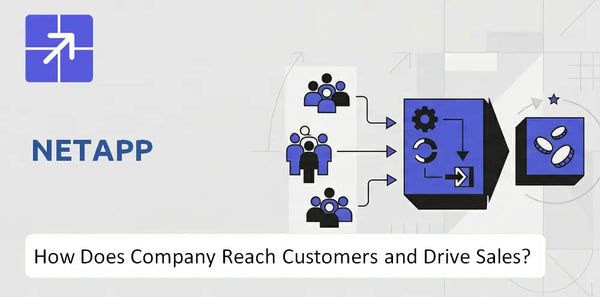
Emphasize partner-led deals and marketplace listings; align pricing to ARR to boost renewals and upsell. See NetApp BCG Matrix Analysis for product positioning insights.
Who Does NetApp Want to Sell To?
NetApp wants to sell to large, data-intensive enterprises – Global 2000 firms operating fragmented, multi-cloud environments – targeting CIOs, Chief Data Officers, and Cloud Architects who need enterprise-grade data management and strict data sovereignty to run high-performance data pipelines both on-premises and in public clouds.
 Main Customer Group: Data-Intensive Enterprise
NetApp targets Global 2000 organizations in regulated industries – financial services, healthcare, and government – where datasets exceed petabytes and performance, compliance, and sovereignty are nonnegotiable. Sales efforts focus on CIOs, Chief Data Officers, and Cloud Architects who prioritize unified data management across multi-cloud and hybrid architectures.
Additional Target Segments: Workload and Industry Niches
Secondary targets include large SaaS providers, telcos, and hyperscalers running analytics, AI/ML, and backup/recovery workloads. NetApp also goes after adjacent buyers such as infrastructure VPs and compliance officers in firms with strict data residency or industry rules.
Market Positioning: Enterprise-Grade Data Management Across Clouds
NetApp positions itself as the provider that delivers on-premises enterprise storage features in public clouds – data fabric, unified management, and performance for cloud data services sales. The go-to-market mixes direct field sales, channel partners, and cloud alliances to capture multi-cloud workloads.
Why This Positioning Works: Compliance, Performance, and Familiarity
Buyers value consistent data controls and lower migration risk; NetApp's messaging emphasizes data sovereignty, enterprise features in public clouds, and partner ecosystem benefits for resellers. This resonates with CIOs and Cloud Architects who prioritize predictable performance and regulated-data compliance when choosing a NetApp sales strategy.
NetApp reported $6.7 billion revenue for fiscal 2025 and highlights cloud service growth exceeding 20% year-over-year, underscoring demand for cloud data services sales; these figures support its NetApp go-to-market focus on large regulated workloads and multi-cloud adoption. Read more on corporate priorities in this article: Mission, Vision, and Values of NetApp Company
NetApp SWOT Analysis
- Complete SWOT Breakdown
- Fully Customizable
- Editable in Excel & Word
- Professional Formatting
- Investor-Ready Format

How Does NetApp Get in Front of Customers?
NetApp gets in front of customers through a dual-track distribution model: first-party integrations with hyperscalers for public cloud services and a global channel network plus direct enterprise sales for hybrid and on – premises deals. Awareness and demand are driven by partner co-selling, targeted field sales, and digital lead engines matched to account-based motions.

Hyperscaler-first cloud distribution
NetApp sells cloud services like Amazon FSx for NetApp ONTAP and Azure NetApp Files via hyperscaler consoles and sales teams, capturing demand from large cloud migrations and native cloud buyer journeys.
Digital channels and content-led reach
NetApp uses SEO, paid media, targeted content, email nurture, and platform listings to generate cloud data services sales leads; marketing automation and CRM connect search and campaign signals to the sales funnel.
Global channel and direct sales access
For hybrid and on – premises, NetApp relies on a network of over 10,000 channel partners and distributors plus a high-touch direct sales force that targets strategic accounts and large refresh cycles.
Demand generation through events and co-sell
Demand comes from joint GTM campaigns with hyperscalers, partner enablement roadshows, industry events, and ABM (account-based marketing) plays focused on cloud migration projects.
Customer acquisition efficiency metrics
NetApp's model improves acquisition ROI by converting marketplace and partner-led inquiries into pipeline; FY2025 product and cloud revenue mix shifts increased subscription and cloud ARR contribution, tightening payback on marketing spend.
Scale advantage: hyperscaler integrations
The strongest reach factor in 2025 is first – party hyperscaler distribution – placement in AWS and Azure marketplaces and console-native products multiplies addressable reach and shortens sales cycles for cloud-native buyers.
For an in-depth view of strategy and financials tied to growth and channel mix, see Growth Outlook of NetApp Company
NetApp Business Model Canvas
- One-time Payment
- No Research Needed – Save Hours of Work
- Built by Experts, Trusted by Consultants
- Instant Download, Ready to Use
- 100% Editable, Fully Customizable

How Does NetApp Turn Attention Into Sales?
NetApp turns attention into sales by shifting customers from CAPEX to OPEX via the Keystone consumption model and by locking in users with a unified management plane, BlueXP, that simplifies multi-cloud and on-prem data operations.
Core sales model: consumption-led, partner and direct motion
NetApp sales strategy mixes direct enterprise sales, channel partners, and cloud marketplace listings; Keystone (consumption) plus BlueXP enables subscription-style, usage-based buying across AWS, Azure, and on-prem environments, supporting both field sales and inside-sales motions.
Pricing and monetization logic: usage-first with software and services
Keystone converts CAPEX to OPEX with pay-as-you-go and committed-usage contracts; revenue streams include storage hardware, NetApp ONTAP software subscriptions, BlueXP management fees, and professional services – driving recurring ARR and usage fees.
Conversion and purchase drivers: efficiency, cloud parity, and AI demand
Demand for All-Flash arrays and AI workloads accelerates purchases; NetApp emphasizes data reduction and lower TCO – public-cloud net retention hit ~115 percent for that segment by early 2026 – while BlueXP's single-pane management reduces friction for cloud-native buyers.
Repeat revenue and customer expansion: sticky platform and upsell motion
High net retention and Keystone consumption contracts create predictable renewal streams; customers expand via upsells to All-Flash, data services, AI-optimized tiers, and cloud connectors – NetApp reports material ARR growth tied to consumption and software-led sales.
NetApp combines account-based marketing, partner-led selling, and cloud marketplace GTM to reach enterprise buyers; see Target Customers and Market of NetApp Company for customer segmentation and go-to-market detail: Target Customers and Market of NetApp Company
NetApp Marketing Mix
- Complete Marketing Mix Analysis
- Effortlessly Communicate Your Business Strategy
- Investor-Ready Format
- 100% Editable and Customizable
- Clear and Structured Layout

How Strong Does NetApp's Commercial Engine Look Going Forward?
NetApp's commercial engine looks solid entering FY2025/FY2026, driven by strong All-Flash FlashArray demand and growing cloud subscription ARR; key supports include hyperscaler integrations and a shift to software-led, high-margin revenue while competition and execution risk remain.
What Supports Future Demand
Deep engineering ties with hyperscalers and position in generative AI infrastructure lift product-market fit; All-Flash FlashArray revenue is projected to grow at a double-digit pace through 2026, underpinning hardware-to-software migration and NetApp sales strategy.
Channel and Marketing Effectiveness
NetApp's channel partner strategy and partner ecosystem expand reach across enterprise accounts; a mix of field sales, inside sales, events, and digital demand generation keeps customer acquisition diversified and supports NetApp go-to-market motions.
Risks to Commercial Performance
Pressure from Pure Storage and cloud-native startups on price and displacement, slower-than-expected cloud ARR adoption, or a slip in execution could hurt bookings; macro IT spend weakness would raise customer acquisition cost and compress ROI for demand campaigns.
The Overall Sales and Marketing Outlook
The outlook is positive and adaptable: public cloud ARR is on track to exceed $750 million by end of FY2026, non-GAAP operating margins should remain near 28 – 30 percent, and disciplined sales enablement and account-based marketing support a software-led, high-margin transition.
Relevant tactics to watch: sharpened NetApp demand generation campaigns, tighter NetApp sales enablement and training programs, continued focus on cloud data services sales, and optimized NetApp channel partner recruitment tactics to convert long-tail leads into enterprise deals; see History and Background of NetApp Company for context: History and Background of NetApp Company
NetApp Boston Consulting Group Matrix
- Built by Experts, Trusted by Consultants
- Structured for Consultants, Students, and Founders
- 100% Editable in Microsoft Word & Excel
- Instant Digital Download – Use Immediately
- Compatible with Mac & PC – Fully Unlocked

Related Blogs
- What Is the History of NetApp Company and How Did It Evolve?
- What Is the Competitive Landscape of NetApp Company and How Does It Compete?
- What Is the Growth Outlook of NetApp Company and Where Is It Heading?
- How Does NetApp Company Work and What Drives Its Business Model?
- What Do the Mission, Vision, and Core Values of NetApp Company Reveal?
- Who Are the Core Customers in NetApp Company's Target Market?
- Who Owns NetApp Company Today and Who Holds Control?
Frequently Asked Questions
NetApp mainly sells to large, data-intensive enterprises, especially Global 2000 firms in regulated industries like financial services, healthcare, and government. Its key buyers are CIOs, Chief Data Officers, and Cloud Architects who need enterprise-grade data management, data sovereignty, and performance across hybrid and multi-cloud environments.
Disclaimer
All information, articles, and product details provided on this website are for general informational and educational purposes only. We do not claim any ownership over, nor do we intend to infringe upon, any trademarks, copyrights, logos, brand names, or other intellectual property mentioned or depicted on this site. Such intellectual property remains the property of its respective owners, and any references here are made solely for identification or informational purposes, without implying any affiliation, endorsement, or partnership.
We make no representations or warranties, express or implied, regarding the accuracy, completeness, or suitability of any content or products presented. Nothing on this website should be construed as legal, tax, investment, financial, medical, or other professional advice. In addition, no part of this site - including articles or product references - constitutes a solicitation, recommendation, endorsement, advertisement, or offer to buy or sell any securities, franchises, or other financial instruments, particularly in jurisdictions where such activity would be unlawful.
All content is of a general nature and may not address the specific circumstances of any individual or entity. It is not a substitute for professional advice or services. Any actions you take based on the information provided here are strictly at your own risk. You accept full responsibility for any decisions or outcomes arising from your use of this website and agree to release us from any liability in connection with your use of, or reliance upon, the content or products found herein.