
How does Nippon Express convert global demand into sales through its sales and marketing model?
Nippon Express aligns global account teams, digital platforms, and localized sales hubs to win multinational contracts and specialized transport work. This matters because the Cargo-Partner acquisition (2025) accelerated European cross-border sales and supports a target of 50 percent overseas revenue by 2028.
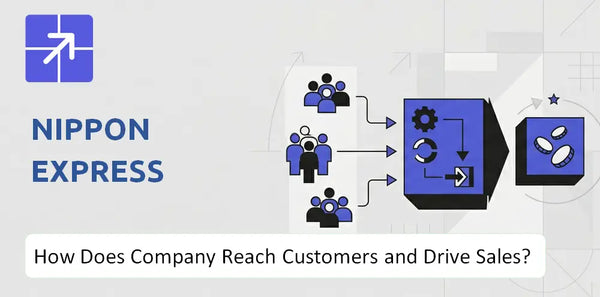
The company blends direct enterprise sales, partner channels, and digital quotations to shorten sales cycles and raise win rates; invest in account-based marketing to capture higher-margin specialized logistics. See Nippon Express BCG Matrix Analysis.
Who Does Nippon Express Want to Sell To?
Nippon Express wants to sell to large, regulated, and high-tech manufacturers – especially Global Key Accounts in Semiconductors, Pharmaceuticals, Automotive, and Electronics – by offering multi-country, multi-modal logistics and compliance-focused services to convert demand into long contracts.
 Main customer group: Global Key Accounts in high-moat industries
Nippon Express targets multinational OEMs and contract manufacturers in Semiconductors, Pharmaceuticals, Automotive, and Electronics because these buyers need end-to-end, cross-border logistics. Winning GKAs depends on integrated solutions, 30+ GDP-certified sites for pharma, and clean-room transport for fabs.
Additional segments: Mid-market Europe and North American tech firms
Secondary targets are mid-market European manufacturers and North American technology firms to diversify revenue beyond Japan. Nippon Express logistics services pursue regional contracts and multi-modal freight forwarding sales process improvements to capture these growing segments.
Market positioning: Compliance-led, high-touch global integrator
Nippon Express positions itself as a compliance-first, asset-light global integrator that combines warehouse GDP certifications, clean-room handling, and a dense Nippon Express distribution network in Japan and expanding European presence. Pricing strategies and CRM and customer retention strategies lock in multi-year contracts.
Why this positioning works: Industry-specific capabilities and scale
The message – specialized, compliant, and global – resonates because semiconductor capital expenditure rose globally in 2024 – 25 and pharmaceutical logistics demand grew with biologics complexity; Nippon Express B2B sales leverage those trends and digital channels to convert RFPs into contracts. See a related overview: How Nippon Express Company Works and Makes Money
Nippon Express SWOT Analysis
- Complete SWOT Breakdown
- Fully Customizable
- Editable in Excel & Word
- Professional Formatting
- Investor-Ready Format

How Does Nippon Express Get in Front of Customers?
Nippon Express reaches customers via a dual-track model: high-touch Global Key Account management for large enterprises and digital-first platforms (e-NX Quote, e-NX Book) for mid-market and e – commerce clients. Marketing leans on NX Quality branding, direct sales expansion in Eastern Europe after the 2024 Cargo-Partner acquisition, and targeted digital channels to shorten the sales cycle.

Enterprise consultative sales through Global Key Account managers
Global Key Account managers act as strategic consultants to large clients, integrating logistics engineering, risk mitigation, and custom contract design; this channel accounted for a majority of high-margin air and ocean contracts in 2025.
Digital marketing and platform-led access
Nippon Express uses SEO, paid search, email, and platform integrations to drive e-NX Quote and e-NX Book signups; digital channels reduced average quote-to-book time by over 30% in 2025 for online customers.
Sales channels and distribution network
Direct sales via regional offices, partnerships with local freight forwarders, and an expanded Nippon Express distribution network after the Cargo-Partner deal now covers over 40 additional Eastern European countries, boosting direct sales reach.
Demand generation tactics
Targeted campaigns (industry webinars, trade shows, and account-based marketing) plus NX Quality messaging drive demand; lead capture through e-NX and event follow-ups lifted mid-market conversion rates by double digits year-over-year.
Customer acquisition efficiency
Combining consultative B2B sales with instant digital quoting improved customer acquisition cost efficiency; reported digital channel wins rose to 25 – 35% of new accounts in 2025 depending on region.
Most important reach advantage
NX Quality reputation plus integrated digital tools form the key reach advantage – customers seeking reliability and visibility now choose Nippon Express logistics services to avoid the supply-chain disruptions seen earlier in the decade.
For an analysis of competitive positioning, see Competitive Landscape of Nippon Express Company
Nippon Express Business Model Canvas
- One-time Payment
- No Research Needed – Save Hours of Work
- Built by Experts, Trusted by Consultants
- Instant Download, Ready to Use
- 100% Editable, Fully Customizable

How Does Nippon Express Turn Attention Into Sales?
Nippon Express turns attention into sales by converting freight inquiries into integrated End-to-End contract logistics, bundling warehousing, distribution, and customs brokerage with core transport; advanced IT integration and value-based pricing in high-risk sectors lock in long-term contracts and raise margins.
Integrated contract logistics as the core sales model
Nippon Express uses direct B2B sales and partner-led selling to move clients from transactional freight forwarding to End-to-End contracts that include warehousing, distribution, and customs brokerage.
Value-based pricing and monetization logic
Pricing shifts from commodity ocean rates to value-based fees in pharma and semiconductors, enabling higher margins through service-level premiums, SLAs, and bundled recurring contract fees.
Conversion and purchase drivers
Conversion hinges on embedded IT: visibility tools integrate with client ERP systems, creating switching costs; sales teams leverage case studies, trade-show leads, and Cargo – Partner lanes to close deals.
Repeat revenue and customer expansion
Cross-selling drives growth: by March 2026 about 35 percent of new revenue came from existing clients using expanded lanes via the Cargo-Partner network; retention is supported by SLA penalties, KPI dashboards, and annual contract renewals.
Key mechanics: sales teams qualify leads from Nippon Express marketing and trade shows, propose bundled contracts with guaranteed KPIs, embed Nippon Express logistics services into client systems for visibility, then upsell specialized value-added services with premium pricing; see a related analysis here: Growth Outlook of Nippon Express Company
Nippon Express Marketing Mix
- Complete Marketing Mix Analysis
- Effortlessly Communicate Your Business Strategy
- Investor-Ready Format
- 100% Editable and Customizable
- Clear and Structured Layout

How Strong Does Nippon Express's Commercial Engine Look Going Forward?
Nippon Express commercial engine looks poised for steady expansion into 2025/2026, supported by sector diversification and margin recovery; continued global trade volatility and freight-rate swings could weaken near-term sales momentum.
Sector exposure and value – added services support future demand
Nippon Express benefits from strong demand in semiconductors and green energy, which drove higher-margin project logistics in FY 2025; its move into specialized Nippon Express logistics services and integrated supply – chain solutions strengthens pipeline conversion and contract wins.
Channel reach and digital sales effectiveness
Regional B2B sales teams plus expanded digital channels and CRM tools improved lead qualification in 2025; Nippon Express digital channels and omnichannel engagement shortened sales cycles for e – commerce fulfillment and freight forwarding sales process conversions.
Risks from trade volatility and pricing pressure
Global trade swings and freight – rate fluctuation remain core risks to Nippon Express distribution network revenue; competitive pricing strategies to win contracts could compress margins if volume growth lags.
Overall sales and marketing outlook for 2025/2026
Outlook is Steady Expansion: revenue is on track to exceed 2.5 trillion JPY in FY 2025 with operating margins trending toward 4.5 percent as M&A integration costs decline; Nippon Express B2B sales and partnerships, plus deep Asian – European connectivity, should help it outperform peers lacking specialized industrial expertise.
For detail on corporate direction and values that underpin these commercial strengths, see Mission, Vision, and Values of Nippon Express Company
Nippon Express Boston Consulting Group Matrix
- Built by Experts, Trusted by Consultants
- Structured for Consultants, Students, and Founders
- 100% Editable in Microsoft Word & Excel
- Instant Digital Download – Use Immediately
- Compatible with Mac & PC – Fully Unlocked

Related Blogs
- What Is the History of Nippon Express Company and How Did It Evolve?
- What Is the Competitive Landscape of Nippon Express Company and How Does It Compete?
- What Is the Growth Outlook of Nippon Express Company and Where Is It Heading?
- How Does Nippon Express Company Work and What Drives Its Business Model?
- What Do the Mission, Vision, and Core Values of Nippon Express Company Reveal?
- Who Are the Core Customers in Nippon Express Company's Target Market?
- Who Owns Nippon Express Company Today and Who Holds Control?
Frequently Asked Questions
Nippon Express wants to sell to large, regulated, high-tech manufacturers, especially Global Key Accounts in Semiconductors, Pharmaceuticals, Automotive, and Electronics. It also targets mid-market European manufacturers and North American technology firms to diversify revenue and win longer-term logistics contracts.
Disclaimer
All information, articles, and product details provided on this website are for general informational and educational purposes only. We do not claim any ownership over, nor do we intend to infringe upon, any trademarks, copyrights, logos, brand names, or other intellectual property mentioned or depicted on this site. Such intellectual property remains the property of its respective owners, and any references here are made solely for identification or informational purposes, without implying any affiliation, endorsement, or partnership.
We make no representations or warranties, express or implied, regarding the accuracy, completeness, or suitability of any content or products presented. Nothing on this website should be construed as legal, tax, investment, financial, medical, or other professional advice. In addition, no part of this site - including articles or product references - constitutes a solicitation, recommendation, endorsement, advertisement, or offer to buy or sell any securities, franchises, or other financial instruments, particularly in jurisdictions where such activity would be unlawful.
All content is of a general nature and may not address the specific circumstances of any individual or entity. It is not a substitute for professional advice or services. Any actions you take based on the information provided here are strictly at your own risk. You accept full responsibility for any decisions or outcomes arising from your use of this website and agree to release us from any liability in connection with your use of, or reliance upon, the content or products found herein.