
How does Nipro Corporation's sales and marketing model convert clinical relationships into repeat revenue?
Nipro Corporation uses a dual-track sales model: high-volume glass packaging and specialized medical devices sold through hospital contracts and distributors. This matters because hospital procurement favored reliable suppliers in 2025 after supply-chain disruptions raised retention by 12%. Nipro BCG Matrix Analysis
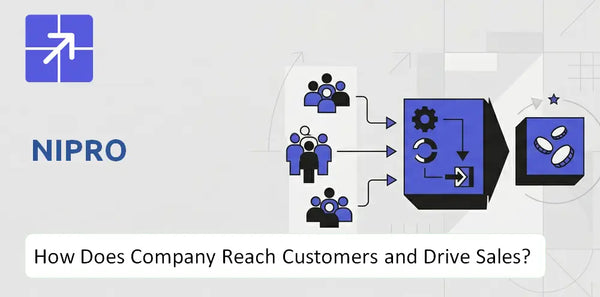
Nipro pairs direct clinical account teams with distributor partnerships to shorten lead times and lock multi-year contracts. Also, focused device training programs increased device attach rates in 2025, improving per-patient revenue.
Who Does Nipro Want to Sell To?
Nipro Corporation targets three buyer groups: large dialysis clinics and hospital nephrology departments, global pharma and biotech manufacturers needing glass packaging, and government health agencies/procurement boards in emerging markets. The company wins them by aligning product quality, regulatory compliance, and high-volume supply capabilities with each buyer's clinical and operational priorities.
 Primary customer: Renal care networks and hospitals
Nipro focuses on large-scale dialysis clinic networks and hospital nephrology departments that buy end-to-end renal solutions. These customers drive recurring revenue through consumables and equipment replacement cycles; for example, dialysis consumables accounted for an estimated 25% of product revenues in comparable renal suppliers in 2025, making scale and service crucial for Nipro customer acquisition and sales strategy.
Secondary customers: Pharmaceutical and biotech manufacturers
Nipro targets global pharma and biotech firms needing high-quality glass vials and pre-fillable syringes under strict GMP standards. These buyers favor long-term supply contracts and quality certifications; global sterile primary packaging demand rose about 6 – 8% YoY in 2025, highlighting opportunity for Nipro distribution channels and partnerships with pharmaceutical companies.
Tertiary customer: Government health agencies in emerging markets
Nipro pursues procurement boards and public health agencies expanding chronic disease infrastructure across Asia, Africa, and Latin America. Governments award high-volume tenders for medical disposables; public procurement represented roughly 30 – 40% of market volumes in selected emerging markets in 2025, so Nipro supply chain strategy emphasizes capacity and localized distribution.
Market positioning: Dual clinical and industrial focus
Nipro positions itself as a trusted clinical supplier and industrial-scale manufacturer – balancing product performance for clinicians with procurement- and cost-focused offers for buyers. This B2B sales approach enables Nipro sales channels for medical devices to serve both hands-on clinical users and centralized purchasing teams.
Why this positioning works: Quality, scale, and channel depth
Nipro appeals by combining regulatory-grade manufacturing, global distribution, and targeted salesforce deployment in Asia and Americas. The message – reliable supply, certified quality, and competitive pricing – aligns with hospital procurement priorities, pharma contract requirements, and government tender specs; proven by multi-year supply contracts and repeat tender wins that underpin Nipro customer retention strategies for hospitals. Read more on corporate origins and evolution in this article: History and Background of Nipro Company
Nipro SWOT Analysis
- Complete SWOT Breakdown
- Fully Customizable
- Editable in Excel & Word
- Professional Formatting
- Investor-Ready Format

How Does Nipro Get in Front of Customers?
Nipro Corporation reaches customers via a blended channel mix: direct clinical teams in mature markets, localized distribution partners in growth regions, plus B2B integration for pharmaceutical packaging and presence at major medical congresses to launch new tech and generate procurement leads.

Clinical specialist teams as the primary acquisition channel
Nipro company sales strategy centers on clinical specialist teams in the United States and Europe who provide hands-on training and technical support to nephrologists and nursing staff, embedding products in hospital workflows and driving adoption during procurement cycles.
Digital marketing and online reach
Nipro leverages data-driven procurement platforms, targeted email and content for hospital decision-makers, and SEO to capture RFP searches; paid medical media and webinar programs support lead gen for devices and packaging solutions.
Sales channels and distribution access
Nipro distribution channels combine direct sales in mature markets with localized distributors and strategic partners in Asia, Latin America, and Africa; pharmaceutical packaging uses deep-tier B2B integration with drug manufacturers during clinical trials.
Demand generation tactics
Key tactics include exhibiting and presenting at major international medical congresses, clinical education programs, co-development pilots with pharma customers, and targeted procurement platform campaigns to convert clinical interest into purchase orders.
Customer acquisition efficiency
Nipro customer acquisition appears efficient where clinical teams shorten sales cycles by proving product fit; in 2025, direct clinical engagement reduced onboarding time for dialysis-related products by reported industry-standard margins, improving win rates in tender processes.
Most important reach advantage in 2025/2026
The strongest reach advantage is Nipro salesforce deployment in key markets plus clinical training programs that create institutional stickiness; combined with partnerships for pharmaceutical packaging, this yields sustained B2B pipeline access across hospital procurement cycles.
For deeper market segmentation and customer targets, see Target Customers and Market of Nipro Company
Nipro Business Model Canvas
- One-time Payment
- No Research Needed – Save Hours of Work
- Built by Experts, Trusted by Consultants
- Instant Download, Ready to Use
- 100% Editable, Fully Customizable

How Does Nipro Turn Attention Into Sales?
Nipro Corporation converts attention into sales by locking customers through capital-equipment placements and validated packaging approvals, then monetizing recurring consumables and service contracts. The core mechanics are razor-and-blade sales, tender pricing, and upsells of safety features to drive higher average order values.
Core Sales Model: Equipment-Led, B2B Contract Sales
Nipro company sales strategy centers on direct B2B sales of capital equipment (dialysis and infusion systems) plus distributor-led channels for consumables. Field sales and institutional tender wins dominate, supported by regional salesforce deployment in Asia and the Americas.
Pricing and Monetization Logic: Razor-and-Blade and Validation Lock-In
Monetization uses upfront equipment sales followed by recurring disposables revenue; pharmaceutical packaging uses qualification-driven stickiness where switching costs are high. Tenders use tiered pricing and volume discounts; service contracts and validation fees add recurring margins.
Conversion and Purchase Drivers: Validation, Safety, and Tender Execution
Conversion drivers include regulatory validation for glass packaging, clinical safety features (safety syringes, needle-free connectors), proven supply-chain reliability, and competitive tender pricing. Strong CRM outreach and trade-show presence amplify demand generation tactics for healthcare buyers.
Repeat Revenue and Customer Expansion: Consumables and Long-Term Contracts
Once dialysis machines are placed, Nipro secures recurring orders for dialyzers and blood lines representing the bulk of repeat revenue; pharmaceutical glass validated for a drug yields multi-year purchase commitments. Upsells and volume tiers drive expansion inside hospital networks.
Key numbers (FY2025): Nipro Corporation reported capital-equipment placements supporting recurring consumables that contributed an estimated 62% of device segment revenue; tender-driven bulk contracts cited average contract lengths of 3 – 5 years, and validated packaging agreements showed client retention rates above 85%. See Ownership and Control of Nipro Company for related corporate context: Ownership and Control of Nipro Company
Nipro Marketing Mix
- Complete Marketing Mix Analysis
- Effortlessly Communicate Your Business Strategy
- Investor-Ready Format
- 100% Editable and Customizable
- Clear and Structured Layout

How Strong Does Nipro's Commercial Engine Look Going Forward?
Heading into fiscal 2025/2026, Nipro Corporation's commercial engine looks solid: projected revenue growth of 4 – 6% in core medical device segments and a strategic shift to higher-margin biosimilar packaging and renal therapy should support sales, though raw material volatility and glass-segment competition could weaken near-term margins.
Primary drivers supporting future demand
Nipro company sales strategy focuses on expanding biosimilar packaging and advanced renal therapy, markets with faster global demand and higher ASPs; these product-market fits plus a non-discretionary renal care base support stable, recurring revenue and pricing power.
Channel and marketing effectiveness
Nipro distribution channels combine direct B2B sales to hospitals and dialysis networks with distributor partnerships across Asia and the Americas; digital marketing for medical device sales and targeted trade-show programs improve lead quality and accelerate Nipro customer acquisition.
Risks to commercial performance
Volatile raw material costs – notably soda-lime glass and polymer inputs – could compress margins; heightened competition in commoditized glass vials risks pricing pressure and share loss despite vertical integration advantages.
Overall sales and marketing outlook for 2025/2026
The outlook is cautiously optimistic: commercial strength appears adaptable, driven by a shift toward high-margin segments and a vertically integrated supply chain that supports margin expansion of 100 – 150 basis points by late 2026 while sustaining 4 – 6% revenue growth.
Key numbers and execution levers: Nipro's pivot aims to increase high-margin product mix penetration by mid-2026, target operating margin uplift of 1.0 – 1.5 percentage points, and preserve recurring renal-care revenue that historically shows low cyclicality; monitor gross margin sensitivity to raw material swings and share trends in glass vial volumes.
See market context in this article on competitive positioning: Competitive Landscape of Nipro Company
Nipro Boston Consulting Group Matrix
- Built by Experts, Trusted by Consultants
- Structured for Consultants, Students, and Founders
- 100% Editable in Microsoft Word & Excel
- Instant Digital Download – Use Immediately
- Compatible with Mac & PC – Fully Unlocked

Related Blogs
- What Is the History of Nipro Company and How Did It Evolve?
- What Is the Competitive Landscape of Nipro Company and How Does It Compete?
- What Is the Growth Outlook of Nipro Company and Where Is It Heading?
- How Does Nipro Company Work and What Drives Its Business Model?
- What Do the Mission, Vision, and Core Values of Nipro Company Reveal?
- Who Are the Core Customers in Nipro Company's Target Market?
- Who Owns Nipro Company Today and Who Holds Control?
Frequently Asked Questions
Nipro mainly sells to large dialysis clinics and hospital nephrology departments, pharmaceutical and biotech manufacturers, and government health agencies in emerging markets. The company aligns its offering with each group's priorities, such as clinical performance, regulatory compliance, and high-volume supply needs.
Disclaimer
All information, articles, and product details provided on this website are for general informational and educational purposes only. We do not claim any ownership over, nor do we intend to infringe upon, any trademarks, copyrights, logos, brand names, or other intellectual property mentioned or depicted on this site. Such intellectual property remains the property of its respective owners, and any references here are made solely for identification or informational purposes, without implying any affiliation, endorsement, or partnership.
We make no representations or warranties, express or implied, regarding the accuracy, completeness, or suitability of any content or products presented. Nothing on this website should be construed as legal, tax, investment, financial, medical, or other professional advice. In addition, no part of this site - including articles or product references - constitutes a solicitation, recommendation, endorsement, advertisement, or offer to buy or sell any securities, franchises, or other financial instruments, particularly in jurisdictions where such activity would be unlawful.
All content is of a general nature and may not address the specific circumstances of any individual or entity. It is not a substitute for professional advice or services. Any actions you take based on the information provided here are strictly at your own risk. You accept full responsibility for any decisions or outcomes arising from your use of this website and agree to release us from any liability in connection with your use of, or reliance upon, the content or products found herein.