
How does ONEOK, Inc. convert pipeline reach into sales through its sales and marketing model?
ONEOK, Inc. sells fee-based access and marketing services by linking supply basins to end markets via its 50,000-mile network. This matters because steady volumes and contracted fees drove ONEOK's 2025 adjusted EBITDA resilience amid midstream volatility. See Oneok BCG Matrix Analysis
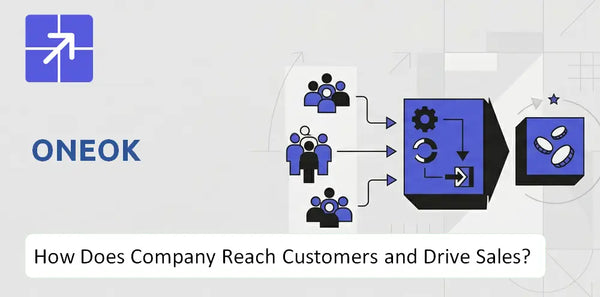
ONEOK aligns commercial teams with contract structures and capacity products to convert capacity into predictable cash flow; in 2025 long-term contracts and NGL marketing limited spot exposure, supporting stable distributions.
Who Does Oneok Want to Sell To?
ONEOK, Inc. targets upstream producers needing gathering, processing, and NGL fractionation and downstream buyers such as local natural gas distribution companies, power generators, and large industrial users; after 2024 – 2025 asset integrations, it also pursues refined-product marketers and international exporters via Gulf Coast terminals, focusing on creditworthy counterparties and long-term volume contracts.
 Core upstream producers
ONEOK prioritizes exploration and production firms in the Permian, Bakken, and Mid-Continent basins that require gathering, processing, and NGL fractionation; securing multi-year contracts with these producers drives cash flow visibility and supports pipeline utilization targets.
Primary downstream buyers
Local natural gas distribution utilities, electric power generators, and large industrial users like petrochemical plants and refineries form the main demand base; these buyers value reliable delivery, price stability, and long-term supply agreements for planning and risk management.
Expanded market segments after 2024 – 2025 integrations
Following integration of major Gulf Coast terminals in 2024 and 2025, ONEOK added refined-product marketers and international exporters to its buyer set, enabling export volumes and access to global NGL and refined-products markets via coastal loading capacity.
Market positioning
ONEOK positions itself as a midstream partner offering integrated gathering, processing, fractionation, and marine-terminal services; it emphasizes stable throughput, contracted volumes, and credit-worthy counterparties to support predictable revenue and attractive take-or-pay style structures.
Why the positioning works
Long-term, multi-year contracts with investment-grade or similarly creditworthy counterparties reduce cash-flow volatility; ONEOK's integrated assets and Gulf Coast export capability increase optionality and pricing power, which helps convert demand into sales and supports higher utilization.
Commercial focus and metrics
Sales teams target counterparties with multi-year commitments; recent disclosures for fiscal 2025 show consolidated throughput and contract backlog growth consistent with the 2024 – 2025 asset integrations, and management highlights a pipeline of commercial contracts expected to underpin mid-single-digit percentage volume growth year-over-year.
For governance and ownership context relevant to customer strategy, see Ownership and Control of Oneok Company
Oneok SWOT Analysis
- Complete SWOT Breakdown
- Fully Customizable
- Editable in Excel & Word
- Professional Formatting
- Investor-Ready Format

How Does Oneok Get in Front of Customers?
ONEOK, Inc. reaches customers through asset proximity in major production corridors and a specialized direct sales force that secures long-term throughput contracts; it also uses hub connectivity, digital scheduling, tariffs, and joint ventures to convert regional demand into booked volumes.

Strategic Asset Placement Drives Acquisition
ONEOK customer acquisition centers on locating pipelines and processing near fast-growing basins so producers must use its routes; bilateral commercial teams then negotiate acreage dedication and long-term throughput agreements, locking in cash flow and utilization.
Digital Scheduling and Tariff Transparency
ONEOK marketing strategy includes online nomination and scheduling platforms and clearly posted tariffs for hubs like Mont Belvieu and Conway, reducing friction for shippers and speeding conversion from interest to booked capacity.
Direct Commercial Sales and E&P Partnerships
ONEOK sales channels rely on a specialized direct sales force and business development group that runs negotiations with E&P firms, plus joint ventures to enter new basins without full greenfield spend – improving capital efficiency and reach.
Demand Generation via Contracting and Market Access
Demand generation tactics focus on commercial offers – capacity subscriptions, index or fixed-price tolling, and acreage deals – combined with participation at industry events and targeted outreach to midstream energy customer engagement segments.
Acquisition Efficiency Through Long-Term Contracts
ONEOK customer acquisition appears efficient because take-or-pay and minimum throughput contracts convert initial wins into predictable revenue; in 2025 its fee-based and contract-secured volumes helped sustain stable throughput economics despite commodity swings.
Reach Advantage: Corridor Control and Hub Connectivity
The most important reach advantage is physical control of must-run corridors and direct access to market hubs – this limits competitors and gives ONEOK pricing and contract management leverage when converting regional production growth into contracted flows.
For deeper customer and market context see Target Customers and Market of Oneok Company; ONEOK sales process for pipeline services and commercial contracting secured multi-year commitments in key basins that underpinned 2025 throughput stability according to public filings.
Oneok Business Model Canvas
- One-time Payment
- No Research Needed – Save Hours of Work
- Built by Experts, Trusted by Consultants
- Instant Download, Ready to Use
- 100% Editable, Fully Customizable

How Does Oneok Turn Attention Into Sales?
ONEOK, Inc. converts interest into revenue by moving capacity inquiries into binding, fee-based take-or-pay contracts and bundling gathering, processing, and transportation to capture multiple fees per molecule. The commercial engine targets long-term, fee-based commitments to lock in cash flow and shield margins from commodity swings.
Core sales model: contract-led B2B commercial sales
ONEOK customer acquisition relies on direct, commercial selling to producers and industrials through contracts and negotiated capacity commitments. Sales channels include field commercial teams, strategic partnerships, and contract renewals – focused on take-or-pay pipeline and NGL services.
Pricing and monetization logic: fee-first, bundled services
Pricing centers on fixed fees, minimum volume commitments, and tiered tariffs; in 2025 approximately 90 percent of ONEOK, Inc. earnings come from fee-based activities. Bundling gathering, processing, and transportation lets ONEOK monetize a single molecule across multiple revenue streams.
Conversion and purchase drivers: contractual certainty and capacity access
Conversion hinges on take-or-pay terms, capacity reservation fees, and commercial credibility; customers trade commodity exposure for guaranteed takeaway and price predictability. Sales execution leverages contract structuring, credit terms, and timely project delivery to turn inquiries into signed agreements.
Repeat revenue and customer expansion: upsells via expansions and debottlenecking
ONEOK converts legacy relationships into recurring growth by offering system expansions and debottlenecking projects that let producers scale throughput; incremental capacity adds are capital-efficient and typically structured as attachments to existing contracts, driving higher lifetime value and retention.
Commercial metrics: in 2025 ONEOK, Inc. reported fee-based operating earnings representing about 90 percent of total adjusted EBITDA, contract terms averaging multiple years with typical take-or-pay minimums covering 80 – 100 percent of booked capacity, and upsell-driven incremental capital projects that historically increased contracted volumes by mid-single-digit percentages annually. For context on competitive positioning and industry contracts see Competitive Landscape of Oneok Company
Oneok Marketing Mix
- Complete Marketing Mix Analysis
- Effortlessly Communicate Your Business Strategy
- Investor-Ready Format
- 100% Editable and Customizable
- Clear and Structured Layout

How Strong Does Oneok's Commercial Engine Look Going Forward?
ONEOK, Inc.'s commercial engine looks robust heading into 2025/2026, driven by diversified NGL and natural gas flows after the Magellan and EnLink integrations; key supports include petrochemical NGL demand and rising US LNG exports, while pipeline permitting and midstream regulatory risk could temper growth.
What Supports Future Demand
ONEOK customer acquisition benefits from a broader product mix after the Magellan and EnLink deals, raising exposure to higher-margin NGL liquids and fee-based gas services; 2025 EBITDA is projected above 6.6 billion USD, underpinning reinvestment in commercial outreach and contract wins.
Channel and Marketing Effectiveness
ONEOK sales channels combine long-term contracts, index-linked pricing, and retained shipper relationships in the Mid-Continent and Permian; targeted B2B engagement, trade networks, and account-level ONEOK CRM and sales automation improve conversion of industrial leads into firm transportation and fractionation contracts.
Risks to Commercial Performance
Regulatory hurdles for new pipelines and slower permitting raise execution risk; commodity price volatility can compress margins on NGL processing and interrupt pricing and contract management strategies, and customer concentration in petrochemicals or LNG buyers can amplify exposure.
The Overall Sales and Marketing Outlook
Outlook is strong and adaptable: with a debt-to-EBITDA ratio trending toward the 3.5x target and internal cash flow funding organic projects, ONEOK is positioned to grow distributions and defend its moat across key basins; see the Growth Outlook of Oneok Company for more context.
Oneok Boston Consulting Group Matrix
- Built by Experts, Trusted by Consultants
- Structured for Consultants, Students, and Founders
- 100% Editable in Microsoft Word & Excel
- Instant Digital Download – Use Immediately
- Compatible with Mac & PC – Fully Unlocked

Related Blogs
- What Is the History of Oneok Company and How Did It Evolve?
- What Is the Competitive Landscape of Oneok Company and How Does It Compete?
- What Is the Growth Outlook of Oneok Company and Where Is It Heading?
- How Does Oneok Company Work and What Drives Its Business Model?
- What Do the Mission, Vision, and Core Values of Oneok Company Reveal?
- Who Are the Core Customers in Oneok Company's Target Market?
- Who Owns Oneok Company Today and Who Holds Control?
Frequently Asked Questions
Oneok wants to sell to upstream producers, downstream utilities, power generators, industrial users, and, after recent Gulf Coast integrations, refined-product marketers and international exporters. The company focuses on creditworthy counterparties and long-term volume contracts that support steady cash flow and utilization.
Disclaimer
All information, articles, and product details provided on this website are for general informational and educational purposes only. We do not claim any ownership over, nor do we intend to infringe upon, any trademarks, copyrights, logos, brand names, or other intellectual property mentioned or depicted on this site. Such intellectual property remains the property of its respective owners, and any references here are made solely for identification or informational purposes, without implying any affiliation, endorsement, or partnership.
We make no representations or warranties, express or implied, regarding the accuracy, completeness, or suitability of any content or products presented. Nothing on this website should be construed as legal, tax, investment, financial, medical, or other professional advice. In addition, no part of this site - including articles or product references - constitutes a solicitation, recommendation, endorsement, advertisement, or offer to buy or sell any securities, franchises, or other financial instruments, particularly in jurisdictions where such activity would be unlawful.
All content is of a general nature and may not address the specific circumstances of any individual or entity. It is not a substitute for professional advice or services. Any actions you take based on the information provided here are strictly at your own risk. You accept full responsibility for any decisions or outcomes arising from your use of this website and agree to release us from any liability in connection with your use of, or reliance upon, the content or products found herein.