
How does Pinnacle West Capital Corporation's regulated sales and marketing model convert growing Arizona demand into recoverable revenue?
Pinnacle West Capital Corporation sells electricity via regulated rates and infrastructure investments rather than retail marketing, relying on the Regulatory Compact to recover costs. This matters as Arizona's rapid 2025 – 2026 growth forces large, front-loaded capex for reliability and decarbonization, pressuring rate cases and approvals.
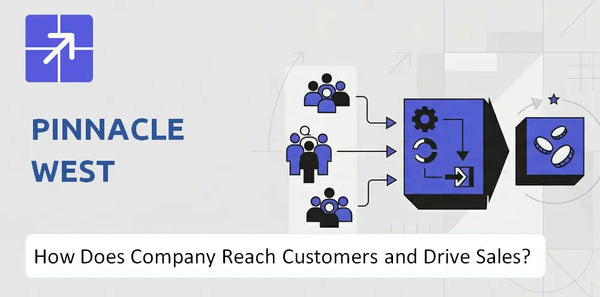
Pinnacle West Capital Corporation secures revenue through approved rate filings, performance-based mechanisms, and capital trackers; anticipate tighter regulatory scrutiny as peak demand and electrification spike. See Pinnacle West BCG Matrix Analysis.
Who Does Pinnacle West Want to Sell To?
Pinnacle West Capital Corporation targets three core buyer segments in Arizona: fast-growing residential customers, high-load industrial manufacturers in the Silicon Desert, and rapidly expanding data center operators; the company wins them via tailored reliability, pricing, and capacity planning tied to demand growth.
 Main Residential Growth Market
Pinnacle West customer acquisition focuses on an expanding residential base growing at approximately 2 percent annually within its Arizona service territory, above the national utility average; the company uses targeted APS customer engagement, digital marketing channels, and rate design to convert new housing starts into long-term retail electricity customers.
High-Load Industrial Accounts
The company pursues large industrial buyers in the Silicon Desert – semiconductor and tech manufacturers such as TSMC's Phoenix campus and Intel's Ocotillo expansion – providing 24/7 baseload power, bespoke commercial contracts, and grid upgrades to secure multi-year demand from GW-scale loads.
Data Centers as Primary Growth Lever
By March 2026, Pinnacle West demand generation centers on a surging data center pipeline in Arizona, with several gigawatts of potential new load under management; large-scale corporate energy buyers now represent the most significant growth opportunity and require tailored commercial sales approaches and interconnection planning.
Market Positioning
Pinnacle West sales strategy positions APS as a reliable, regulatory-aligned energy partner offering flexible rate structures, demand response options, and grid modernization investments to attract residential, industrial, and data center segments; the firm leverages energy company sales channels and partnerships to secure large contracts.
Why This Positioning Works
Reliability commitments, targeted pricing, and capacity planning align with buyer needs: homeowners value stable rates and customer service, semiconductor fabs require near-100 percent uptime, and data centers demand scalable power supply – these differentiators boost Pinnacle West customer retention and upsell tactics while supporting conversion of large leads into firm energy sales; see Ownership and Control of Pinnacle West Company for governance context: Ownership and Control of Pinnacle West Company
Supporting Numbers
Arizona residential growth ~2% annually; data center pipeline measured in multiple gigawatts by March 2026; Pinnacle West manages commercial interconnection requests and capacity agreements that can add GW-scale demand, making corporate buyers the top growth driver for the utility's portfolio.
Pinnacle West SWOT Analysis
- Complete SWOT Breakdown
- Fully Customizable
- Editable in Excel & Word
- Professional Formatting
- Investor-Ready Format

How Does Pinnacle West Get in Front of Customers?
Pinnacle West Capital Corporation leverages its exclusive Arizona service territory to engage customers via economic development partnerships, targeted commercial consultations, and digital-first residential programs that drive awareness, manage peak load, and convert demand into sales.

Economic development and municipal partnerships
Pinnacle West customer acquisition for large users centers on collaboration with the Arizona Commerce Authority and municipalities to win corporate relocations and expansions; the utility provides grid-interconnection roadmaps and site-specific renewables planning to secure multi-megawatt contracts and long-term commercial load. See Growth Outlook of Pinnacle West Company for context.
Digital marketing and online reach
Pinnacle West digital marketing strategy for utility sales uses web portals, email, social, and mobile apps to promote energy efficiency and demand-response enrollments; in 2025 the company reported increased portal adoption and automated outage alerts that improved customer engagement metrics year-over-year.
Sales channels and distribution access
For commercial and industrial customers Pinnacle West sales strategy operates as consultative direct sales via engineering and account teams; residential access is through online account management, contractor partnerships for rooftop solar interconnections, and smart-home integrators participating in APS customer engagement programs.
Demand generation tactics
Pinnacle West demand generation focuses on incentives, time-of-use rates, demand-response enrollments, and targeted outreach during heat seasons to shift load; incentives and efficiency rebates drove a 10 – 15% uptake in residential program participation in recent peak seasons per regulatory filings in 2025.
Customer acquisition efficiency
Given the regulated monopoly territory, Pinnacle West customer acquisition costs are low relative to competitive retailers; effectiveness is measured by program enrollment rates and peak load reduction – demand-side management helped defer capacity additions, lowering capital expenditures in the short term.
Most important reach advantage in 2025
The exclusive service territory and formal ties with state and local economic development give Pinnacle West a scaling advantage for large loads; combined with data-driven customer segmentation and demand-response programs, this remains the primary lever to convert regional demand into energy sales in 2025.
Pinnacle West Business Model Canvas
- One-time Payment
- No Research Needed – Save Hours of Work
- Built by Experts, Trusted by Consultants
- Instant Download, Ready to Use
- 100% Editable, Fully Customizable

How Does Pinnacle West Turn Attention Into Sales?
Pinnacle West turns attention into sales by converting new load into rate-base additions through the Arizona Corporation Commission rate-making process; interest from industrial or residential prospects becomes revenue once the load is connected and related infrastructure is approved in rates. The company pairs timely rate cases, adjustor mechanisms, and time-of-use pricing to monetize record load growth in fiscal 2025.
Core sales model: Regulated utility contracting and grid interconnection
Pinnacle West customer acquisition centers on regulated hookups, long-term service contracts, and interconnection agreements for developers and industrial users. Sales flows from physical connections plus inclusion of infrastructure costs in the regulated rate base.
Pricing and monetization logic: Rate cases, adjustors, and time-varying tariffs
Revenue is recurring through utility rates set by the Arizona Corporation Commission, supplemented by adjustor (rider) mechanisms for rapid recovery of clean energy investments. Tiered pricing and time-of-use rates create usage-based monetization.
Conversion and purchase drivers: Interconnection, regulatory approval, and tariff design
Conversion hinges on fast interconnection work, successful rate-case outcomes, and adjustors that reduce lag between investment and recovery; pricing signals (TOU) shift load to off-peak slots, improving asset utilization. Sales execution includes field engineering, permitting, and developer engagement.
Repeat revenue and customer expansion: Demand growth and program-based retention
Pinnacle West drives repeat revenue via long-duration service relationships, demand-response and energy-efficiency programs that lock in usage patterns, and upsells like distributed energy interconnections. In fiscal 2025 management targeted a return on equity near 9.55 percent while converting record-high load growth into earnings through adjustors and timely rate filings.
For historical context and regulatory milestones see History and Background of Pinnacle West Company
Pinnacle West Marketing Mix
- Complete Marketing Mix Analysis
- Effortlessly Communicate Your Business Strategy
- Investor-Ready Format
- 100% Editable and Customizable
- Clear and Structured Layout

How Strong Does Pinnacle West's Commercial Engine Look Going Forward?
Pinnacle West Capital Corporation's commercial engine looks strong into 2026/2027, driven by sustained industrial load growth and a heavy capital program; main supports are grid investments and regional electrification, while regulatory lag and interest rate volatility could weaken margin conversion.
Drivers Supporting Future Demand
Record Phoenix metro industrial expansion and electrification lift visibility on demand; the $5.5 billion 2025 – 2027 capital plan for grid modernization and carbon-free transition directly supports Pinnacle West demand generation and Pinnacle West customer acquisition through increased capacity and reliability.
Channel and Marketing Effectiveness
APS customer engagement combines digital outreach, field sales, and partnership channels to convert industrial leads; Pinnacle West sales strategy leverages data analytics and targeted customer segmentation to raise conversion rates and support utility marketing strategy across residential and commercial cohorts.
Risks to Commercial Performance
Regulatory lag can delay recovery of capital spending into rates, and interest rate volatility raises financing costs – both compressing earnings conversion despite demand growth; weather variability and slower-than-expected DER (distributed energy resources) economics are secondary risks to Pinnacle West demand generation.
Overall Sales and Marketing Outlook
Outlook appears strong and adaptable: professional judgment projects a 5 – 7 percent CAGR in EPS through 2026 supported by a growing rate base and projected 4 – 6 percent annual load growth; Pinnacle West sales strategy should capture value from electrification while using utility marketing strategy and digital marketing for electricity customers to sustain retention and upsell.
For context on competitive positioning and market drivers see Competitive Landscape of Pinnacle West Company
Pinnacle West Boston Consulting Group Matrix
- Built by Experts, Trusted by Consultants
- Structured for Consultants, Students, and Founders
- 100% Editable in Microsoft Word & Excel
- Instant Digital Download – Use Immediately
- Compatible with Mac & PC – Fully Unlocked

Related Blogs
- What Is the History of Pinnacle West Company and How Did It Evolve?
- What Is the Competitive Landscape of Pinnacle West Company and How Does It Compete?
- What Is the Growth Outlook of Pinnacle West Company and Where Is It Heading?
- How Does Pinnacle West Company Work and What Drives Its Business Model?
- What Do the Mission, Vision, and Core Values of Pinnacle West Company Reveal?
- Who Are the Core Customers in Pinnacle West Company's Target Market?
- Who Owns Pinnacle West Company Today and Who Holds Control?
Frequently Asked Questions
Pinnacle West targets three main segments in Arizona: fast-growing residential customers, high-load industrial manufacturers, and data center operators. The company uses reliability, pricing, and capacity planning to match each group's needs, with residential growth, Silicon Desert industrial accounts, and a surging data center pipeline driving demand.
Disclaimer
All information, articles, and product details provided on this website are for general informational and educational purposes only. We do not claim any ownership over, nor do we intend to infringe upon, any trademarks, copyrights, logos, brand names, or other intellectual property mentioned or depicted on this site. Such intellectual property remains the property of its respective owners, and any references here are made solely for identification or informational purposes, without implying any affiliation, endorsement, or partnership.
We make no representations or warranties, express or implied, regarding the accuracy, completeness, or suitability of any content or products presented. Nothing on this website should be construed as legal, tax, investment, financial, medical, or other professional advice. In addition, no part of this site - including articles or product references - constitutes a solicitation, recommendation, endorsement, advertisement, or offer to buy or sell any securities, franchises, or other financial instruments, particularly in jurisdictions where such activity would be unlawful.
All content is of a general nature and may not address the specific circumstances of any individual or entity. It is not a substitute for professional advice or services. Any actions you take based on the information provided here are strictly at your own risk. You accept full responsibility for any decisions or outcomes arising from your use of this website and agree to release us from any liability in connection with your use of, or reliance upon, the content or products found herein.