
How does Quarto Group convert its sales and marketing model into sustained retail and direct sales momentum?
The Quarto Group marries centralized global distribution with localized creative teams to sell high-margin illustrated non-fiction through retail, gift, and direct channels. This matters as tactile book demand rose in 2025 while book retailing rebounded in gift segments; Quarto Group BCG Matrix Analysis
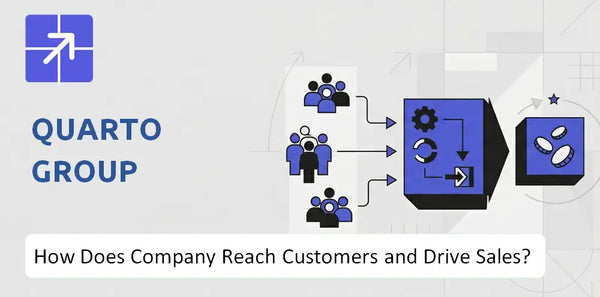
Focus marketing on tactile quality, seasonal gifting, and wholesale partnerships to convert browsing into premium purchases; in 2025 Quarto leaned into gift retail promotions and trade show placement to lift sell-through.
Who Does Quarto Group Want to Sell To?
The Quarto Group wants to sell to three core customer groups: mass-market retailers and e-tailers, specialty non-book retailers, and international co-edition partners; it is now prioritizing prosumer hobbyists and parents/educators for sustained growth. The strategy blends retail partnerships, direct-to-consumer channels, and targeted English-language exports to convert interest into sales.
 Primary customer: Prosumer hobbyists and mass-market buyers
The most important group is prosumer hobbyists – home cooks, gardeners, and craft-makers – who buy high-end instructional content and drive higher unit price and repeat purchases. Quarto Group customer acquisition focuses on mass-market digital and physical retailers and direct-to-consumer book sales to reach this segment.
Additional segments: Specialty retailers and parents/educators
Secondary targets include specialty non-book retailers (gift, home, and lifestyle stores) and international co-edition partners in Asia and Europe. The children's literature push – nearly 40 percent of new title output – aims to win parents and educators through curated lists and educational channels.
Market positioning: UK/US anchors with export growth
Geographically Quarto Group concentrates on the United States and United Kingdom, which represent about 70 percent of total revenue, while expanding English-language export markets in Asia and Europe to diversify sales. Distribution channels mix wholesale retail partnerships for publishers and international co-editions to scale reach.
Why this positioning works: targeted content and channel mix
Quarto Group sales strategy converts demand into purchases by matching high-value niche content to the right channel: specialty stores for premium formats, mass retailers for volume, and DTC e-commerce for margin capture. The approach leverages the Quarto Group digital marketing strategy for book sales and retail partnerships for publishers to optimize conversion rates; see How Quarto Group Company Works and Makes Money for related context.
Quarto Group SWOT Analysis
- Complete SWOT Breakdown
- Fully Customizable
- Editable in Excel & Word
- Professional Formatting
- Investor-Ready Format

How Does Quarto Group Get in Front of Customers?
The Quarto Group gets in front of customers through a mix of algorithm-driven platform listings, a targeted field sales force placing curated displays in non-traditional retailers, and rights sales to foreign publishers; these channels build awareness, capture impulse buyers, and convert demand into orders across retail and digital touchpoints.

Platform-first marketplace discovery
The biggest acquisition channel is digital marketplaces: in 2025 digital sales through Amazon and Target.com drove over 45 percent of total volume, so metadata optimization and algorithmic discovery are central to Quarto Group customer acquisition.
Digital marketing and platform distribution
Quarto Group digital marketing strategy for book sales focuses on metadata SEO, paid retail search on Amazon and Target, targeted email to direct-to-consumer lists, and platform listings for its 15,000-plus active titles to maximize visibility and conversion.
Field sales and retail partnerships
Sales channels combine wholesale distribution to bookstores and supermarkets with a specialized field sales force that places curated displays in garden centers, museum shops, and lifestyle boutiques like Anthropologie to reach impulse buyers.
Demand generation tactics
Demand is driven by coordinated tactics: timed promotions on marketplaces, seasonal in-store displays, author and influencer partnerships for lifestyle titles, and co-marketing with museum and brand partners to create event-driven spikes in sales.
Customer acquisition efficiency
Quarto Group appears efficient at acquisition by leveraging existing marketplace traffic and low-cost metadata work; with 15,000+ active titles and platform-first listings, marginal acquisition cost per title falls as catalog scale grows.
Most important reach advantage
The strongest reach advantage in 2025 is the combination of algorithmic discoverability on large e-commerce platforms and the targeted field sales model that captures non-traditional retail customers, amplified by co-edition rights sales to expand international distribution; see Growth Outlook of Quarto Group Company for context: Growth Outlook of Quarto Group Company
Quarto Group Business Model Canvas
- One-time Payment
- No Research Needed – Save Hours of Work
- Built by Experts, Trusted by Consultants
- Instant Download, Ready to Use
- 100% Editable, Fully Customizable

How Does Quarto Group Turn Attention Into Sales?
Quarto Group turns attention into sales by leveraging a high-margin backlist and repurposing content across formats to capture multiple price points; dynamic pricing and series-driven retention convert interest into recurring revenue.
Core Sales Model: Backlist-led, Multi-channel Distribution
Quarto Group customer acquisition relies on retail partnerships, wholesale distribution, and direct-to-consumer channels. The sales model mixes trade retail, specialist retailers, online marketplaces, and an e-commerce arm to maximize reach and shelf presence.
Pricing and Monetization Logic: Dynamic, Tiered, Repurposed
Pricing strategy uses tiered SKUs and dynamic adjustments; the company implemented a 6 percent price rise across the 2025 catalog to cover higher paper and logistics costs. Monetization is one-time sales across formats, plus higher-margin backlist sales and collectible/luxury editions to lift average order values.
Conversion and Purchase Drivers: Backlist Advantage and Format Variety
Conversion is driven by the Backlist Advantage: about 65 to 70 percent of annual revenue comes from titles published in prior years, reducing incremental marketing spend and improving margins. Repurposing core content – hardcovers, paperbacks, gift editions, kits – captures demand across price points and channels, improving conversion rates.
Repeat Revenue and Customer Expansion: Series and Collection Pull-Through
High retention comes from series-based publishing, especially in children's and illustrated categories, which drives multi-book purchases and brand loyalty. Repeat sales and backlist longevity produce predictable, high-margin recurring income and support international distribution scale.
For operational context and company history see History and Background of Quarto Group Company
Quarto Group Marketing Mix
- Complete Marketing Mix Analysis
- Effortlessly Communicate Your Business Strategy
- Investor-Ready Format
- 100% Editable and Customizable
- Clear and Structured Layout

How Strong Does Quarto Group's Commercial Engine Look Going Forward?
The Quarto Group's commercial engine looks resilient into 2025/2026, driven by a leaner balance sheet and a net debt-to-EBITDA trending toward 0.8x. Key supports include AI-led inventory cuts and high-margin licensing, while bookstore consolidation and retail disruption remain downside risks.
Balance Sheet and Financial Leverage
The Quarto Group enters 2025 with net debt-to-EBITDA approaching 0.8x, improving cash flexibility and lowering refinancing risk; free cash flow was positive in FY2025 and supports reinvestment in marketing and DTC (direct-to-consumer) initiatives.
AI and Inventory Management
AI-driven inventory optimization reduced stock write-offs by 12 percent in 2025, improving gross margin and enabling more targeted promotions across Quarto Group distribution channels and its e-commerce platform for publishing sales.
Special Sales and Non-Bookshop Channels
Shift into giftable non-fiction and special sales in non-bookstore retail creates a defensive moat and diversifies retail partnerships for publishers, increasing revenue share from high-margin licensing and non-traditional wholesale and retail distribution approaches.
Channel and Marketing Effectiveness
Quarto Group customer acquisition mixes wholesale, DTC, and digital channels; investment in digital marketing and social media raised online conversion rates in 2025, while targeted product listings and influencer tie-ins improved ROI on publishing marketing strategies.
Risks to Commercial Performance
Consolidation of traditional bookshops and secular retail declines remain the main risks; a failure to monetize digital marketing or execute pricing strategies to convert demand into purchases could pressure operating margin below the projected 11 – 12 percent.
Overall Sales and Marketing Outlook
Outlook is stable and cash-generative for 2025/2026: modest organic growth from direct-to-consumer book sales and international distribution plus scalable licensing revenue should keep operating margins near 11 to 12 percent, while effective channel mix and optimized product listings support sustained Quarto Group sales strategy momentum.
For context on competitive positioning see Competitive Landscape of Quarto Group Company
Quarto Group Boston Consulting Group Matrix
- Built by Experts, Trusted by Consultants
- Structured for Consultants, Students, and Founders
- 100% Editable in Microsoft Word & Excel
- Instant Digital Download – Use Immediately
- Compatible with Mac & PC – Fully Unlocked

Related Blogs
- What Is the History of Quarto Group Company and How Did It Evolve?
- What Is the Competitive Landscape of Quarto Group Company and How Does It Compete?
- What Is the Growth Outlook of Quarto Group Company and Where Is It Heading?
- How Does Quarto Group Company Work and What Drives Its Business Model?
- What Do the Mission, Vision, and Core Values of Quarto Group Company Reveal?
- Who Are the Core Customers in Quarto Group Company's Target Market?
- Who Owns Quarto Group Company Today and Who Holds Control?
Frequently Asked Questions
Quarto Group wants to sell to mass-market retailers and e-tailers, specialty non-book retailers, and international co-edition partners. It is also prioritizing prosumer hobbyists and parents or educators, using retail partnerships, direct-to-consumer channels, and English-language exports to turn interest into sales.
Disclaimer
All information, articles, and product details provided on this website are for general informational and educational purposes only. We do not claim any ownership over, nor do we intend to infringe upon, any trademarks, copyrights, logos, brand names, or other intellectual property mentioned or depicted on this site. Such intellectual property remains the property of its respective owners, and any references here are made solely for identification or informational purposes, without implying any affiliation, endorsement, or partnership.
We make no representations or warranties, express or implied, regarding the accuracy, completeness, or suitability of any content or products presented. Nothing on this website should be construed as legal, tax, investment, financial, medical, or other professional advice. In addition, no part of this site - including articles or product references - constitutes a solicitation, recommendation, endorsement, advertisement, or offer to buy or sell any securities, franchises, or other financial instruments, particularly in jurisdictions where such activity would be unlawful.
All content is of a general nature and may not address the specific circumstances of any individual or entity. It is not a substitute for professional advice or services. Any actions you take based on the information provided here are strictly at your own risk. You accept full responsibility for any decisions or outcomes arising from your use of this website and agree to release us from any liability in connection with your use of, or reliance upon, the content or products found herein.