
How does Quiñenco S.A. convert its sales and marketing model into repeatable revenue across subsidiaries?
Quiñenco S.A. ties active management and cross-subsidiary coordination to sales funnels, using distribution scale and partner channels to monetize demand. This matters as 2025 revenue mix shows shipping and cables drove margin recovery, supporting capital returns.
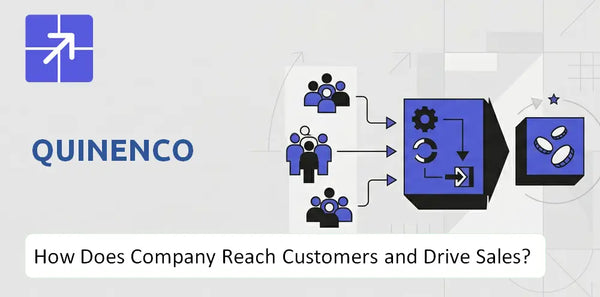
Focus on channel economics: prioritise long-term contracts in Hapag-Lloyd and industrial OEM deals for Nexans to stabilize revenue. See product placement analysis: Quinenco BCG Matrix Analysis.
Who Does Quinenco Want to Sell To?
Quiñenco S.A. targets two core groups: mass-market consumers across the Southern Cone via CCU and high-value retail and corporate banking clients through Banco de Chile, plus global industrial and B2B customers for logistics, cabling, and infrastructure via Hapag – Lloyd and Nexans stakes.
 Main customer group: Retail and Corporate Banking Clients
Banco de Chile serves over 2.5 million retail and corporate clients, focusing on low – risk profiles and high – net – worth individuals to maintain superior asset quality and reduce NPLs; this is central to Quinenco customer acquisition and Quinenco sales strategy.
Additional target segments: Beverage Consumers and International B2B
CCU aims for the Southern Cone consumer base, holding >40% beer market share in Chile and expanding in Argentina and Colombia; internationally, Hapag – Lloyd (via CSAV stake) and Nexans target exporters, importers, and renewable energy projects for high – voltage cabling.
Market positioning: Diversified, scale-driven leader
Quiñenco positions across retail banking, consumer beverages, and industrial B2B to capture margin stability and growth; scale in Banco de Chile and CCU enables competitive pricing and broad Quinenco distribution network reach.
Why the positioning works: Track record and channel depth
Strong market share – CCU's >40% in Chile beer and Banco de Chile's >2.5 million clients – plus Nexans' focus on Europe/North America energy projects and Hapag – Lloyd's global fleet turn Quinenco marketing channels and digital transformation into reliable demand conversion levers; see related context in Mission, Vision, and Values of Quinenco Company.
Quinenco SWOT Analysis
- Complete SWOT Breakdown
- Fully Customizable
- Editable in Excel & Word
- Professional Formatting
- Investor-Ready Format

How Does Quinenco Get in Front of Customers?
Quiñenco S.A. reaches customers through a mix of physical networks and digital platforms: bank branches and apps, mass retail and traditional trade for beverages, fuel stations for energy, and global shipping lanes for logistics, converting awareness into purchases via omnichannel availability and targeted promotions.

Main acquisition channel: Physical distribution networks
Quiñenco customer acquisition leans on brick-and-mortar reach – Banco de Chile's ~260 branches, CCU's access to over 100,000 points of sale in Chile, Enex's >450 Shell service stations, and Hapag-Lloyd's presence in 135 countries via a fleet of >280 vessels – delivering products where customers shop and travel.
Digital marketing and online reach
Banco de Chile's digital platform manages over 95% of routine transactions as of early 2026, while group brands use search, paid media, apps, email and social to drive traffic, support e commerce and feed CRM systems that convert leads into sales.
Sales channels and distribution access
Quinenco sales strategy combines direct retail (CCU in modern and traditional trade), franchise and company-owned fuel sites (Enex/Shell), banking branches and digital banking (Banco de Chile), plus Hapag-Lloyd's global shipping to reach B2B importers and retail customers.
Demand generation tactics
Brands run promotions, trade activations, in-store merchandising, seasonal campaigns and targeted digital ads; CCU uses retail promotions to move volume at scale, Banco de Chile offers product bundles and cross-sells, and Enex uses forecourt promotions to drive impulse purchases.
Customer acquisition efficiency
High physical coverage plus digital self-service lowers acquisition costs: with Banco de Chile processing >95% routine transactions digitally, branch-driven costs drop and conversion funnels tighten, improving unit economics across the portfolio.
Most important reach advantage
The dominant advantage is the integrated distribution network – over 100,000 retail touchpoints, >450 fuel stations, ~260 bank branches and global shipping in 135 countries – giving Quinenco distribution network scale and ubiquity that converts demand into sales.
Further reading on market positioning and competitors: Competitive Landscape of Quinenco Company
Quinenco Business Model Canvas
- One-time Payment
- No Research Needed – Save Hours of Work
- Built by Experts, Trusted by Consultants
- Instant Download, Ready to Use
- 100% Editable, Fully Customizable

How Does Quinenco Turn Attention Into Sales?
Quinenco turns attention into sales by leveraging high switching costs, strong brand equity, and operational efficiency across its banking, beverages, shipping, and cables businesses to convert interest into recurring revenue.
Core Sales Model: Portfolio-led, cross-sell and contract-based selling
Quinenco customer acquisition relies on a mix of direct retail, corporate contracts, and partner-led distribution. Banking and insurance use branch and digital channels for cross-selling; CCU uses retail and on-trade distribution; Hapag-Lloyd and Nexans sell primarily via long-term contracts and B2B tenders.
Pricing and Monetization Logic: Premiumization, yield management, and contract margins
Pricing mixes include deposit spreads and fee income in banking, premium SKU upsell at CCU, dynamic freight pricing at Hapag-Lloyd, and fixed-price backlog conversion at Nexans. Recurring revenue comes from services, insurance premiums, subscription-like deposit relationships, and multi-year contracts.
Conversion and Purchase Drivers: High switching costs, trust, and operational execution
Conversion is driven by high switching costs in banking – Quiñenco S.A. posts ROE 18 – 22% by cross-selling insurance and investment products to its deposit base – CCU's premiumization shifts consumers to higher-margin labels, Hapag-Lloyd's yield systems boost per-TEU revenue, and Nexans converts backlog as projects hit construction milestones.
Repeat Revenue and Customer Expansion: Cross-sell, premium upsell, and backlog realization
Quinenco sales strategy emphasizes retention: banks upsell insurance and wealth products to existing clients; CCU increases wallet share via premium SKUs and seasonal campaigns; Hapag-Lloyd maintains high utilization to sustain yields; Nexans converts a multi-billion dollar order book into revenue as 2026 projects reach key milestones.
Relevant metrics: Quinenco group-wide focus on ROE and margin mix – banking ROE 18 – 22%, Hapag-Lloyd utilization and yield optimization boosting freight rate realization, CCU premiumization raising per-unit margin, Nexans converting a record multi-billion dollar backlog into 2026 revenue as grid projects advance. For detailed strategic context see Growth Outlook of Quinenco Company.
Quinenco Marketing Mix
- Complete Marketing Mix Analysis
- Effortlessly Communicate Your Business Strategy
- Investor-Ready Format
- 100% Editable and Customizable
- Clear and Structured Layout

How Strong Does Quinenco's Commercial Engine Look Going Forward?
Quiñenco S.A.'s commercial engine enters 2025/2026 with fortified stability driven by diversified cash flows across shipping, banking, and industrials; strengths include Hapag-Lloyd fleet renewals and Banco de Chile's stable NIMs, while downside stems from trade volatility and commodity cycles that can pressure volumes and margins.
What Supports Future Demand
Brand-backed assets and diversified subsidiaries provide repeat demand: Hapag-Lloyd fleet upgrades and terminal stakes protect freight revenues; Banco de Chile's market-leading efficiency ratios and recovering loan growth sustain net interest income. Nexans electrification orders and beverage consolidation add industrial tailwinds to Quinenco customer acquisition.
Channel and Marketing Effectiveness
Quinenco's reach is largely indirect via portfolio companies that use broad retail partnerships, wholesale distribution, and digital channels; Banco de Chile's digital transformation and retail banking CRM improve cross-sell rates, while beverages and fuel retail partners enable quick shelf-to-customer conversion supporting the Quinenco sales strategy.
Risks to Commercial Performance
Primary risks are global shipping rate swings (container demand), Chilean macro volatility affecting loan growth and provisioning, and raw-material price moves for Nexans. Currency exposure and concentrated South American retail markets heighten country risk despite diversification, affecting Quinenco demand generation and lead conversion strategies.
The Overall Sales and Marketing Outlook
Outlook is steady and adaptable for 2025/2026: management guidance and analyst consensus point to dividend yield near 7 – 9 percent supported by diversified EBITDA streams. Expect gradual value compounding from electrification and retail consolidation, while monitoring logistics and distribution pressures and digital marketing ROI at portfolio companies. Read more on Quinenco's evolution here: History and Background of Quinenco Company
Quinenco Boston Consulting Group Matrix
- Built by Experts, Trusted by Consultants
- Structured for Consultants, Students, and Founders
- 100% Editable in Microsoft Word & Excel
- Instant Digital Download – Use Immediately
- Compatible with Mac & PC – Fully Unlocked

Related Blogs
- What Is the History of Quinenco Company and How Did It Evolve?
- What Is the Competitive Landscape of Quinenco Company and How Does It Compete?
- What Is the Growth Outlook of Quinenco Company and Where Is It Heading?
- How Does Quinenco Company Work and What Drives Its Business Model?
- What Do the Mission, Vision, and Core Values of Quinenco Company Reveal?
- Who Are the Core Customers in Quinenco Company's Target Market?
- Who Owns Quinenco Company Today and Who Holds Control?
Frequently Asked Questions
Quinenco targets retail and corporate banking clients through Banco de Chile, mass-market beverage consumers through CCU, and global industrial B2B customers through stakes in Hapag-Lloyd and Nexans. The company focuses on low-risk banking clients, Southern Cone consumers, and exporters, importers, and infrastructure buyers.
Disclaimer
All information, articles, and product details provided on this website are for general informational and educational purposes only. We do not claim any ownership over, nor do we intend to infringe upon, any trademarks, copyrights, logos, brand names, or other intellectual property mentioned or depicted on this site. Such intellectual property remains the property of its respective owners, and any references here are made solely for identification or informational purposes, without implying any affiliation, endorsement, or partnership.
We make no representations or warranties, express or implied, regarding the accuracy, completeness, or suitability of any content or products presented. Nothing on this website should be construed as legal, tax, investment, financial, medical, or other professional advice. In addition, no part of this site - including articles or product references - constitutes a solicitation, recommendation, endorsement, advertisement, or offer to buy or sell any securities, franchises, or other financial instruments, particularly in jurisdictions where such activity would be unlawful.
All content is of a general nature and may not address the specific circumstances of any individual or entity. It is not a substitute for professional advice or services. Any actions you take based on the information provided here are strictly at your own risk. You accept full responsibility for any decisions or outcomes arising from your use of this website and agree to release us from any liability in connection with your use of, or reliance upon, the content or products found herein.