
How does Royal Bank of Canada's sales and marketing model turn cross-sell and digital channels into recurring revenue?
Royal Bank of Canada uses branch, advisor-led wealth channels and digital platforms to push high-margin products and cross-sell to an expanded client base after the HSBC Canada deal. In 2025 RBC reported a 53.5 percent efficiency ratio and a balance sheet above C$2.1 trillion, showing scale and operating leverage.
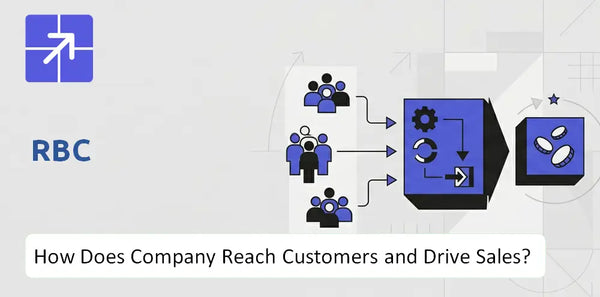
Focus on seamless onboarding and targeted offers; prioritize high-net-worth advisory upsell and digital product funnels. See RBC BCG Matrix Analysis for product-level positioning.
Who Does RBC Want to Sell To?
Royal Bank of Canada wants to sell to four primary audiences: Canadian retail consumers (notably New to Canada and young professionals), high-net-worth clients via Wealth Management, mid-market and international commercial clients, and global institutional and corporate clients through Capital Markets. The bank pursues multi-product relationships and high-yield segments to boost lifetime value and cross-sell.
 Main customer group: Canadian retail consumers (focus: New to Canada, young professionals)
RBC targets mass affluent and entry retail segments to capture lifetime value early; in 2025 the bank emphasized onboarding New to Canada and young professionals via digital offers and targeted promotions to lift acquisition and conversion. This aligns with RBC marketing strategy and higher customer acquisition ROI from tailored digital channels.
Additional segments: Wealth, Commercial, Capital Markets
Wealth Management pursues high-net-worth and ultra-high-net-worth clients in North America and the UK, where RBC ranks among the top five global wealth managers; Commercial focuses on mid-market and cross-border firms (enhanced by the HSBC integration), and Capital Markets serves institutional investors and corporates needing debt, equity, and advisory services.
Market positioning: Full-service, omnichannel financial platform
RBC positions itself as a diversified financial services platform offering retail banking, wealth management, commercial banking, and capital markets. The bank emphasizes RBC digital channels plus branch network coverage to convert demand into sales across an RBC omnichannel marketing and sales approach.
Why this positioning works: Cross-sell and high-yield focus
RBC defines ideal clients by multi-product potential, not just deposits; cross-selling drives higher revenue per client. In 2025, targeted promotions, CRM-driven personalized offers, and data analytics increased sales conversion and customer retention, supporting RBC sales conversion and improved ROE for high-yield segments. See Target Customers and Market of RBC Company for related analysis.
RBC SWOT Analysis
- Complete SWOT Breakdown
- Fully Customizable
- Editable in Excel & Word
- Professional Formatting
- Investor-Ready Format

How Does RBC Get in Front of Customers?
Royal Bank of Canada gets in front of customers through a dense branch network plus a dominant digital engine: physical advisory hubs, mobile and web channels, partner ecosystems, and a dedicated direct-sales force drive awareness, demand, and conversion.

Main acquisition channel: Mobile and digital platform
RBC marketing strategy centers on digital-first acquisition: over 8.5 million active mobile users in 2026 who generate the majority of new leads and account openings, making mobile apps the top funnel source for deposits and lending.
Digital marketing and online reach
RBC digital channels combine search, paid media, social, content, email, and app notifications; NOMI AI drives personalized predictive nudges and delivers over 1 billion personalized touchpoints annually to boost RBC customer engagement and conversion.
Sales channels and distribution access
Branch network of more than 1,200 Canadian branches acts as high-touch advisory hubs while institutional and wealth segments use a high-performance direct sales force and specialized advisors to win mandates and large mandates.
Demand generation tactics
RBC uses targeted campaigns, Avion Rewards integrations, co-branded partnerships with Petro-Canada and Rexall, and app-driven offers; these tactics keep RBC top-of-mind in everyday spending and drive cross-selling for mortgages and investments.
Customer acquisition efficiency
RBC appears efficient: digital sign-ups scale via in-app onboarding and CRM-led remarketing; NOMI personalization improves funnel conversion and reduces cost-per-acquisition versus branch-only channels.
Most important reach advantage
The combined advantage is omnichannel density – physical branches plus a high-engagement app and ecosystem partnerships – enabling RBC sales conversion by turning online interest into accounts and upsells at scale; see Competitive Landscape of RBC Company for context: Competitive Landscape of RBC Company
RBC Business Model Canvas
- One-time Payment
- No Research Needed – Save Hours of Work
- Built by Experts, Trusted by Consultants
- Instant Download, Ready to Use
- 100% Editable, Fully Customizable

How Does RBC Turn Attention Into Sales?
Royal Bank of Canada turns attention into sales by using client-primacy prompts and data-led Next Best Action recommendations to convert clicks and branch visits into bundled product relationships and revenue.
Core sales model: client primacy and bundling
Royal Bank of Canada runs a hybrid retail and digital sales model: branch-led advice, relationship managers, and self-serve digital channels drive product sign-ups. Sales focus on bundling – mortgages, credit cards, and wealth – so the bank becomes the lead provider for each client.
Pricing and monetization logic: margins plus fee income
Revenue mixes Net Interest Income from lending with fee-based wealth and capital markets income. In 2025 Net Interest Margins stabilized near 1.45 – 1.50%, while fee income supports recurring non-interest revenue.
Conversion and purchase drivers: Next Best Action and data
RBC uses real-time transaction data and CRM-driven Next Best Action prompts to recommend relevant products; this increases conversion by prompting timely offers for mortgages, cards, or insurance. Trust, branch access, and digital convenience all raise close rates.
Repeat revenue and customer expansion: bundling lifts lifetime value
Retail clients holding three or more products show materially higher retention and a 20% higher lifetime value. In 2025 RBC converted 90% of HSBC-migrated international clients into broader wealth and commercial products, boosting recurring fee streams.
Executional details: Royal Bank of Canada integrates RBC digital channels, branch network, and relationship managers into an omnichannel sales funnel; CRM and analytics score leads, trigger personalized offers, and push Next Best Actions across mobile, web, and phone to convert interest into accounts and cross-sales. See Ownership and Control of RBC Company for governance context: Ownership and Control of RBC Company
RBC Marketing Mix
- Complete Marketing Mix Analysis
- Effortlessly Communicate Your Business Strategy
- Investor-Ready Format
- 100% Editable and Customizable
- Clear and Structured Layout

How Strong Does RBC's Commercial Engine Look Going Forward?
Royal Bank of Canada's commercial engine enters 2026-2027 strongly: CET1 at 13.2 percent, C$740 million in annual cost synergies realized from the HSBC Canada integration, and a forecasted ROE above 16.5 percent. Key supports include digital adoption, international commercial banking strength, and capital flexibility; monitored weakness is City National's US CRE exposure.
What Supports Future Demand
Brand strength, wide branch and digital reach, and cross-selling depth drive RBC marketing strategy and RBC customer acquisition; HSBC Canada synergies of C$740 million boost margin for reinvestment in personalized offers to convert prospects.
Channel and Marketing Effectiveness
RBC digital channels and branch network work together in an omnichannel marketing and sales approach; CRM-driven campaigns and targeted promotions lift RBC sales conversion and RBC customer engagement, with digital account openings growing double digits in 2025.
Risks to Commercial Performance
US commercial real estate exposure at City National is the primary risk to RBC sales funnel health; macro pressure or deposit outflows could constrain share buybacks despite excess capital, and regulatory or competitive shifts could raise customer acquisition costs.
The Overall Sales and Marketing Outlook
Outlook is strong and adaptable for 2026: capital at 13.2 percent CET1 funds growth and buybacks, digital and international commercial banking give sustained demand-generation advantages, and expected ROE > 16.5 percent signals a productive sales engine.
Read more on strategic operations and revenue drivers in this analysis: How RBC Company Works and Makes Money
RBC Boston Consulting Group Matrix
- Built by Experts, Trusted by Consultants
- Structured for Consultants, Students, and Founders
- 100% Editable in Microsoft Word & Excel
- Instant Digital Download – Use Immediately
- Compatible with Mac & PC – Fully Unlocked

Related Blogs
- What Is the History of RBC Company and How Did It Evolve?
- What Is the Competitive Landscape of RBC Company and How Does It Compete?
- What Is the Growth Outlook of RBC Company and Where Is It Heading?
- How Does RBC Company Work and What Drives Its Business Model?
- What Do the Mission, Vision, and Core Values of RBC Company Reveal?
- Who Are the Core Customers in RBC Company's Target Market?
- Who Owns RBC Company Today and Who Holds Control?
Frequently Asked Questions
RBC sells to four primary audiences: Canadian retail consumers, high-net-worth clients, mid-market and international commercial clients, and global institutional and corporate clients. The bank focuses on multi-product relationships and high-yield segments to increase lifetime value and cross-sell opportunities across its business lines.
Disclaimer
All information, articles, and product details provided on this website are for general informational and educational purposes only. We do not claim any ownership over, nor do we intend to infringe upon, any trademarks, copyrights, logos, brand names, or other intellectual property mentioned or depicted on this site. Such intellectual property remains the property of its respective owners, and any references here are made solely for identification or informational purposes, without implying any affiliation, endorsement, or partnership.
We make no representations or warranties, express or implied, regarding the accuracy, completeness, or suitability of any content or products presented. Nothing on this website should be construed as legal, tax, investment, financial, medical, or other professional advice. In addition, no part of this site - including articles or product references - constitutes a solicitation, recommendation, endorsement, advertisement, or offer to buy or sell any securities, franchises, or other financial instruments, particularly in jurisdictions where such activity would be unlawful.
All content is of a general nature and may not address the specific circumstances of any individual or entity. It is not a substitute for professional advice or services. Any actions you take based on the information provided here are strictly at your own risk. You accept full responsibility for any decisions or outcomes arising from your use of this website and agree to release us from any liability in connection with your use of, or reliance upon, the content or products found herein.