
How does Samsara convert field sensor installs into recurring cloud sales through its sales and marketing model?
Samsara pairs hardware-led field sales with digital self-serve and channel partners to embed its Connected Operations Cloud into operator workflows. This matters because by March 2026 Samsara showed improving net retention and rising SaaS gross margins, signaling scalable commercial efficiency. Samsara BCG Matrix Analysis
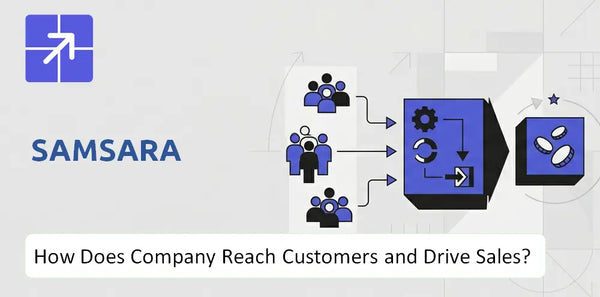
Samsara drives trials via fleet and site pilots, then upsells cloud tiers and services; marketing targets verticals with ROI case studies. Expect quicker payback where fuel, safety, or compliance costs are high, shortening sales cycles.
Who Does Samsara Want to Sell To?
Samsara primarily sells to large industrial operators that run fleets and heavy equipment – transportation, construction, utilities, energy, and public-sector agencies – targeting decision-makers who buy for risk reduction and margin improvement. The company wins these buyers by shifting from fleet managers to COOs and CFOs with enterprise contracts and integrated IoT and SaaS solutions.
 Main target: enterprise operators with distributed physical assets
Samsara focuses on enterprises managing large vehicle and equipment fleets where telematics, safety, and fuel efficiency drive material savings. As of early 2026, enterprises with Annual Contract Value over $100,000 per account generate just over 50 percent of total revenue, making this cohort the primary revenue engine.
Secondary targets: mid-market fleets and public agencies
Mid-market fleet managers and municipal agencies adopt Samsara for tactical fleet tracking and regulatory compliance. These segments feed the top of the Samsara sales funnel via content, trade shows, and partner channels before converting into larger enterprise deals over time.
Market positioning: integrated IoT + SaaS platform for operational leaders
Samsara positions itself as an end-to-end IoT fleet management and operations platform that ties telematics hardware to cloud software for safety, compliance, efficiency, and sustainability. The message targets COOs and CFOs who value measurable ROI and scalable deployment across distributed assets.
Why this positioning works: measurable savings and enterprise-ready delivery
Samsara emphasizes quantifiable outcomes – reduced idling, lower accident rates, and fuel savings – backed by enterprise sales processes, account-based marketing, and channel partnerships. See an analysis of ownership and strategic priorities in this piece Ownership and Control of Samsara Company.
Samsara SWOT Analysis
- Complete SWOT Breakdown
- Fully Customizable
- Editable in Excel & Word
- Professional Formatting
- Investor-Ready Format

How Does Samsara Get in Front of Customers?
Samsara gets in front of customers through a multi-channel commercial engine: a segmented direct sales force, digital performance marketing, strategic partnerships with insurers and OEMs, localized international sales pods, trade shows, and content highlighting ROI in fuel savings and accident reduction.

Direct sales pods drive high-value deals
Samsara customer acquisition centers on a high-velocity direct sales force segmented by account size and industry vertical; field sales pods convert enterprise fleet customers with tailored demos and pilot programs, shortening the Samsara sales funnel for large accounts.
Digital marketing and performance channels
Samsara marketing strategy uses search, paid media, social, content, and email to generate inbound leads; digital campaigns emphasize quantifiable ROI – fuel savings and accident reduction – and feed demos that lift demo-to-paid conversion rates.
Partner channels: insurers and OEM integrations
Samsara expands distribution via partnerships with insurance providers and OEMs that integrate Samsara data to lower premiums or add vehicle utility; these partnerships act as trusted reseller and referral channels in the B2B technology sales channels mix.
Demand generation: content, events, trade shows
SaaS demand generation tactics include content-led case studies, webinars, and heavy trade show presence; by 2025 Samsara highlighted measurable outcomes – fuel savings of up to 15% and crash reductions cited in customer studies – to drive qualified leads.
Customer acquisition efficiency and metrics
Samsara appears to optimize acquisition efficiency by combining paid channels with partner referrals and sales-led pilots; localized sales pods in Western Europe and Mexico improved close velocity and reduced customer acquisition cost for fleet safety and ESG reporting tools.
Most important reach advantage in 2025
The strongest reach advantage is integrated partner distribution – insurance and OEM integrations – plus localized direct sales pods, which together scaled international customer access and supported Samsara inbound marketing case study success across regions.
See a deeper Competitive Landscape of Samsara Company: Competitive Landscape of Samsara Company
Samsara Business Model Canvas
- One-time Payment
- No Research Needed – Save Hours of Work
- Built by Experts, Trusted by Consultants
- Instant Download, Ready to Use
- 100% Editable, Fully Customizable

How Does Samsara Turn Attention Into Sales?
Samsara converts attention into revenue by using a land-and-expand SaaS model: quick time-to-value pilots (often AI video safety or GPS telematics) that embed its modular IoT platform and unlock cross-sell expansion into Equipment Monitoring and Site Visibility under multi-year subscriptions.
Core Sales Model: Land-and-Expand via Direct and Partner Sales
Samsara primarily uses direct enterprise sales supplemented by channel partners and system integrators. Initial deals typically target a single use case (demo-to-paid conversion), then expand across fleet and site operations through account-based selling.
Pricing and Monetization Logic: Value-Based, Multi-Year Subscriptions
Revenue comes from recurring subscriptions, hardware sales, and implementation services, with contracts usually running three to five years. Pricing is anchored to measured ROI: lower insurance claims, reduced fuel use, and optimized maintenance schedules.
Conversion and Purchase Drivers: Rapid Time-to-Value and Quantifiable ROI
Fast pilots that deliver measurable savings drive conversion; sales teams pair demos with ROI modeling showing payback often within months. Trust from certifications, customer case studies, and presence at trade events increases deal velocity.
Repeat Revenue and Expansion: High Net Retention through Cross-Sell
Once deployed, customers expand across modules, sustaining a Net Retention Rate above 115 percent in recent fiscal periods; multi-year contracts provide predictable cash flow and high renewal rates.
Key numbers and mechanics: typical contract length 3 – 5 years, Net Retention Rate > 115 percent, ROI use cases (insurance, fuel, maintenance) are core to Samsara customer acquisition and the Samsara sales funnel. See further market context in Target Customers and Market of Samsara Company.
Samsara Marketing Mix
- Complete Marketing Mix Analysis
- Effortlessly Communicate Your Business Strategy
- Investor-Ready Format
- 100% Editable and Customizable
- Clear and Structured Layout

How Strong Does Samsara's Commercial Engine Look Going Forward?
Heading into the remainder of 2026, Samsara's commercial engine looks strong, driven by product-led expansion and a projected fiscal revenue growth rate near 28 – 32%. Key supports are AI-driven Data Insights, expanding hardware-to-software attach, and scalable channels; freight/construction cyclicality and macro sensitivity remain watch points.
What Supports Future Demand
Generative AI in the Data Insights engine will enable higher-tier pricing and automate workflows, boosting average revenue per user (ARPU). Strong product-market fit in IoT fleet management marketing and growing software attach rates across an installed hardware base drive recurring SaaS revenue and upsell.
Channel and Marketing Effectiveness
Direct sales, digital inbound marketing, and partner channels combine to shorten the Samsara sales funnel; case studies show enterprise demo-to-paid conversion improving with account-based marketing. Continued investment in SEO, content marketing, trade shows, and targeted digital ads sustains SaaS demand generation tactics and lead volume.
Risks to Commercial Performance
Revenue exposure to freight and construction makes ARR growth sensitive to macro cycles; procurement pauses can slow new account creation. Price elasticity for hardware and competitive pressure in B2B technology sales channels could compress margins if churn or longer sales cycles rise.
The Overall Sales and Marketing Outlook
Outlook for 2025/2026 is strong and adaptable: market share gains and a path to GAAP profitability are plausible as high-margin software scales over hardware. Expect continued efficiency in Samsara customer acquisition and healthier conversion rates if AI features deepen stickiness and shorten the enterprise sales process. Read more on corporate direction at Mission, Vision, and Values of Samsara Company.
Samsara Boston Consulting Group Matrix
- Built by Experts, Trusted by Consultants
- Structured for Consultants, Students, and Founders
- 100% Editable in Microsoft Word & Excel
- Instant Digital Download – Use Immediately
- Compatible with Mac & PC – Fully Unlocked

Related Blogs
- What Is the History of Samsara Company and How Did It Evolve?
- What Is the Competitive Landscape of Samsara Company and How Does It Compete?
- What Is the Growth Outlook of Samsara Company and Where Is It Heading?
- How Does Samsara Company Work and What Drives Its Business Model?
- What Do the Mission, Vision, and Core Values of Samsara Company Reveal?
- Who Are the Core Customers in Samsara Company's Target Market?
- Who Owns Samsara Company Today and Who Holds Control?
Frequently Asked Questions
Samsara mainly sells to large industrial operators with fleets and heavy equipment. Its core buyers include transportation, construction, utilities, energy, and public-sector organizations. The company targets decision-makers who care about risk reduction, margin improvement, and enterprise-wide operational savings, especially COOs and CFOs.
Disclaimer
All information, articles, and product details provided on this website are for general informational and educational purposes only. We do not claim any ownership over, nor do we intend to infringe upon, any trademarks, copyrights, logos, brand names, or other intellectual property mentioned or depicted on this site. Such intellectual property remains the property of its respective owners, and any references here are made solely for identification or informational purposes, without implying any affiliation, endorsement, or partnership.
We make no representations or warranties, express or implied, regarding the accuracy, completeness, or suitability of any content or products presented. Nothing on this website should be construed as legal, tax, investment, financial, medical, or other professional advice. In addition, no part of this site - including articles or product references - constitutes a solicitation, recommendation, endorsement, advertisement, or offer to buy or sell any securities, franchises, or other financial instruments, particularly in jurisdictions where such activity would be unlawful.
All content is of a general nature and may not address the specific circumstances of any individual or entity. It is not a substitute for professional advice or services. Any actions you take based on the information provided here are strictly at your own risk. You accept full responsibility for any decisions or outcomes arising from your use of this website and agree to release us from any liability in connection with your use of, or reliance upon, the content or products found herein.