
How does Smulders Group's sales and marketing model convert engineering prowess into contracted revenue?
Smulders Group sells engineered steel solutions via direct bids, long-term OEM partnerships, and project-based contracts, focusing on offshore wind and energy majors. This matters because in 2025 Smulders won multiple large offshore contracts, underlining its role as a strategic supplier.
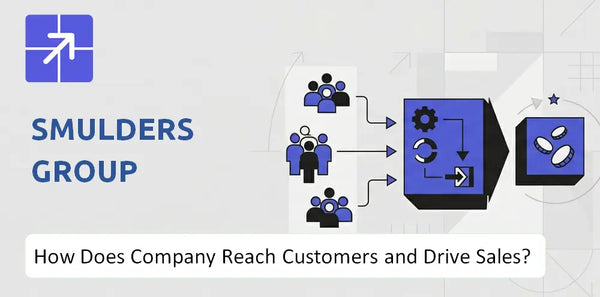
Smulders leans on technical sales teams and integrated project delivery to shorten sales cycles and reduce client risk; expect continued demand from 2026 offshore wind schedules. See Smulders Group BCG Matrix Analysis for product positioning.
Who Does Smulders Group Want to Sell To?
Smulders Group wants to sell to Tier-1 energy developers, national utilities, and EPCI contractors that run large, technically complex offshore and onshore projects; it targets buyers who value yard capacity, quality, and long-term reliability over lowest price and wins contracts through project-scale alignment and technical capability.
 Primary target: Tier-1 offshore developers
Smulders Group focuses on global offshore wind leaders – Orsted, RWE, Vattenfall – supplying jacket foundations, transition pieces, and substations where orders run into thousands of tonnes. In 2025 Smulders won multiple North Sea/Baltic contracts as demand for jackets and transition pieces hit record levels.
Additional segments: oil & gas operators and EPCI contractors
Smulders pursues major oil and gas operators for platform modules and decommissioning work and partners with EPCI contractors that integrate fabrication into turn-key projects; these segments value modular fabrication expertise and on-time delivery capacity.
Market positioning: capacity and technical complexity
Smulders positions itself as a specialist for large-scale, technically demanding steel structures where yard throughput and specialist welding/fabrication matter; pricing is secondary to schedule certainty and technical compliance for target customers.
Why this positioning works
Clients in the North Sea and Baltic prioritize reliability after seeing supply-chain volatility; Smulders converts demand into long-term contracts by offering proven yard capacity, engineering support, and project references – see Ownership and Control of Smulders Group Company for corporate context Ownership and Control of Smulders Group Company.
Smulders Group SWOT Analysis
- Complete SWOT Breakdown
- Fully Customizable
- Editable in Excel & Word
- Professional Formatting
- Investor-Ready Format

How Does Smulders Group Get in Front of Customers?
Smulders Group gets in front of customers mainly through strategic B2B channels: long-term framework agreements, government and consortium tenders, and early technical engagement at FEED (pre-FEED) stages. It uses specialized yards in Belgium, the Netherlands, Poland, and the UK plus industry seats and summits to demonstrate capacity, local content, and logistical readiness.

Framework agreements and tender wins
Smulders Group customer acquisition centers on long-term framework agreements and winning high-value government and consortium tenders; this matters because ~70 – 80% of large EPC and fabrication revenue typically stems from framework-backed projects in 2025 energy markets.
Industry presence and events
Smulders boosts demand generation by attending major energy summits and holding regulatory seats, positioning itself at pre-FEED to influence specs; early engagement converts inquiries into shortlisted bids more often than late-stage offers.
Physical yards as commercial assets
The company leverages yards in Belgium, the Netherlands, Poland, and the UK as proof of local content and logistics capability; this reduces procurement friction for utilities and offshore wind developers during qualification.
Direct sales and consortium negotiation
Direct negotiations with energy consortiums and consortium-led procurement are primary sales channels, supported by dedicated bid teams that convert technical relationships into commercial contracts.
Demand generation: targeted technical outreach
Demand is driven by targeted RFP responses, technical workshops during FEED, and case-study showcases at trade events; this approach emphasizes industrial fabrication credibility and long-term partnership potential.
Acquisition efficiency via repeat business
Customer acquisition efficiency is high because repeat frameworks and renewals reduce bid-to-win time; retaining clients through aftersales and maintenance lowers effective acquisition cost per project.
Key reach advantage in 2025
The most important reach advantage is early-stage technical influence (pre-FEED/FEED) combined with local yards – this translates to higher shortlisting rates and faster contract awards in the 2025 offshore wind pipeline.
For operational context and historical deals that inform these channels, see the company background: History and Background of Smulders Group Company
Smulders Group Business Model Canvas
- One-time Payment
- No Research Needed – Save Hours of Work
- Built by Experts, Trusted by Consultants
- Instant Download, Ready to Use
- 100% Editable, Fully Customizable

How Does Smulders Group Turn Attention Into Sales?
Smulders Group turns attention into sales through technical wins in competitive bids and by selling turnkey EPC packages; it converts leads into revenue via fabrication capacity, pricing protections, and capacity reservation agreements that create bankable backlog.
Technical bidding and turnkey EPC sales model
Smulders Group customer acquisition centers on direct, contract-led selling into developers, utilities, and EPC consortia. The core sales model is competitive tendering plus turnkey EPC delivery for offshore wind substations, transition pieces, and heavy steel structures.
Pricing and monetization: cost-plus, fixed-price with indexing
Pricing is done via cost-plus or fixed-price contracts with inflation and steel-price indexing; this preserves margins against 2025 steel volatility of roughly 5 – 8%. Revenue comes as milestone payments on EPC contracts and capacity reservation fees paid upfront.
Conversion and purchase drivers: capacity, trust, and technical fit
Conversion is driven by Smulders Group sales strategy: having fabrication capacity to deliver over 35 transition pieces or multiple large substations per year creates a moat. Proven engineering, on-time delivery track record, and detailed technical bids convert project inquiries into signed contracts.
Repeat revenue, upsell, and capacity reservation
After-sales and maintenance contracts, logistics services, and spare-part supply drive upsell and retention. Increasing use of capacity reservation agreements turns future demand into a bankable backlog, with developers prepaying to lock production slots years ahead.
For commercial context and target segments see Target Customers and Market of Smulders Group Company
Smulders Group Marketing Mix
- Complete Marketing Mix Analysis
- Effortlessly Communicate Your Business Strategy
- Investor-Ready Format
- 100% Editable and Customizable
- Clear and Structured Layout

How Strong Does Smulders Group's Commercial Engine Look Going Forward?
The commercial engine of Smulders Group looks robust heading into 2026, driven by a multi-billion euro backlog, structural offshore wind demand, and integration gains from Eiffage Metal; key supports are capacity and pricing power while risks include labor cost inflation and steel supply volatility.
Tailwind: Structural Offshore Wind Demand
Europe's 111 GW offshore wind target by 2030 creates a foundations supply gap; Smulders Group customer acquisition benefits from a multi-billion euro backlog extending into the late 2020s, positioning Smulders Group as a price maker for foundations and export platforms.
Channel and Marketing Effectiveness
Business development focuses on EPC and OEM channels, trade shows, and direct tenders; Smulders B2B marketing and targeted proposals (tender hit rates above industry norms) convert project inquiries into sales via a disciplined sales funnel and CRM-led account management.
Risks to Commercial Performance
Rising labor costs and potential steel supply chain disruptions are the main risks; steel price volatility and logistics bottlenecks could compress margins below the projected operating margin band of 7.5 to 9.2 percent, though diversified yards mitigate site-specific disruption.
Overall Sales and Marketing Outlook
Outlook for 2025/2026 is highly positive: revenue growth should outpace the sector's ~12% CAGR for offshore wind installation, supported by backlog conversion, Eiffage Metal operational efficiencies, and targeted demand generation; still, margin upside depends on steel and labor trends. Read related analysis: How Smulders Group Company Works and Makes Money
Smulders Group Boston Consulting Group Matrix
- Built by Experts, Trusted by Consultants
- Structured for Consultants, Students, and Founders
- 100% Editable in Microsoft Word & Excel
- Instant Digital Download – Use Immediately
- Compatible with Mac & PC – Fully Unlocked

Related Blogs
- What Is the History of Smulders Group Company and How Did It Evolve?
- What Is the Competitive Landscape of Smulders Group Company and How Does It Compete?
- What Is the Growth Outlook of Smulders Group Company and Where Is It Heading?
- How Does Smulders Group Company Work and What Drives Its Business Model?
- What Do the Mission, Vision, and Core Values of Smulders Group Company Reveal?
- Who Are the Core Customers in Smulders Group Company's Target Market?
- Who Owns Smulders Group Company Today and Who Holds Control?
Frequently Asked Questions
Smulders Group mainly sells to Tier-1 energy developers, national utilities, and EPCI contractors. Its strongest focus is on large offshore wind leaders, plus oil and gas operators and project partners that need complex steel structures, proven yard capacity, and reliable delivery more than the lowest price.
Disclaimer
All information, articles, and product details provided on this website are for general informational and educational purposes only. We do not claim any ownership over, nor do we intend to infringe upon, any trademarks, copyrights, logos, brand names, or other intellectual property mentioned or depicted on this site. Such intellectual property remains the property of its respective owners, and any references here are made solely for identification or informational purposes, without implying any affiliation, endorsement, or partnership.
We make no representations or warranties, express or implied, regarding the accuracy, completeness, or suitability of any content or products presented. Nothing on this website should be construed as legal, tax, investment, financial, medical, or other professional advice. In addition, no part of this site - including articles or product references - constitutes a solicitation, recommendation, endorsement, advertisement, or offer to buy or sell any securities, franchises, or other financial instruments, particularly in jurisdictions where such activity would be unlawful.
All content is of a general nature and may not address the specific circumstances of any individual or entity. It is not a substitute for professional advice or services. Any actions you take based on the information provided here are strictly at your own risk. You accept full responsibility for any decisions or outcomes arising from your use of this website and agree to release us from any liability in connection with your use of, or reliance upon, the content or products found herein.