
How does SoftBank Group Corp. convert its AI-focused sales and marketing model into measurable sales outcomes?
SoftBank Group Corp. sells strategic capital and market access, not products, using portfolio orchestration and capital cycles to drive exits and valuation uplifts. This matters because by March 2026 SoftBank prioritized an AI-ecosystem playbook that accelerated IPOs and secondary liquidity events.
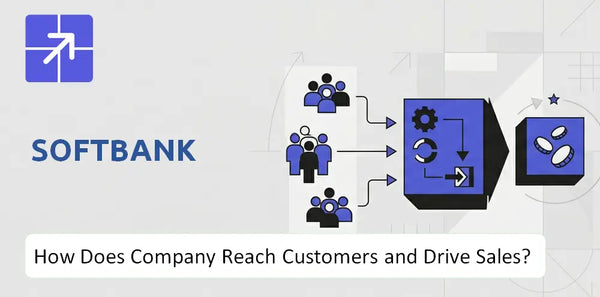
SoftBank pairs concentrated investments with follow-on capital, board influence, and cross-portfolio commercial deals to turn demand into exits and recurring revenue streams; see Softbank BCG Matrix Analysis.
Who Does Softbank Want to Sell To?
SoftBank Group Corp. targets elite tech founders, large institutional investors, and consumer/enterprise customers tied to Arm and SoftBank Corp., aiming to win them with scale capital, Vision Fund structuring and balance-sheet backing, and platform products for enterprise AI and Japanese consumer markets.
 Main customer group: Elite technology founders and management teams
SoftBank customer acquisition centers on high-growth startups and founders needing large-scale capital and global market reach; SoftBank sells its ecosystem – capital, distribution, and Go-to-Market support – to enable rapid scale. In 2025 SoftBank deployed over ¥1.4 trillion from its balance sheet into late-stage tech and AI companies to retain control of outcomes.
Additional target segments: Institutional investors and strategic partners
SoftBank sales strategy historically targeted sovereign wealth funds and pension funds as Vision Fund LPs; by 2025 it shifted to using its own capital while still courting institutional co-investors for risk sharing. The firm also pursues strategic partners – cloud providers, chipmakers – to accelerate portfolio sales through alliances and distribution channels.
Market positioning: Platform owner for AI and semiconductor ecosystems
SoftBank positions itself as a platform owner – backing platform-scale founders, owning Arm (major stake) and SoftBank Corp., and providing capital plus distribution to capture value across hardware, software, and telco stacks. Positioning targets enterprise AI adopters as primary buyers for infrastructure and apps in 2025/2026.
Why this positioning works: Scale, capital depth, and ecosystem reach
SoftBank marketing strategy and sales funnel rely on deep pockets – ¥3.8 trillion available liquidity disclosed in 2025 reports – and portfolio integration to offer faster enterprise AI rollouts and semiconductor IP access. That message appeals to founders and institutional backers seeking rapid market leadership and measurable customer acquisition outcomes.
See further analysis on governance and stakes at Ownership and Control of Softbank Company
Softbank SWOT Analysis
- Complete SWOT Breakdown
- Fully Customizable
- Editable in Excel & Word
- Professional Formatting
- Investor-Ready Format

How Does Softbank Get in Front of Customers?
SoftBank Group Corp. reaches customers through reputation-led venture sourcing, platform ubiquity via Arm, and direct consumer channels in Japan – notably SoftBank Corp.'s retail footprint and PayPay – combining corporate vision, embedded technology, and retail/payment distribution to build awareness, generate demand, and convert transactions.

Vision-Led Deal Flow and Corporate Branding
Masayoshi Son's Artificial Super Intelligence vision acts as a reputation magnet, driving high-value inbound opportunities and allowing SoftBank Group Corp. to secure venture deals without standard competitive auctions; this reputation-led channel is a primary driver of SoftBank customer acquisition at the corporate and portfolio level.
Platform and Digital Reach via Arm
Arm-based architectures power over 99% of the world's smartphones and, as of early 2026, hold a 25% share of cloud data center CPUs, giving SoftBank unmatched digital marketing and online reach into OEM roadmaps, developer ecosystems, and platform distribution channels globally.
Retail and Direct Sales in Japan
SoftBank Corp. operates about 2,300 retail locations across Japan, plus direct carrier sales and channel partners, enabling in-person conversions, device upsells, and subscription activations that feed the SoftBank sales funnel and boost retention and ARPU.
Demand Generation: PayPay and Promotions
PayPay, with over 65 million users, serves as a promotional engine – cashback, merchant partnerships, and in-app campaigns drive transaction volume and cross-sell into telecom services, demonstrating how SoftBank converts demand into sales with data-driven promotions.
Customer Acquisition Efficiency and Data Use
SoftBank leverages device-level and payment-platform data to target offers, shortening acquisition funnels and improving lifetime value; consolidated signals from Arm, SoftBank Corp., and PayPay reduce CAC and increase conversion rates for both B2C and B2B channels.
Scale Advantage: Integrated Reach Across Markets
The most important reach advantage in 2025/2026 is the combination of Arm's global technical ubiquity and SoftBank Corp.'s domestic retail/payments network, giving SoftBank Group Corp. both macro insight into global tech roadmaps and direct contact with nearly half of Japan's population; see related analysis in How Softbank Company Works and Makes Money.
Softbank Business Model Canvas
- One-time Payment
- No Research Needed – Save Hours of Work
- Built by Experts, Trusted by Consultants
- Instant Download, Ready to Use
- 100% Editable, Fully Customizable

How Does Softbank Turn Attention Into Sales?
SoftBank Group Corp. converts attention into sales via licensing royalties, strategic IPOs and secondary sales, and collateralized financing redeployed into AI investments; Arm royalties and portfolio financial engineering are central to turning market interest into recurring and one – off revenue.
High – margin licensing and portfolio monetization
SoftBank relies on a partner – led licensing model for Arm and strategic capital markets exits for its Vision Fund holdings, combining recurring royalties with episodic IPO and secondary sale proceeds to convert attention into cash.
Pricing and monetization logic: royalties, dividends, financing spreads
Arm earns per – chip royalties and license fees; after v9 adoption in 2025 revenue per chip rose by 40%. SoftBank also monetizes stakes via dividends, asset – backed lending using Alibaba and Arm shares as collateral, and selective secondary sales.
Conversion and purchase drivers: credibility, structure, and financing
Market attention converts when SoftBank pairs technology credibility (Arm architecture gains) with financing mechanisms – IPOs, share buybacks, and asset – backed loans – that provide liquidity to realize capital gains and fund new investments.
Repeat revenue and portfolio expansion: royalties plus redeployment
Recurring royalty streams from Arm and dividend income provide steady cash; SoftBank redeploys low – cost financing into high – yield AI opportunities, targeting an IRR of 20%+ across Vision Fund 2 to compound returns and fund further monetization.
SoftBank customer acquisition mixes digital marketing, partner channels, and corporate transactions: retail and carrier channels build consumer reach in Japan and globally while Vision Fund exits and secondary sales crystallize institutional demand into realized gains; see Mission, Vision, and Values of Softbank Company for context.
Key 2025/2026 mechanics and figures: Arm v9 drove a 40% increase in revenue per chip in 2025; SoftBank increasingly used secondary sales and share buybacks across 2025/2026 to extract value when IPO windows were thin; asset – backed lending against Alibaba and Arm reduced financing cost and funded redeployment into AI, aiming for a 20%+ IRR on Vision Fund 2 assets.
Softbank Marketing Mix
- Complete Marketing Mix Analysis
- Effortlessly Communicate Your Business Strategy
- Investor-Ready Format
- 100% Editable and Customizable
- Clear and Structured Layout

How Strong Does Softbank's Commercial Engine Look Going Forward?
SoftBank Group Corp.'s commercial engine looks materially stronger heading into FY2026, backed by a stabilized Loan-to-Value ratio and a growing AI-led earnings base; key supports include liquidity for offensive AI infrastructure bets and Arm's rising profitability, while concentration in AI and geopolitics could weaken demand conversion.
What Supports Future Demand
SoftBank customer acquisition benefits from a 18.5% Loan-to-Value (LTV) as of March 2026, sustaining a $40 billion liquidity cushion for AI infrastructure investments; Arm's projected FY2026 net income above $1.8 billion provides a valuation floor that supports marketing spend and partner confidence.
Channel and Marketing Effectiveness
SoftBank distribution channels combine carrier retail, enterprise sales, and digital marketing to feed a broad SoftBank sales funnel; omnichannel tactics and targeted SoftBank digital marketing campaigns leverage CRM and data analytics to raise conversion rates and retention, especially in Japan and key global markets.
Risks to Commercial Performance
Concentration risk from AI and semiconductors increases exposure to cyclical downturns and geopolitical supply-chain shocks; if Arm or other AI assets underperform, SoftBank sales strategy and partner-led customer acquisition could face downgrades and slower conversion rates.
The Overall Sales and Marketing Outlook
Outlook for SoftBank marketing strategy in 2025/2026 is one of Aggressive Stability: well-funded, focused on AI-driven product-market fit, and capable of scaling via partnerships and the SoftBank Vision Fund, but still vulnerable to sector concentration and external shocks; see Competitive Landscape of Softbank Company for context: Competitive Landscape of Softbank Company.
Softbank Boston Consulting Group Matrix
- Built by Experts, Trusted by Consultants
- Structured for Consultants, Students, and Founders
- 100% Editable in Microsoft Word & Excel
- Instant Digital Download – Use Immediately
- Compatible with Mac & PC – Fully Unlocked

Related Blogs
- What Is the History of Softbank Company and How Did It Evolve?
- What Is the Competitive Landscape of Softbank Company and How Does It Compete?
- What Is the Growth Outlook of Softbank Company and Where Is It Heading?
- How Does Softbank Company Work and What Drives Its Business Model?
- What Do the Mission, Vision, and Core Values of Softbank Company Reveal?
- Who Are the Core Customers in Softbank Company's Target Market?
- Who Owns Softbank Company Today and Who Holds Control?
Frequently Asked Questions
Softbank targets elite technology founders, institutional investors, and consumer and enterprise customers tied to Arm and SoftBank Corp. It sells capital, distribution, and go-to-market support to help startups scale, while also reaching strategic partners and enterprise AI buyers through its platform and balance-sheet strength.
Disclaimer
All information, articles, and product details provided on this website are for general informational and educational purposes only. We do not claim any ownership over, nor do we intend to infringe upon, any trademarks, copyrights, logos, brand names, or other intellectual property mentioned or depicted on this site. Such intellectual property remains the property of its respective owners, and any references here are made solely for identification or informational purposes, without implying any affiliation, endorsement, or partnership.
We make no representations or warranties, express or implied, regarding the accuracy, completeness, or suitability of any content or products presented. Nothing on this website should be construed as legal, tax, investment, financial, medical, or other professional advice. In addition, no part of this site - including articles or product references - constitutes a solicitation, recommendation, endorsement, advertisement, or offer to buy or sell any securities, franchises, or other financial instruments, particularly in jurisdictions where such activity would be unlawful.
All content is of a general nature and may not address the specific circumstances of any individual or entity. It is not a substitute for professional advice or services. Any actions you take based on the information provided here are strictly at your own risk. You accept full responsibility for any decisions or outcomes arising from your use of this website and agree to release us from any liability in connection with your use of, or reliance upon, the content or products found herein.