
How does SpaceX's sales and marketing model convert launch demand and Starlink subscriptions into revenue?
SpaceX pairs direct government and commercial launch contracts with recurring Starlink subscriptions to fund Starship development. This hybrid model matters because rapid reuse and subscriber growth drove a $210,000,000,000 valuation signal in early 2026, showing scale economics and pricing power.
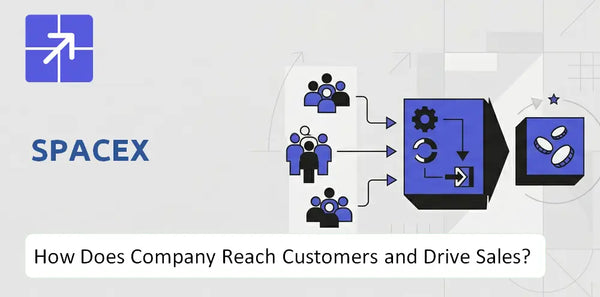
SpaceX targets prime customers via long-term government deals and bulk commercial agreements, then upsells satellite internet to broader markets. Also track launch cadence and Starlink user growth as practical demand indicators. SpaceX BCG Matrix Analysis
Who Does SpaceX Want to Sell To?
SpaceX sells to three core groups: government and defense agencies, commercial satellite operators, and Starlink end users (residential, enterprise, and military). It wins them through contract-based government sales, competitively priced orbital launches, and Starlink subscriptions and enterprise agreements.
 Primary buyer: Government and Defense
Government and defense agencies (NASA, U.S. Space Force, allied space programs) supply high-value, multi-year contracts for ISS resupply, crew transport, and classified national-security payloads. By FY2025 SpaceX captured $6.8 billion in U.S. government launch and services awards, anchoring revenue and providing steady backlog.
Secondary buyers: Commercial satellite operators
Commercial satellite operators demand frequent, reliable access to LEO and GTO. SpaceX targets them with a lower per-kg pricing model enabled by reusable Falcon 9 and Falcon Heavy, winning roughly 60 – 70% share of commercial launches by manifest in 2025 and offering bundled mission assurance and rideshare options.
Growth segment: Starlink consumers and enterprises
Starlink targets residential consumers in underserved regions, enterprise customers in maritime and aviation, and military/tactical users via Starshield. As of March 2026 Starlink reported >3.8 million subscribers and increasing ARPU from enterprise and mobility contracts.
Market positioning: Low-cost, high-frequency access and resilient connectivity
SpaceX positions itself as the lowest-cost-per-kg launch provider and a vertically integrated connectivity supplier through Starlink. This SpaceX marketing strategy and sales model emphasizes pricing enabled by reusable rockets and direct sales to large buyers.
Why the positioning works
Reusability cuts marginal launch cost, enabling competitive SpaceX pricing strategy for commercial launches and rapid cadence that customers value. For Starlink, direct subscription channels, enterprise SLAs, and Starshield for defense create diversified revenue and higher willingness to pay in mobility and enterprise segments.
How SpaceX converts demand into sales
Sales flow: government procurement via awarded contracts, commercial direct sales and brokered manifest slots, and online/partner subscriptions for Starlink. For details on the broader business model see How SpaceX Company Works and Makes Money.
SpaceX SWOT Analysis
- Complete SWOT Breakdown
- Fully Customizable
- Editable in Excel & Word
- Professional Formatting
- Investor-Ready Format

How Does SpaceX Get in Front of Customers?
SpaceX gets in front of customers through institutional prestige for launch contracts and a direct digital sales model for Starlink; it pairs a specialized BD (business development) salesforce with online self-service and B2B partnerships to build awareness, convert demand, and onboard users.

Flight heritage as the primary acquisition channel
SpaceX marketing strategy centers on its flight record: a company-reported 148 successful launches in 2025 drives credibility that converts into long-term commercial and government contracts via a targeted business development team and proposal pipeline.
Digital marketing and direct online reach for Starlink
SpaceX sales model for Starlink bypasses retail: the company uses a streamlined website, app-based onboarding, email nurture, and organic social proof to convert users; by Q1 2026 Starlink exceeded 5.5 million active subscribers, largely via word-of-mouth and product performance.
Sales channels and distribution access via B2B partnerships
Commercial launch sales use direct contracting and long-tail relationship management with satellite operators; Starlink expands reach through partnerships with airlines for in – flight Wi – Fi and carriers like T – Mobile for direct-to-cell services, reducing dependency on physical channels.
Demand generation tactics that scale
SpaceX leverages mission publicity, launch livestreams, customer case studies, and technical demonstrations rather than paid consumer advertising; events and product reliability act as demand multipliers for both launches and Starlink subscriptions.
Customer acquisition efficiency and unit economics
SpaceX customer acquisition relies on low paid CAC for Starlink (heavy organic growth) and high contract value for launches; reusable rockets and flight cadence improve pricing flexibility and reduce marginal cost per launch, tightening sales economics for commercial customers.
Most important reach advantage in 2025/2026
The strongest reach advantage is technical credibility: record launch cadence and reusable-rocket cost improvements make SpaceX the default choice for many satellite operators and governments, while Starlink's demonstrated service quality drives referral-led growth. See the company mission for context: Mission, Vision, and Values of SpaceX Company
SpaceX Business Model Canvas
- One-time Payment
- No Research Needed – Save Hours of Work
- Built by Experts, Trusted by Consultants
- Instant Download, Ready to Use
- 100% Editable, Fully Customizable

How Does SpaceX Turn Attention Into Sales?
SpaceX turns attention into sales by undercutting legacy launch providers by 30 – 50% and locking customers with predictable flight cadence for launches and subscription-based Starlink hardware plus recurring service fees.
Core sales model: direct contract and subscription-led
SpaceX sells launch services primarily through direct B2B contracts with satellite operators, governments, and large commercial customers while Starlink uses direct-to-consumer and enterprise subscriptions with hardware as the on-ramp. The sales model mixes fixed-price contracts, multi-launch agreements, and subscription billing to convert leads into binding revenue streams.
Pricing and monetization logic: low-cost access plus recurring fees
SpaceX targets 30 – 50% lower pricing versus legacy providers on Falcon 9 launches while preserving margins through hardware reusability; Starlink monetizes via subscription plans and one-time terminal sales that transitioned to hardware-level profitability by 2025. Tiered data plans and premium SLAs create upsell lanes for maritime, aviation, and enterprise customers.
Conversion and purchase drivers: predictability, cadence, and cost
Predictable, frequent Falcon 9 flights make SpaceX the de facto utility for space access; this reliability, combined with multi-billion dollar backlog visibility as of 2025, short sales cycles for routine launches and strong government contracts accelerate conversion. Starlink converts interest via demos, targeted enterprise pilots, and channel sales for maritime and aviation integrators.
Repeat revenue and customer expansion: subscriptions and high switching costs
Starlink's subscription model ensures recurring revenue and high retention as terminals become embedded in critical infrastructure; by 2025 hardware profitability plus tiered pricing drives expansion revenue through add-ons and premium tiers. Long-term government and commercial launch customers sign multi-launch and multi-year agreements, yielding steady repeat revenue.
Relevant mechanics and resources: SpaceX marketing strategy focuses on predictable launch cadence and pricing that targets commercial launch sales and government contracts; see Target Customers and Market of SpaceX Company for market segmentation and buyer profiles: Target Customers and Market of SpaceX Company
SpaceX Marketing Mix
- Complete Marketing Mix Analysis
- Effortlessly Communicate Your Business Strategy
- Investor-Ready Format
- 100% Editable and Customizable
- Clear and Structured Layout

How Strong Does SpaceX's Commercial Engine Look Going Forward?
SpaceX's commercial engine enters 2025/2026 with unprecedented scale and a projected annual revenue run rate above 20 billion dollars, driven by Starship scaling, Starlink growth, and defense contracts; regulatory risk and orbital congestion could weaken demand, while direct-to-cell and Starshield lift the revenue floor.
Starship scale and Starlink backbone support future demand
Starship promises an order-of-magnitude cut in cost per kilogram to orbit, shifting SpaceX marketing strategy and pricing power; Starlink adds recurring telecom revenue with >4 million subscribers by late 2025. Direct-to-cell trials and Starshield defense contracts diversify demand beyond commercial launch sales.
Channel and marketing effectiveness: direct sales plus partner motions
SpaceX sales model mixes direct B2B outreach for commercial launches and government contracts with digital marketing and PR for Starlink customer acquisition; strong brand and price advantage lift conversion for satellite operators and startups buying launch services.
Risks to commercial performance: regulation, congestion, and execution
Regulatory scrutiny over spectrum and orbital debris, launch failures, and congested low Earth orbit could compress margins and slow Starship ramp; reliance on continued rapid Starlink subscription growth is also a vulnerability.
Overall sales and marketing outlook for 2025/2026
Outlook appears strong and adaptable: with >20 billion dollars run rate, unmatched launch cadence, and growing recurring Starlink and Starshield revenues, SpaceX is positioned to convert launch demand into long-term contracts despite identifiable regulatory and congestion risks. Read more on company origins in History and Background of SpaceX Company
SpaceX Boston Consulting Group Matrix
- Built by Experts, Trusted by Consultants
- Structured for Consultants, Students, and Founders
- 100% Editable in Microsoft Word & Excel
- Instant Digital Download – Use Immediately
- Compatible with Mac & PC – Fully Unlocked

Related Blogs
- What Is the History of SpaceX Company and How Did It Evolve?
- What Is the Competitive Landscape of SpaceX Company and How Does It Compete?
- What Is the Growth Outlook of SpaceX Company and Where Is It Heading?
- How Does SpaceX Company Work and What Drives Its Business Model?
- What Do the Mission, Vision, and Core Values of SpaceX Company Reveal?
- Who Are the Core Customers in SpaceX Company's Target Market?
- Who Owns SpaceX Company Today and Who Holds Control?
Frequently Asked Questions
SpaceX mainly sells to government and defense agencies, commercial satellite operators, and Starlink end users. The blog explains that these buyers are reached through contract-based government sales, competitively priced launches, and direct Starlink subscriptions and enterprise agreements. Those three groups form the core of its demand and sales model.
Disclaimer
All information, articles, and product details provided on this website are for general informational and educational purposes only. We do not claim any ownership over, nor do we intend to infringe upon, any trademarks, copyrights, logos, brand names, or other intellectual property mentioned or depicted on this site. Such intellectual property remains the property of its respective owners, and any references here are made solely for identification or informational purposes, without implying any affiliation, endorsement, or partnership.
We make no representations or warranties, express or implied, regarding the accuracy, completeness, or suitability of any content or products presented. Nothing on this website should be construed as legal, tax, investment, financial, medical, or other professional advice. In addition, no part of this site - including articles or product references - constitutes a solicitation, recommendation, endorsement, advertisement, or offer to buy or sell any securities, franchises, or other financial instruments, particularly in jurisdictions where such activity would be unlawful.
All content is of a general nature and may not address the specific circumstances of any individual or entity. It is not a substitute for professional advice or services. Any actions you take based on the information provided here are strictly at your own risk. You accept full responsibility for any decisions or outcomes arising from your use of this website and agree to release us from any liability in connection with your use of, or reliance upon, the content or products found herein.