
How does ST Engineering's sales and marketing model convert technical competence into sustained contracts?
ST Engineering sells through technical integration, long-term contracts, and stakeholder alignment across Commercial Aerospace, Defense and Public Security, and Urban Solutions and Satcom. This matters because the firm's multi-year order book and 2025 backlog growth drive revenue predictability and investor confidence.
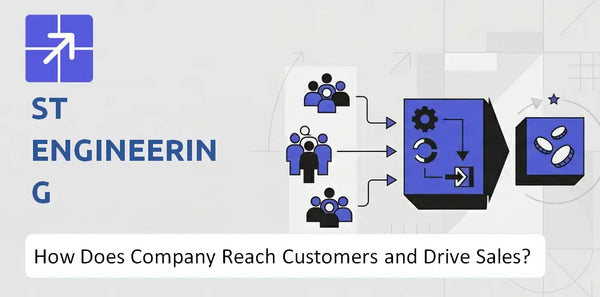
Focus on program-level account teams and lifecycle services to close deals and secure recurring revenue; tie proposals to capability demos and trials. See ST Engineering BCG Matrix Analysis
Who Does ST Engineering Want to Sell To?
ST Engineering wants to sell to three high-value buyer groups: sovereign defense customers, global commercial airlines/lessors, and municipal transport authorities. The company wins them by offering lifecycle contracts, technological sovereignty, and high-reliability engineering that justify long-term service agreements.
 Primary buyers: Sovereign governments and defense ministries
ST Engineering targets defense buyers in the Asia-Pacific, Middle East, and North America who buy naval platforms, armored vehicles, radar and cybersecurity systems. These customers value long-term lifecycle support and sovereign-capability transfer; recent 2025 defence contracts accounted for a material portion of the firm's group order book exceeding US$5.2 billion.
Secondary buyers: Global airlines and aircraft lessors
ST Engineering pursues major carriers, freighter operators and lessors (examples include integrators like DHL and Amazon Air) for Passenger-to-Freighter conversions and MRO services. In 2025 MRO and conversions drove steady revenue with aftermarket contracts representing roughly 30% of aerospace segment revenues, reflecting the company's ST Engineering marketing and demand generation in aerospace.
Additional buyers: Municipal authorities and transport operators
Urban clients buy smart-city tech – electronic tolling, traffic management, and rail signalling – where ST Engineering sells integrated systems plus multi-year service contracts. These deals align with the company's ST Engineering sales strategy emphasizing recurring revenue and aftersales service that boosts retention and lifecycle value.
Market positioning: High-reliability, lifecycle partner
ST Engineering positions itself as a trusted systems integrator and lifecycle partner for capital-intensive clients, competing on engineering depth, certifications, and end-to-end delivery. The go-to-market mix uses direct government contracting, strategic reseller partnerships, and targeted events to fill a B2B sales pipeline.
Why this positioning works: Capital depth and long contracts
Clients with budget certainty and procurement cycles prefer vendors offering technology transfer and service guarantees; ST Engineering converts leads into sales via tailored bids, performance-based warranties, and CRM-led pipeline management. The firm's focus on technological sovereignty and decade-long service agreements supports higher contract values and predictable revenue.
Practical reach and channels
ST Engineering uses government procurement processes, aerospace MRO networks, reseller programs, and trade shows to generate demand. Measurable tactics include CRM sales pipeline tracking, lead nurturing, and aftersales KPIs that reduce customer acquisition cost and improve ROI for large contracts. See the company overview for strategic context: Mission, Vision, and Values of ST Engineering Company
ST Engineering SWOT Analysis
- Complete SWOT Breakdown
- Fully Customizable
- Editable in Excel & Word
- Professional Formatting
- Investor-Ready Format

How Does ST Engineering Get in Front of Customers?
ST Engineering gets in front of customers via direct B2G sales, a global physical MRO and JV footprint, targeted trade shows, and growing digital lead-generation from Smart City and AI platforms; these channels build awareness, generate demand, and convert long procurement cycles into contracts.

Defense-focused direct B2G engagement
ST Engineering marketing centers on multi-year, relationship-driven government procurement. The defense sales strategy relies on direct proposals, capability demonstrations at expos, and long procurement dialogues that convert through accredited certifications and local offsets.
Digital marketing and platform-led proof-of-concept
ST Engineering uses Smart City pilots and AI analytics to generate digital leads; proof-of-concept data is shared with urban planners and transport ministers to shorten evaluation cycles. Content, email outreach, and targeted LinkedIn campaigns feed the CRM pipeline for follow-up.
Global MRO network and joint ventures
The aerospace sales channels include airframe MRO facilities across the United States, Europe, and Asia, placing services near major fleets. Strategic partnerships like Elbe Flugzeugwerke capture European freighter-conversion demand and expand reseller and channel programs.
Events, expos, and demonstrations
Trade shows such as the Singapore Airshow and AUSA are core ST Engineering demand generation tactics; live demos and booth engagements drive RFPs. For 2025, management reported trade-show wins accounted for a meaningful share of new defense bids.
Sales pipeline and lead-nurturing efficiency
ST Engineering CRM sales pipeline management focuses on long sales cycles: multi-stage nurturing, technical evaluation support, and local-prime teaming. Reported 2025 backlog and contract wins show disciplined conversion rates in defense and aerospace segments.
Most important reach advantage: global physical footprint
The strongest reach advantage is ST Engineering sales channels and on-the-ground presence – MRO hubs, local JVs, and government relationships – enabling proximity to customers and faster post-sale support; this drives recurring revenue and aftersales retention.
For more on overall commercial strategy and 2025 positioning see Growth Outlook of ST Engineering Company
ST Engineering Business Model Canvas
- One-time Payment
- No Research Needed – Save Hours of Work
- Built by Experts, Trusted by Consultants
- Instant Download, Ready to Use
- 100% Editable, Fully Customizable

How Does ST Engineering Turn Attention Into Sales?
ST Engineering turns market attention into sales through disciplined bidding, long-term service contracts, and product-led integration that locks in multi-year revenue streams. The company leverages a record order book and performance-based contracting to convert leads into predictable cash flows.
Core sales model: contract-led, project and services sales
ST Engineering sells primarily via direct, contract-led B2B and government procurement channels, winning work through competitive bids and public tenders tied to long-term service agreements and performance metrics.
Pricing and monetization logic: LTSAs with mixed pricing
Pricing mixes cost-plus and fixed-price elements inside long-term service agreements (LTSAs), plus performance incentives; this structure hedges inflation and creates recurring service revenue over contract lives.
Conversion and purchase drivers: order book, bids, and performance contracting
Conversion relies on a rigorous bidding process, proven delivery track record, and growing emphasis on performance-based contracting; a record order book of S$28.2 billion (early 2026) turns today's wins into years of recognized revenue.
Repeat revenue and customer expansion: integrations, upsells, and maintenance
ST Engineering locks recurring revenue via proprietary integrations (eg, TransCore tolling within Urban Solutions), maintenance LTSAs, and Smart MRO upsells – selling data analytics with mechanical MRO to boost airline fleet availability and aftersales retention.
Key mechanics: high switching costs from integrated software (TransCore tolling), LTSA pricing that blends fixed and cost-plus elements, and a shift to performance-based contracts that tie payments to outcomes; these reduce churn and increase lifetime value. See a company overview here: History and Background of ST Engineering Company
ST Engineering Marketing Mix
- Complete Marketing Mix Analysis
- Effortlessly Communicate Your Business Strategy
- Investor-Ready Format
- 100% Editable and Customizable
- Clear and Structured Layout

How Strong Does ST Engineering's Commercial Engine Look Going Forward?
ST Engineering's commercial engine enters 2025/2026 with high revenue visibility and improving margins, driven by rising widebody MRO demand and stronger defense budgets; key risks are supply-chain volatility and labor cost inflation, though contractual escalation clauses and a book-to-bill >1.0x support resilience.
Demand drivers supporting future revenue
Brand strength in aerospace and defense, long-term service contracts, and diversified government procurement pipelines underpin demand; international widebody MRO recovery and global defense spending growth are central to ST Engineering marketing and demand generation.
Channel and marketing effectiveness
ST Engineering sales strategy uses direct government contracting, OEM partnerships, and authorized resellers to reach markets; digital lead generation, trade-show presence, and CRM-driven pipeline management sustain customer acquisition and conversion.
Risks to commercial performance
Supply-chain disruptions, higher labor and raw-material costs, and execution risk from M&A integration could pressure margins; sustained backlog concentration in a few large customers elevates revenue volatility despite contract escalation clauses mitigating pass-through risk.
Overall sales and marketing outlook for 2025/2026
Outlook appears strong and adaptable: Group revenue is projected above S$11.8 billion for 2025 with targeted EBIT margin expansion toward 11-12 percent, and management guidance implies mid-to-high single-digit organic growth supported by a book-to-bill ratio consistently above 1.0x. For practical details on target segments and procurement routes see Target Customers and Market of ST Engineering Company.
ST Engineering Boston Consulting Group Matrix
- Built by Experts, Trusted by Consultants
- Structured for Consultants, Students, and Founders
- 100% Editable in Microsoft Word & Excel
- Instant Digital Download – Use Immediately
- Compatible with Mac & PC – Fully Unlocked

Related Blogs
- What Is the History of ST Engineering Company and How Did It Evolve?
- What Is the Competitive Landscape of ST Engineering Company and How Does It Compete?
- What Is the Growth Outlook of ST Engineering Company and Where Is It Heading?
- How Does ST Engineering Company Work and What Drives Its Business Model?
- What Do the Mission, Vision, and Core Values of ST Engineering Company Reveal?
- Who Are the Core Customers in ST Engineering Company's Target Market?
- Who Owns ST Engineering Company Today and Who Holds Control?
Frequently Asked Questions
ST Engineering mainly sells to sovereign defense customers, global commercial airlines and lessors, and municipal transport authorities. The article explains that these buyers value lifecycle contracts, technological sovereignty, and high-reliability engineering, which helps ST Engineering turn long procurement cycles into long-term service agreements.
Disclaimer
All information, articles, and product details provided on this website are for general informational and educational purposes only. We do not claim any ownership over, nor do we intend to infringe upon, any trademarks, copyrights, logos, brand names, or other intellectual property mentioned or depicted on this site. Such intellectual property remains the property of its respective owners, and any references here are made solely for identification or informational purposes, without implying any affiliation, endorsement, or partnership.
We make no representations or warranties, express or implied, regarding the accuracy, completeness, or suitability of any content or products presented. Nothing on this website should be construed as legal, tax, investment, financial, medical, or other professional advice. In addition, no part of this site - including articles or product references - constitutes a solicitation, recommendation, endorsement, advertisement, or offer to buy or sell any securities, franchises, or other financial instruments, particularly in jurisdictions where such activity would be unlawful.
All content is of a general nature and may not address the specific circumstances of any individual or entity. It is not a substitute for professional advice or services. Any actions you take based on the information provided here are strictly at your own risk. You accept full responsibility for any decisions or outcomes arising from your use of this website and agree to release us from any liability in connection with your use of, or reliance upon, the content or products found herein.