
How does Telia Company's sales and marketing model convert Nordic and Baltic demand into subscriptions and revenue?
Telia Company shifted to a decentralized, digital-first sales model to convert 5G and fiber investment into subscriptions and higher ARPU. Early 2026 data show local units driving faster rollouts and improved customer retention, cutting sales cycles and boosting service margins.
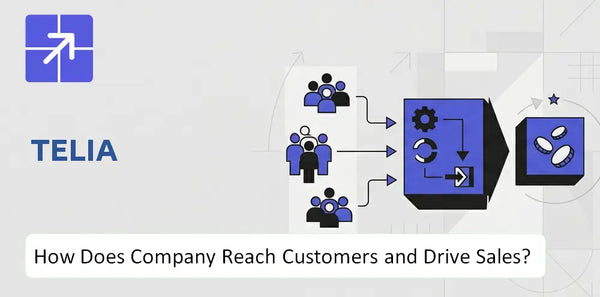
Focus on local channels, digital funnels, and partner ecosystems to shorten conversion time and lift lifetime value; link to deeper product analysis: Telia BCG Matrix Analysis
Who Does Telia Want to Sell To?
Telia Company wants to sell to two clear groups: premium Nordic households that pay for reliable converged services, and digitally-dependent enterprises needing mission-critical 5G, IoT, and managed connectivity. The company prioritizes high-ARPU, low-price-sensitivity segments and measures success by customer lifetime value.
 Main target: Premium Nordic consumers
Telia Company targets households with above-average spending on telecom: affluent, urban, and family households that buy converged bundles (mobile, broadband, TV) and value uptime. In 2025 Telia reported consumer ARPU stability with average monthly ARPU around SEK 300 – 350 in key Nordic markets, driving acquisition via omnichannel retail and digital channels.
Secondary target: Large enterprises & public sector
Telia Company focuses on public agencies and large manufacturers/logistics firms that require private 5G, IoT platforms, and SLAs for uptime and security. Enterprise revenue emphasis grew in 2025, with managed services and B2B connectivity representing a double-digit share of service revenue and higher gross margins per contract.
Market positioning: Reliability and converged value
Telia Company positions itself as the premium, secure network provider in the Nordics, selling on network quality, integrated bundles, and enterprise-grade SLAs. Positioning is supported by continued fiber and 5G investments: capital expenditure in 2025 remained near SEK 10 – 12 billion to sustain network leadership.
Why this positioning works
Focusing on less price-sensitive customers raises customer lifetime value; Telia reported improved retention metrics in 2025 after shifting KPIs from volume to CLV. The message – secure, reliable connectivity with local support – resonates with public sector buyers and high-ARPU households, especially when backed by CRM personalization, loyalty offers, and targeted advertising across Telia digital channels.
Competitive Landscape of Telia Company
Telia SWOT Analysis
- Complete SWOT Breakdown
- Fully Customizable
- Editable in Excel & Word
- Professional Formatting
- Investor-Ready Format

How Does Telia Get in Front of Customers?
Telia Company gets in front of customers via an omnichannel mix: a legacy retail footprint plus a digital-first funnel that drives awareness, generates demand, and converts sales through personalized AI-driven touchpoints and direct enterprise engagement.

Main Acquisition Channel: Digital-First Self-Service
Digital channels are the primary acquisition engine: in 2025 over 65 percent of consumer sales interactions occur online via AI-enhanced portals and apps that auto-personalize offers from usage data, lowering cost-to-acquire and speeding conversions.
Digital Marketing and Online Reach
Telia Company uses search, paid media, social, email, apps, and platform partnerships to push targeted advertising and content; CRM-driven segmentation and real-time analytics power personalization and conversion optimization across channels.
Sales Channels and Distribution Access
Physical retail outlets remain for device sales and service; a specialized direct sales force handles enterprise deals, while retailer partnerships and online marketplaces extend reach – 5G coverage (> 95 percent population in core markets) is used as a distribution and sales differentiator.
Demand Generation Tactics
Campaigns combine 5G product launches, promotional pricing, targeted ads, events, and influencer outreach; seasonal bundles and loyalty incentives drive short-term uptake and higher ARPU through upsell mechanics.
Customer Acquisition Efficiency
Automation and AI reduce onboarding friction; Telia reports improved digital conversion rates and lower CAC relative to legacy channels in 2025 as self-service share surpassed 65 percent, improving unit economics for consumer subscriptions.
Most Important Reach Advantage
Network leadership – extensive 5G reach plus integrated B2B service offerings – remains the strongest advantage, attracting tech-forward consumers and enterprises seeking turnkey connectivity embedded in digital transformation projects. See more on historical context in History and Background of Telia Company.
Telia Business Model Canvas
- One-time Payment
- No Research Needed – Save Hours of Work
- Built by Experts, Trusted by Consultants
- Instant Download, Ready to Use
- 100% Editable, Fully Customizable

How Does Telia Turn Attention Into Sales?
Telia Company turns attention into sales by bundling services (convergence) and indexing prices while migrating legacy customers to fiber and 5G FWA, converting interest into higher ARPU and multi-year contracts across consumer and B2B segments.
Core sales model: Convergence-led omnichannel selling
Telia Company uses an omnichannel mix of direct sales, retail stores, digital self-serve, and partner-led distribution to sell subscriptions and hardware. Convergence – bundling mobile, fixed broadband, and TV – forms the backbone of the sales approach and lowers churn.
Pricing and monetization logic: More-for-more plus indexation
Telia applies a more-for-more pricing strategy: tiered bundles charge premium prices for higher speed and integrated services. For 2025/2026 Telia uses price indexation and migration from copper to fiber and 5G FWA to lift service revenue and protect margins.
Conversion and purchase drivers: Convergence, contracts, and managed services
Convergence drives conversion: bundled offers create stickiness and reduce churn by 15 – 20% versus single-play customers. In B2B, managed services (cybersecurity, cloud integration) convert interest into multi-year contracts and raise switching costs.
Repeat revenue and customer expansion: Upsell, renewals, and ecosystem services
Telia focuses on upsell (higher-speed fiber, 5G FWA, value-added services) and cross-sell within its ecosystem to increase ARPU. For 2025 Telia reports service revenue growth driven by migration off copper and higher take-rates for converged bundles.
Sales mechanics in practice: Telia CRM and personalization segment high-value prospects, run targeted advertising across digital channels and retail, and push promotions that move legacy copper users to fiber or 5G FWA. The result: stabilized subscriber base in a mature market and measurable revenue uplift from fewer churn events and longer contract durations; see operational context in this article on company strategy: How Telia Company Works and Makes Money
Telia Marketing Mix
- Complete Marketing Mix Analysis
- Effortlessly Communicate Your Business Strategy
- Investor-Ready Format
- 100% Editable and Customizable
- Clear and Structured Layout

How Strong Does Telia's Commercial Engine Look Going Forward?
The commercial engine of Telia Company looks stable and more efficient heading into 2026, supported by cost cuts, portfolio simplification, and steady cash generation; main supports are brand reach and streamlined operations, while competition in Finland and TV & Media volatility could weaken near-term sales.
What Supports Future Demand
Telia Company customer acquisition benefits from a recognizable Nordic brand, broad telco footprint, and improved product-market fit after the 2024-2025 simplification that removed ~3,000 roles and rationalized offerings. Strong mobile and fixed broadband penetration and a focus on enterprise B2B follow-through underpin recurring revenue and higher conversion from demand to subscriptions.
Channel and Marketing Effectiveness
Telia omnichannel marketing mixes retail stores, digital channels, and partner distribution; digital sales and CRM and personalization drive online-to-offline journeys and improve checkout conversion. Ongoing investment kept Capex-to-sales near 15 percent in 2025 while EBITDA margin expanded, indicating disciplined spend on Telia digital channels and targeted advertising strategies for subscriber growth.
Risks to Commercial Performance
Intense competition in Finland pressures pricing and ARPU (average revenue per user); TV and Media unit volatility can dent overall margin and promotional needs may rise. Macroeconomic headwinds or slower 5G uptake would slow how Telia converts mobile data demand into subscriptions and strain promotional pricing and conversion rate optimization.
Overall Sales and Marketing Outlook
The outlook for 2025/2026 is one of stability and efficiency: core telecom cash flow is robust, dividend policy is supported, and the leaner operating model should defend premium pricing. Execution risk remains in consumer media and competitive markets, but Telia distribution and partnerships plus CRM personalization efforts give a clear playbook to sustain growth; see Target Customers and Market of Telia Company for related market detail: Target Customers and Market of Telia Company
Telia Boston Consulting Group Matrix
- Built by Experts, Trusted by Consultants
- Structured for Consultants, Students, and Founders
- 100% Editable in Microsoft Word & Excel
- Instant Digital Download – Use Immediately
- Compatible with Mac & PC – Fully Unlocked

Related Blogs
- What Is the History of Telia Company and How Did It Evolve?
- What Is the Competitive Landscape of Telia Company and How Does It Compete?
- What Is the Growth Outlook of Telia Company and Where Is It Heading?
- How Does Telia Company Work and What Drives Its Business Model?
- What Do the Mission, Vision, and Core Values of Telia Company Reveal?
- Who Are the Core Customers in Telia Company's Target Market?
- Who Owns Telia Company Today and Who Holds Control?
Frequently Asked Questions
Telia wants to sell to premium Nordic households and digitally dependent enterprises. The company focuses on customers who value reliable converged services, mission-critical connectivity, and higher service quality rather than low prices. Its targets include affluent consumers, public agencies, manufacturers, logistics firms, and other buyers needing 5G, IoT, and managed connectivity.
Disclaimer
All information, articles, and product details provided on this website are for general informational and educational purposes only. We do not claim any ownership over, nor do we intend to infringe upon, any trademarks, copyrights, logos, brand names, or other intellectual property mentioned or depicted on this site. Such intellectual property remains the property of its respective owners, and any references here are made solely for identification or informational purposes, without implying any affiliation, endorsement, or partnership.
We make no representations or warranties, express or implied, regarding the accuracy, completeness, or suitability of any content or products presented. Nothing on this website should be construed as legal, tax, investment, financial, medical, or other professional advice. In addition, no part of this site - including articles or product references - constitutes a solicitation, recommendation, endorsement, advertisement, or offer to buy or sell any securities, franchises, or other financial instruments, particularly in jurisdictions where such activity would be unlawful.
All content is of a general nature and may not address the specific circumstances of any individual or entity. It is not a substitute for professional advice or services. Any actions you take based on the information provided here are strictly at your own risk. You accept full responsibility for any decisions or outcomes arising from your use of this website and agree to release us from any liability in connection with your use of, or reliance upon, the content or products found herein.