
How does Terna Energy S.A. convert project pipelines into sales through its integrated sales and marketing model?
Terna Energy S.A. ties development, financing, and asset management to secure long-term offtake and maximize revenue per MW. This matters because Terna's €5.5 billion 2025 – 2029 investment plan depends on high-yield PPAs and merchant exposure trends seen in 2025 market signals.
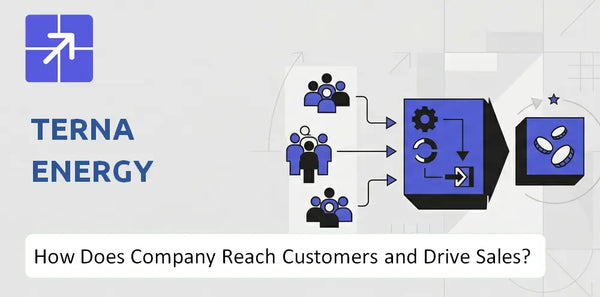
Focus commercial teams on PPA origination and corporate sourcing; use merchant hedges to smooth cash flow. See product insight: Terna Energy BCG Matrix Analysis
Who Does Terna Energy Want to Sell To?
TERNA ENERGY S.A. targets sovereign/institutional tender winners, high-credit corporate off-takers for private PPAs, and merchant buyers in the wholesale Pool to convert demand into secured and market-driven sales.
 Primary buyer: Government-backed and institutional off-takers
TERNA ENERGY wins Feed-in-Premium tenders to secure long-term cash flow visibility needed for project finance; as of 2025 it held over 1.4 GW of contracted capacity under public support mechanisms in Greece and selected EU markets, reducing merchant exposure and lowering financing costs.
Secondary buyer: Large corporate and industrial off-takers
TERNA ENERGY pursues corporate PPAs with high-credit clients to meet ESG targets and hedge price risk; in 2025 the company reported that bilateral contracts accounted for ~28% of its electricity sales portfolio, targeting creditworthy corporates to improve revenue predictability.
Tertiary buyer: Wholesale Pool and merchant market
TERNA ENERGY sells residual output into the Pool to optimize short-term margins; merchant revenues remain managed via hedging and flexible dispatch, with merchant exposure trimmed to ~22% of generation in 2025 to balance upside and volatility.
Market positioning: Integrated renewable developer and PPA counterparty
TERNA ENERGY positions itself as a reliable developer-counterparty offering turnkey EPC experience plus long-term offtake, targeting procurement teams and sovereign buyers; its sales pitch emphasizes bankable contracts and execution track record to win tenders and PPAs.
Why this positioning works: credit, scale, and contracting flexibility
Buyers choose TERNA ENERGY for bankable contracts, scale (project pipeline > 3.2 GW by 2025), and flexible sales channels – public tenders, negotiated PPAs, and Pool participation – reducing counterparty risk and aligning with corporate procurement and sovereign procurement rules. Read a focused market profile: Target Customers and Market of Terna Energy Company
Sales implications: targeting and channel mix
Sales teams prioritize high-credit corporate outreach, tender bidding units, and real-time trading desks; CRM-led lead management tracks PPA negotiations, while digital marketing and partnerships with utilities drive lead generation for solar and wind projects – improving Terna Energy customer acquisition and Terna Energy sales conversion rates.
Terna Energy SWOT Analysis
- Complete SWOT Breakdown
- Fully Customizable
- Editable in Excel & Word
- Professional Formatting
- Investor-Ready Format

How Does Terna Energy Get in Front of Customers?
TERNA ENERGY S.A. reaches customers via national regulatory auctions, direct B2B sales, Energy Management & Trading services, and strategic grid projects; these channels build awareness, generate demand, and convert large corporate and utility needs into signed contracts.

Auctions and Regulatory Tenders Drive Large-Scale Wins
TERNA ENERGY S.A. focuses on national regulatory auctions and competitive tenders to secure capacity and offtake, capturing utility-scale contracts that form the backbone of Terna Energy customer acquisition; in 2025 the company leverages its >2.5 GW operational capacity to win sizeable bids.
Digital and Analyst-Facing Outreach
The company uses targeted digital channels – investor relations content, technical whitepapers, LinkedIn for corporate outreach, and search-optimized content – to support renewable energy marketing strategies and Terna Energy digital marketing tactics for renewables, feeding the sales funnel for PPAs.
Direct B2B Sales and Trading Desk Access
Direct sales teams and the Energy Management and Trading division enable bilateral Power Purchase Agreement sales and cross-border flows, so corporations and utilities access tailored supply; this is Terna Energy sales conversion at scale via negotiated PPAs.
Demand Generation via Strategic Grid Projects
High-profile projects like the Amfilochia pumped storage plant position TERNA ENERGY S.A. as a grid-stability partner, creating inbound demand from national grid operators and heavy industry and strengthening Terna Energy partnerships with utilities and distributors.
CRM, Lead Management and Sales Efficiency
Sales rely on segmented CRM pipelines – targeting corporates, utilities, and traders – with KPI-driven lead scoring and deal-closing timelines under 120 days for negotiated PPAs in 2025, improving Terna Energy customer acquisition cost and conversion rates.
Scale Advantage: Operational Capacity and Market Position
The most important reach advantage is market leadership in Greece and Southeast Europe combined with >2.5 GW operational capacity and a trading desk that enables cross-border sales; this delivers repeatable customer access and high probability of PPA closure in 2025/2026. Read more in Growth Outlook of Terna Energy Company
Terna Energy Business Model Canvas
- One-time Payment
- No Research Needed – Save Hours of Work
- Built by Experts, Trusted by Consultants
- Instant Download, Ready to Use
- 100% Editable, Fully Customizable

How Does Terna Energy Turn Attention Into Sales?
TERNA ENERGY S.A. converts market attention into contracted revenue by moving projects from pipeline to operational assets under long-term Feed-in-Premiums and private Power Purchase Agreements (PPAs), and by monetizing flexibility through utility-scale battery storage and service contracts.
Core sales model: contract-led project commercialization
TERNA ENERGY S.A. relies on direct B2B sales and project-level contracting: development-to-operation pipeline sales secured by long-term PPAs and Feed-in-Premiums, plus partner-led deals with utilities and corporate offtakers.
Pricing and monetization logic: fixed long-term prices and time-shift premium
Revenue comes from locked-in 10 – 15 year pricing via FiP and private PPAs, merchant sales for residual volumes, and battery-enabled arbitrage that raises captured prices per MWh by selling into peak hours.
Conversion and purchase drivers: contract certainty and value-added services
Conversion hinges on creditworthy contracts, demonstrated operational track record, and pricing certainty; integration of storage increases buyer interest by improving deliverability and price profile of power.
Repeat revenue and customer expansion: services and asset management
TERNA ENERGY S.A. expands recurring high-margin revenue through balancing, O&M, and third-party asset management contracts, creating service streams alongside commodity sales and improving lifetime customer value.
Conversion mechanics in 2025: TERNA ENERGY S.A. secures downstream cash flows by executing PPAs and FiP contracts averaging 10 – 15 years, then upsells flexibility and services. Utility-scale batteries deployed across its portfolio allow shifting 20 – 30% of energy sales into peak-price hours in tested sites, lifting average realized price per MWh versus baseload merchant sales. Service contracts now contribute a material, recurring margin to total revenue.
Sales funnel and channels: lead generation targets corporate offtakers, utilities, and large industrials via tendering, direct PPA negotiations, and partnerships; digital outreach and investor/utility relationship management feed a CRM-driven pipeline. TERNA ENERGY S.A. prioritizes creditworthy counterparties and uses competitive bids to convert pipeline to signed contracts with predictable cash flows.
Operational conversion metrics and KPIs: track signed PPA capacity, commissioning rate, average contracted tenor, and captured price uplift from storage. For 2025, TERNA ENERGY S.A. reports a project-to-operation conversion rate above 60% in core markets and service-contract retention rates exceeding 85%, supporting more stable EBITDA margins.
Negotiation and deal structure notes: PPAs and FiP contracts are tailored with indexed or fixed components, floor-price clauses, and volume guarantees to mitigate merchant exposure; battery-backed offers include guaranteed dispatch windows. Long-term contracts reduce merchant volatility and improve project bankability for financing.
Key growth levers: scale storage deployment to expand time-shift arbitrage; broaden third-party O&M to raise annuity-like revenues; and deepen corporate sales to capture long-term sustainability-linked demand. See History and Background of Terna Energy Company for corporate context and past deal examples.
Terna Energy Marketing Mix
- Complete Marketing Mix Analysis
- Effortlessly Communicate Your Business Strategy
- Investor-Ready Format
- 100% Editable and Customizable
- Clear and Structured Layout

How Strong Does Terna Energy's Commercial Engine Look Going Forward?
TERNA ENERGY S.A.'s commercial engine enters 2026 with clear momentum: a 6 GW target by 2029, EBITDA margins above 70% in 2025, and strong investor backing – factors that should support growing Terna Energy customer acquisition and sales conversion, though elevated interest rates could pressure project IRRs and deal cadence.
Asset scale and investor alignment support future demand
TERNA ENERGY S.A.'s pipeline aiming for 6 GW by 2029 and 2025 EBITDA margins >70% create strong product-market fit for utilities and corporates; institutional liquidity from recent ownership transitions improves bidding power and ability to close PPAs.
Channel and marketing effectiveness
Terna Energy marketing channels combine direct B2B sales, corporate procurement outreach, and tendering teams that convert leads into PPAs; digital marketing tactics and CRM-driven lead management shorten the sales funnel for utility and corporate contracts.
Risks to commercial performance
Higher interest rates reduce project IRRs and may slow Terna Energy PPA negotiation and sales process; permitting delays, merchant price volatility, and competitive tendering are the main threats to sales conversion and operating cash flow growth.
Overall sales and marketing outlook
The outlook for 2025 – 2026 is favorable: commercial engine appears strong and adaptable, positioned to deliver consistent double-digit operating cash flow growth if financing costs and permitting remain manageable; Terna Energy customer acquisition and sales conversion should benefit most in the Mediterranean transition.
For ownership context and capital readiness that underpin the commercial plan see Ownership and Control of Terna Energy Company
Terna Energy Boston Consulting Group Matrix
- Built by Experts, Trusted by Consultants
- Structured for Consultants, Students, and Founders
- 100% Editable in Microsoft Word & Excel
- Instant Digital Download – Use Immediately
- Compatible with Mac & PC – Fully Unlocked

Related Blogs
- What Is the History of Terna Energy Company and How Did It Evolve?
- What Is the Competitive Landscape of Terna Energy Company and How Does It Compete?
- What Is the Growth Outlook of Terna Energy Company and Where Is It Heading?
- How Does Terna Energy Company Work and What Drives Its Business Model?
- What Do the Mission, Vision, and Core Values of Terna Energy Company Reveal?
- Who Are the Core Customers in Terna Energy Company's Target Market?
- Who Owns Terna Energy Company Today and Who Holds Control?
Frequently Asked Questions
Terna Energy mainly sells to government-backed off-takers, large corporates, and wholesale Pool buyers. The blog says it uses Feed-in-Premium tenders for long-term contracted sales, corporate PPAs for creditworthy clients, and merchant sales for residual output. This mix helps the company balance secure revenue with market-driven upside.
Disclaimer
All information, articles, and product details provided on this website are for general informational and educational purposes only. We do not claim any ownership over, nor do we intend to infringe upon, any trademarks, copyrights, logos, brand names, or other intellectual property mentioned or depicted on this site. Such intellectual property remains the property of its respective owners, and any references here are made solely for identification or informational purposes, without implying any affiliation, endorsement, or partnership.
We make no representations or warranties, express or implied, regarding the accuracy, completeness, or suitability of any content or products presented. Nothing on this website should be construed as legal, tax, investment, financial, medical, or other professional advice. In addition, no part of this site - including articles or product references - constitutes a solicitation, recommendation, endorsement, advertisement, or offer to buy or sell any securities, franchises, or other financial instruments, particularly in jurisdictions where such activity would be unlawful.
All content is of a general nature and may not address the specific circumstances of any individual or entity. It is not a substitute for professional advice or services. Any actions you take based on the information provided here are strictly at your own risk. You accept full responsibility for any decisions or outcomes arising from your use of this website and agree to release us from any liability in connection with your use of, or reliance upon, the content or products found herein.