
How does Trivago reach customers and convert demand through its sales and marketing model?
Trivago uses meta-search ads and paid listings to funnel high-intent travelers to OTAs and hotels, cutting distribution friction. This matters because rising CPCs in 2025 pushed the company to optimize bid strategies and diversify channels after search-platform volatility.
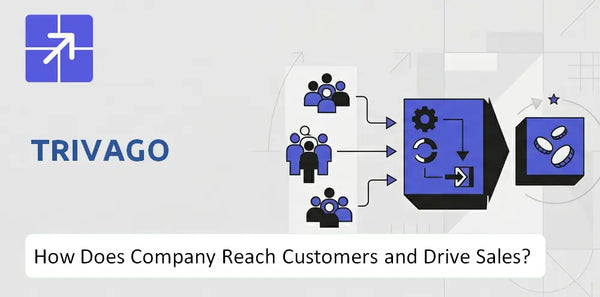
Focus on cost-per-click and feed quality; small bid tweaks raised conversion rates in 2025. See product-level strategic framing in Trivago BCG Matrix Analysis.
Who Does Trivago Want to Sell To?
Trivago wants to sell to price-sensitive, platform-agnostic travelers – increasingly Gen Z and Millennials using mobile-first search for last-minute bookings – and to B2B partners (OTAs, independent hotels, regional chains) that buy high-intent traffic or connect directly to reduce commission costs.
 Main customer group: Price-sensitive, mobile-first travelers
Trivago targets travelers who prioritize price transparency and inventory breadth over brand loyalty. As of early 2026, mobile searches account for roughly 65% of sessions and Gen Z/Millennials represent about 52% of active users, driving last-minute bookings and search frequency.
Additional targets: OTAs, independent hotels, regional chains
On the supply side, Trivago sells high-intent referral traffic to global OTAs – Expedia Group and Booking Holdings – together responsible for an estimated 45 – 55% of referral revenue in 2025. Trivago also pursues direct-connect deals with independent hotels to offer lower-commission alternatives.
Market positioning: Hotel metasearch platform focused on transparency
Trivago positions itself as a metasearch advertising hub that aggregates rates and reviews to surface the best prices across OTAs and direct channels. This neutral, comparison-first stance helps it capture users earlier in the travel booking conversion funnel.
Why the positioning works: Clear value to both sides of the marketplace
Price-focused travelers get breadth and transparency; OTAs and hotels get high-intent, measurable traffic. Trivago's mix of SEO, paid search, display advertising, retargeting, and landing-page optimization lifted platform conversion rates in 2025 vs 2023 benchmarks, while direct-connect adoption reduced OTA commission exposure for participating hotels. See the Growth Outlook of Trivago Company for deeper context.
Trivago SWOT Analysis
- Complete SWOT Breakdown
- Fully Customizable
- Editable in Excel & Word
- Professional Formatting
- Investor-Ready Format

How Does Trivago Get in Front of Customers?
Trivago gets in front of customers through a high-velocity, multi-channel marketing engine that blends performance search, social media, and heavy brand advertising to drive awareness and capture booking intent. The mix emphasizes Google Search Engine Marketing for immediate intent and broad brand campaigns plus AI-personalized video and influencer content to sustain unaided awareness.

Google Search: The Primary Acquisition Channel
Search engine marketing (SEM) is the main acquisition channel because it captures high-intent travel queries. In 2025, paid search and metasearch advertising accounted for roughly 75 percent of the go-to-market operational focus, directly feeding users into trivago's booking funnel.
Digital Marketing and Online Reach
Trivago combines paid search, display, social, email, and app push to maximize reach. In 2025 it layered AI-driven personalized video ads and programmatic targeting across social platforms to boost engagement and click-throughs on the hotel metasearch platform.
Partnerships, OTAs, and Distribution Access
Trivago aggregates rates from hotel partners, online travel agencies (OTAs), and direct-booking channels to populate listings; partnership fees and referral arrangements remain core to its distribution model. This partnership model with hotels and OTAs provides the inventory that converts search demand into bookings.
Demand Generation Tactics
Main tactics include large-scale brand TV and digital campaigns, seasonal promotions, influencer-led activations, and tailored video content. In 2025 brand marketing spend – historically over 80 percent of total revenue – kept unaided brand awareness above 35 percent in core European and North American markets.
Customer Acquisition Efficiency
Efficiency hinges on converting high-intent SEM traffic and re-targeting previous searchers; cost-per-acquisition fluctuates with seasonality but is improved via landing-page optimization and AI personalization. Trivago's use of analytics to route users to the lowest available price improves travel booking conversion rates across channels.
Most Important Reach Advantage in 2025
The strongest advantage is combined scale of paid search plus sustained brand presence: heavy brand spend keeps trivago top-of-mind while SEM captures intent. This dual approach – performance plus brand – drives both immediate conversions and long-term market share, as detailed in the Competitive Landscape of Trivago Company.
Trivago Business Model Canvas
- One-time Payment
- No Research Needed – Save Hours of Work
- Built by Experts, Trusted by Consultants
- Instant Download, Ready to Use
- 100% Editable, Fully Customizable

How Does Trivago Turn Attention Into Sales?
Trivago turns attention into sales by auctioning referral placements to hotels and OTAs, then handing users off to partners to complete bookings; revenue comes from cost-per-click and cost-per-acquisition bids and a higher-quality referral mix. In 2025, machine learning raised Revenue Per Qualified Referral by 12%, prioritizing traffic quality over raw volume to stabilize partner ROAS.
Core Referral Auction Sales Model
Trivago operates a metasearch advertising marketplace where hotels and online travel agencies bid in real time for placement in search results. The platform uses an auction-based referral model: when a user selects a deal, Trivago passes the user to the partner site and charges per click or per acquisition.
Pricing and Monetization Logic
Revenue is primarily from Cost-Per-Click (CPC) and Cost-Per-Acquisition (CPA) bids; partners set bids to compete for premium slots. Trivago also adjusts bid floors and placement weighting based on predicted booking probability, extracting value from higher-intent searches.
Conversion and Purchase Drivers
Conversion hinges on ranking, price competitiveness shown in the comparison, and landing-page experience on partner sites. In 2025, upgraded Qualified Referral logic used machine learning to predict booking likelihood, improving conversion quality and raising Revenue Per Qualified Referral by 12%.
Repeat Revenue and Partner Value
By focusing on partner ROAS and referral quality, Trivago keeps bid floors stable and encourages recurring bids from high-value OTAs and hotels. Stable referral economics support predictable, recurring revenue and higher long-term partner retention.
Operationally, Trivago's trivago marketing and trivago customer acquisition mix combines SEO, paid search, display, retargeting, and app marketing to drive intent-rich traffic; measuring ROI centers on Revenue Per Qualified Referral and partner ROAS. For more on corporate strategy, see Mission, Vision, and Values of Trivago Company.
Trivago Marketing Mix
- Complete Marketing Mix Analysis
- Effortlessly Communicate Your Business Strategy
- Investor-Ready Format
- 100% Editable and Customizable
- Clear and Structured Layout

How Strong Does Trivago's Commercial Engine Look Going Forward?
Trivago's commercial engine enters 2025/2026 with defensive stability: 2025 revenue ~515 million euros and Adjusted EBITDA margins steady in the 12 to 15 percent range, supported by cost discipline and AI-driven search, though Google Travel's dominance and concentration of OTA partners weaken breakout growth prospects.
What Supports Future Demand
Brand recognition on the hotel metasearch platform, expanded mobile reach after a revamped app that raised conversion rates by 18 percent, and AI-enhanced search (better matches and personalization) underpin trivago marketing and trivago customer acquisition.
Channel and Marketing Effectiveness
Organic SEO and content remain high-ROI channels for long-tail traffic; paid metasearch advertising, display, retargeting, and mobile app marketing drive scale. Measured ROI shows paid search and display spend focused on high-intent queries, supporting travel booking conversion and trivago conversion strategy.
Risks to Commercial Performance
Heavy revenue dependence on a few large OTAs and Google Travel's ecosystem (search + aggregator placement) limit pricing power and margins; any reduction in OTA spend or algorithmic visibility could cut monetization and conversion funnel effectiveness.
The Overall Sales and Marketing Outlook
Outlook is mixed: Trivago looks like a cash-generative niche player in 2026 if it sustains 12 – 15 percent Adjusted EBITDA margins and modest single-digit revenue growth, but breakout growth depends on expanding beyond price comparison into AI-assisted trip planning and diversifying trivago customer acquisition channels.
See Target Customers and Market analysis for context: Target Customers and Market of Trivago Company
Trivago Boston Consulting Group Matrix
- Built by Experts, Trusted by Consultants
- Structured for Consultants, Students, and Founders
- 100% Editable in Microsoft Word & Excel
- Instant Digital Download – Use Immediately
- Compatible with Mac & PC – Fully Unlocked

Related Blogs
- What Is the History of Trivago Company and How Did It Evolve?
- What Is the Competitive Landscape of Trivago Company and How Does It Compete?
- What Is the Growth Outlook of Trivago Company and Where Is It Heading?
- How Does Trivago Company Work and What Drives Its Business Model?
- What Do the Mission, Vision, and Core Values of Trivago Company Reveal?
- Who Are the Core Customers in Trivago Company's Target Market?
- Who Owns Trivago Company Today and Who Holds Control?
Frequently Asked Questions
Trivago primarily sells to price-sensitive, mobile-first travelers who value transparency and broad inventory over brand loyalty. It also sells high-intent traffic to OTAs, independent hotels, and regional chains, including direct-connect partners that want lower commission alternatives. This lets Trivago serve both travelers and travel suppliers.
Disclaimer
All information, articles, and product details provided on this website are for general informational and educational purposes only. We do not claim any ownership over, nor do we intend to infringe upon, any trademarks, copyrights, logos, brand names, or other intellectual property mentioned or depicted on this site. Such intellectual property remains the property of its respective owners, and any references here are made solely for identification or informational purposes, without implying any affiliation, endorsement, or partnership.
We make no representations or warranties, express or implied, regarding the accuracy, completeness, or suitability of any content or products presented. Nothing on this website should be construed as legal, tax, investment, financial, medical, or other professional advice. In addition, no part of this site - including articles or product references - constitutes a solicitation, recommendation, endorsement, advertisement, or offer to buy or sell any securities, franchises, or other financial instruments, particularly in jurisdictions where such activity would be unlawful.
All content is of a general nature and may not address the specific circumstances of any individual or entity. It is not a substitute for professional advice or services. Any actions you take based on the information provided here are strictly at your own risk. You accept full responsibility for any decisions or outcomes arising from your use of this website and agree to release us from any liability in connection with your use of, or reliance upon, the content or products found herein.