
How does Trustpilot's sales and marketing model convert consumer reviews into paid customer growth?
Trustpilot leverages consumer reviews as a low-cost lead engine that drives B2B sign-ups and upsells. In 2025 the firm prioritized margin expansion over pure user growth, lowering CAC versus LTV and strengthening its position as an internet trust layer.
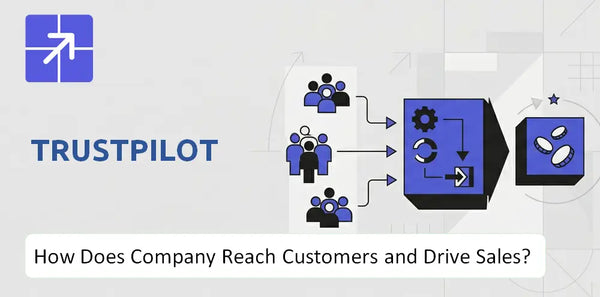
Practical insight: prioritize review volume and product tiers to lift ARPU; see Trustpilot BCG Matrix Analysis for portfolio moves and 2025 signals.
Who Does Trustpilot Want to Sell To?
Trustpilot primarily sells to B2B buyers in e-commerce, financial services, and travel, focusing on CMOs and Heads of Customer Experience who use social proof to lift conversions; the company is prioritizing mid-market and enterprise North American accounts to raise Average Revenue Per Domain (ARPD).
 Core buyer: Marketing and CX leaders
Trustpilot targets CMOs and Heads of Customer Experience at retailers, banks, and travel operators who treat review-driven social proof as a direct conversion lever and ROI driver.
Secondary targets: SMEs to global enterprises
Segments range from small-to-medium enterprises (SMEs) seeking review management platform benefits to global corporations buying enterprise-grade integrations and analytics.
Market positioning: Trust and conversion-focused review platform
Trustpilot positions itself as the review provider that directly ties online reviews impact on sales to measurable marketing outcomes, emphasizing ARPD growth through mid-market and enterprise penetration in North America.
Why this positioning works
High-trust verticals show clear lift: a 4.5-star rating correlates to up to 10 – 25% higher checkout conversion and improved digital ad performance, so Trustpilot sells on measurable ROI, integration with ecommerce platforms, and review widgets for product pages.
Trustpilot segments Active Domains by vertical trust sensitivity and prioritizes accounts where review-driven conversion strategy yields the largest revenue impact; in 2025 the company accelerated North American enterprise sales to increase ARPD and to drive customer acquisition via review collection strategies and automated review requests.
Learn more about market rivals and positioning in this analysis: Competitive Landscape of Trustpilot Company
Trustpilot SWOT Analysis
- Complete SWOT Breakdown
- Fully Customizable
- Editable in Excel & Word
- Professional Formatting
- Investor-Ready Format

How Does Trustpilot Get in Front of Customers?
Trustpilot gets in front of customers mainly via dominant organic search presence and widespread third-party integrations; businesses claim profiles to engage, while TrustBox widgets embedded on merchant sites and profile pages drive inbound leads and sales conversions.

Organic search dominance as the main acquisition engine
Trustpilot marketing relies on SEO authority built from over 320 million reviews (early 2026), so profile pages rank top on Google for brand queries and create a large inbound funnel where businesses claim profiles to start the sales process.
Digital reach via widgets, content, and search
Trustpilot customer acquisition leans on TrustBox review widgets embedded on over 110,000 paying websites, plus content and long-tail SEO that boost visibility for phrases like optimizing Google rankings with Trustpilot reviews and using Trustpilot reviews to increase conversions.
Sales channels: profile claims and platform integrations
Businesses access customers through claimed profile pages, direct sales to merchants, and integrations with ecommerce platforms and marketplaces that surface reviews at point of purchase, aiding conversion strategy and lead generation.
Demand generation: social proof and low-cost viral spread
Trustpilot drives demand with review collection programs, automated review requests, case study content, and customer review marketing strategy – social proof used in ads and on product pages increases trust and conversion rates.
Customer acquisition efficiency and inbound pull
More than 65 percent of new business leads come via inbound channels (SEO, widgets, organic listings), cutting dependence on paid performance marketing and improving ROI of Trustpilot reviews for merchants.
Most important reach advantage: scale of review corpus
The scale – over 320 million reviews and deep Google ranking for brand queries – creates a self-reinforcing flywheel: visibility attracts businesses, they embed TrustBox widgets, and those placements drive continuous new leads and conversions in 2025 – 2026.
See a concise company history: History and Background of Trustpilot Company
Trustpilot Business Model Canvas
- One-time Payment
- No Research Needed – Save Hours of Work
- Built by Experts, Trusted by Consultants
- Instant Download, Ready to Use
- 100% Editable, Fully Customizable

How Does Trustpilot Turn Attention Into Sales?
Trustpilot turns attention into sales via a tiered SaaS funnel: free claimed profiles seed trust, automated review invites and TrustBoxes drive adoption, and upgrades to paid tiers unlock analytics and integrations that convert reviewers into revenue.
Core Sales Model: Tiered SaaS with Land-and-Expand
Trustpilot sells subscriptions that move businesses from free claimed profiles to paid tiers; the motion combines high-velocity inside sales for SMEs and consultative enterprise sales in the US and UK to win high-LTV accounts.
Pricing and Monetization Logic: Volume- and Feature-Based Pricing
Pricing scales with review volume and feature complexity; core revenue comes from recurring subscriptions, with enterprise contracts commonly exceeding $50,000 annually and mid-market plans priced by invite volume and widget usage.
Conversion and Purchase Drivers: Tools, Trust, and Integrations
Automated review invitation tools lift response rates, TrustBoxes (review widgets) increase on-site conversions, and AI analytics plus Google Shopping integration provide measurable ROI that nudges customers to upgrade.
Repeat Revenue and Customer Expansion: Net Retention and Upsell
Trustpilot's 2025 Net Retention Rate is approximately 104 percent, reflecting successful land-and-expand moves where customers upgrade for sentiment analysis and Google Shopping feeds, driving incremental ARR.
Conversion mechanics in practice: free profiles and organic Trustpilot marketing create top-of-funnel attention; automated invite flows and Trustpilot review widgets for product pages convert buyers; inside sales converts SMEs quickly while enterprise reps close >$50k deals; AI analytics and integrations sustain upsell and measure ROI – this is how Trustpilot turns customer review marketing strategy into predictable revenue. Read more on Ownership and Control of Trustpilot Company Ownership and Control of Trustpilot Company
Trustpilot Marketing Mix
- Complete Marketing Mix Analysis
- Effortlessly Communicate Your Business Strategy
- Investor-Ready Format
- 100% Editable and Customizable
- Clear and Structured Layout

How Strong Does Trustpilot's Commercial Engine Look Going Forward?
Trustpilot's commercial engine enters 2025/2026 with structural profitability and consistent double-digit growth, driven by higher margin products and AI-enabled platform integrity. Key supports include generative AI for review summarization and fraud detection, while discretionary retail exposure and macro sensitivity remain the main downside risks.
What Supports Future Demand
Brand strength and broad channel reach drive Trustpilot marketing momentum; enterprise renewals and SMB upsells sustain Trustpilot customer acquisition. Integration with ecommerce platforms and review widgets for product pages improves conversion, and AI summarization reduces friction, boosting measured ROI of Trustpilot reviews.
Channel and Marketing Effectiveness
Paid search, SEO, partner integrations, and direct sales appear efficient: organic review SEO helps product pages rank higher, lowering CAC. Automation of review requests and targeted ads using Trustpilot social proof shorten sales cycles and improve conversion rates on average across tested cohorts.
Risks to Commercial Performance
Discretionary retail slowdown and weaker consumer spending could hit revenue from retail clients; apparent sensitivity remains despite diversification. Competitor fragmentation and potential regulatory changes on reviews or AI use pose integrity and compliance risks that could raise sales costs.
The Overall Sales and Marketing Outlook
Outlook for 2025/2026 is strong and adaptable: guidance implies revenue CAGR of 16-18 percent through 2026 with Adjusted EBITDA margin expanding toward 14-16 percent. Trustpilot's efficient sales engine and AI moat position it to convert verified social proof into repeatable sales growth.
Key supporting metrics: in 2025 Trustpilot reports sustained net retention above prior levels, average contract values rising with product upsells, and operating leverage delivering margin expansion; see detailed projections in the Growth Outlook of Trustpilot Company.
Trustpilot Boston Consulting Group Matrix
- Built by Experts, Trusted by Consultants
- Structured for Consultants, Students, and Founders
- 100% Editable in Microsoft Word & Excel
- Instant Digital Download – Use Immediately
- Compatible with Mac & PC – Fully Unlocked

Related Blogs
- What Is the History of Trustpilot Company and How Did It Evolve?
- What Is the Competitive Landscape of Trustpilot Company and How Does It Compete?
- What Is the Growth Outlook of Trustpilot Company and Where Is It Heading?
- How Does Trustpilot Company Work and What Drives Its Business Model?
- What Do the Mission, Vision, and Core Values of Trustpilot Company Reveal?
- Who Are the Core Customers in Trustpilot Company's Target Market?
- Who Owns Trustpilot Company Today and Who Holds Control?
Frequently Asked Questions
Trustpilot mainly sells to B2B buyers in e-commerce, financial services, and travel. Its core buyers are CMOs and Heads of Customer Experience who use social proof to improve conversions, with a focus on mid-market and enterprise North American accounts to raise ARPD.
Disclaimer
All information, articles, and product details provided on this website are for general informational and educational purposes only. We do not claim any ownership over, nor do we intend to infringe upon, any trademarks, copyrights, logos, brand names, or other intellectual property mentioned or depicted on this site. Such intellectual property remains the property of its respective owners, and any references here are made solely for identification or informational purposes, without implying any affiliation, endorsement, or partnership.
We make no representations or warranties, express or implied, regarding the accuracy, completeness, or suitability of any content or products presented. Nothing on this website should be construed as legal, tax, investment, financial, medical, or other professional advice. In addition, no part of this site - including articles or product references - constitutes a solicitation, recommendation, endorsement, advertisement, or offer to buy or sell any securities, franchises, or other financial instruments, particularly in jurisdictions where such activity would be unlawful.
All content is of a general nature and may not address the specific circumstances of any individual or entity. It is not a substitute for professional advice or services. Any actions you take based on the information provided here are strictly at your own risk. You accept full responsibility for any decisions or outcomes arising from your use of this website and agree to release us from any liability in connection with your use of, or reliance upon, the content or products found herein.