
How does Vardhman Textiles Limited's sales and marketing model convert large-scale vertical integration into repeat customers?
Vardhman Textiles Limited sells via long-term institutional contracts, B2B accounts, and selective branded retail ties to stabilize volumes. This matters as 2025 exports rebounded, highlighting strength in contract-driven demand and superior capacity utilization.
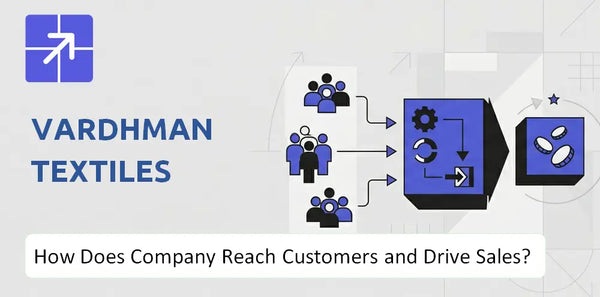
Focus sales on key industrial buyers and label technical service as a differentiator; pair with channel finance to shorten receivable cycles. See product-level strategy in Vardhman Textiles BCG Matrix Analysis.
Who Does Vardhman Textiles Want to Sell To?
Vardhman Textiles Limited targets tier-one global apparel brands, large garment exporters, and fast-growing Indian retailers, plus industrial weavers and knitters in 75 countries; it wins them by offering consistent volumes, ethical sourcing, and premium cotton yarns (40s – 80s counts) as a strategic supply-chain partner.
 Main customer group: Global apparel brands and large exporters
Vardhman Textiles customer acquisition focuses on multinational brands such as Gap, H&M, Uniqlo, and Zara that need high-volume, compliant fabric supply. These blue-chip buyers drive >50% of the fabrics segment demand and prefer suppliers that reduce China-concentration risk via China Plus One sourcing.
Additional target segments: Domestic retailers and industrial yarn users
Secondary targets include high-growth Indian retail chains and premium private labels plus industrial weavers and knitters across 75 countries who buy high-value-added yarns. In yarn, Vardhman prioritizes buyers producing premium garments and technical fabrics, capturing higher margins per kilo.
Market positioning: Strategic partner, not commodity supplier
Vardhman positions itself as a risk-mitigating partner for brands pursuing China Plus One, emphasizing traceability, ethical sourcing, and product consistency. The company targets the premium 40s – 80s count cotton yarn market to command better pricing and stickier B2B textile sales relationships.
Why this positioning works: Scale, compliance, and focused product mix
Large global buyers value Vardhman's integrated supply chain and compliance: in FY2025 Vardhman reported consolidated revenue of INR 35,400 crore and export sales forming ~49% of revenues, demonstrating scale that reassures top brands. That financial scale plus targeted yarn counts converts demand into repeat orders and higher wallet share.
For more on the company's strategic outlook and sales footprint, see Growth Outlook of Vardhman Textiles Company
Vardhman Textiles SWOT Analysis
- Complete SWOT Breakdown
- Fully Customizable
- Editable in Excel & Word
- Professional Formatting
- Investor-Ready Format

How Does Vardhman Textiles Get in Front of Customers?
Vardhman Textiles Limited reaches customers via a multi-channel B2B model: institutional sales teams, international agents in Bangladesh, Vietnam, and Turkey, trade exhibitions, and embedded co-development with brand designers to convert demand into orders.

Main acquisition: Institutional and International Sales
Vardhman Textiles customer acquisition centers on a dedicated international marketing division and a network of specialized agents in key textile hubs, generating large-volume, repeat B2B contracts that drive bulk sales and stable revenue.
Digital marketing and online reach
Digital channels support sales via targeted email outreach, product catalogs, and SEO-driven content to attract global sourcing teams; limited direct-to-consumer activity keeps focus on B2B textile marketing strategies and lead capture.
Sales channels and distribution access
Primary sales channels are direct institutional sales, regional distributors and agents, and export relationships; about 60 – 70% of revenues come from exports to apparel hubs, reflecting Vardhman Textiles export strategy for international customers.
Demand generation tactics
Vardhman drives demand at Premiere Vision, Texworld and similar fairs, showcases seasonal fabric collections, and runs co-development programs where technical teams join customer product cycles to secure specifications early.
Customer acquisition efficiency
Embedding technical staff in design reduces sales cycles and specification churn, converting design-stage interest into purchase orders; this vertical integration improves conversion rates versus cold outreach.
Most important reach advantage in 2025
Co-development with brand designers plus trade-show visibility is the strongest reach advantage, creating a locked-in pipeline where fabrics are specified at conception and orders follow during production seasons.
See a broader operational view in How Vardhman Textiles Company Works and Makes Money: How Vardhman Textiles Company Works and Makes Money
Vardhman Textiles Business Model Canvas
- One-time Payment
- No Research Needed – Save Hours of Work
- Built by Experts, Trusted by Consultants
- Instant Download, Ready to Use
- 100% Editable, Fully Customizable

How Does Vardhman Textiles Turn Attention Into Sales?
Vardhman Textiles converts market attention into sales by combining large-scale manufacturing, technical yarn innovation, and ESG-backed value pricing to win contracts and repeat orders from global apparel brands and retailers.
Core sales model: contract-led B2B manufacturing
Vardhman Textiles customer acquisition relies on direct B2B sales, long-term contracts, and partner-led selling to global brands and wholesalers; the firm also supports select retail and dealer networks for finished fabrics.
Pricing and monetization logic: value-based, product-differentiated pricing
Pricing mixes commodity yarns and higher-margin specialty yarns (core-spun, slub); sustainable sourcing and Zero Liquid Discharge enable premium pricing and contract premiums with Western retailers.
Conversion and purchase drivers: product fit, ESG compliance, and supply reliability
Conversion is driven by technical specs (specialty yarns), ESG credentials (BCI sourcing), and supply-chain reliability – on-time delivery of multi-million-meter orders reduces procurement risk for buyers.
Repeat revenue and customer expansion: retention and account growth
Top-account focus yields strong retention: Vardhman Textiles reports a customer retention rate exceeding 85 percent for its top 50 accounts; cross-selling specialty yarns and finished fabrics increases wallet share per client.
Operational levers: high-capacity spinning and vertical integration support conversion by keeping lead times under control; technical teams offer product development and lab support to speed trial-to-production cycles. In 2025 Vardhman Textiles maintained spinning capacity above 1.1 million spindles-equivalent and reported consolidated revenue of approximately INR 24,500 crore, enabling scale discounts for large buyers and sustained margin on specialty lines.
Sales execution and channels: B2B textile sales are routed via direct sales teams, export desks, and select distribution partners; the export strategy targets Europe and North America where ESG-compliant supply commands premiums. Trade shows, technical samplings, and account-level pilots shorten sales cycles; CRM-driven follow-up and blanket purchase agreements (BPAs) convert trials into recurring orders.
Pricing mechanics to convert demand into purchases: Vardhman structures bids with tiered pricing – volume rebates, lead-time penalties, and sustainability-linked premiums – so buyers trade off unit price against reliability and ESG compliance. This approach helps convert interest from large retailers into signed purchase orders worth multi-million meters and multi-quarter revenue commitments.
Supply-chain role: integrated logistics, vendor-managed inventory for key clients, and a manufacturing network with Zero Liquid Discharge facilities reduce fulfillment risk and support on-time delivery rates above industry averages; that operational reliability underpins repeat business and enables longer payment terms from select customers.
Digital and marketing touches: product catalogs, technical datasheets, and targeted outreach (including participation in global textile expos) feed the top of funnel for Vardhman Textiles demand generation; digital outreach supports the direct sales force and helps qualify leads for high-value B2B deals. See Ownership and Control of Vardhman Textiles Company for related governance context: Ownership and Control of Vardhman Textiles Company
Vardhman Textiles Marketing Mix
- Complete Marketing Mix Analysis
- Effortlessly Communicate Your Business Strategy
- Investor-Ready Format
- 100% Editable and Customizable
- Clear and Structured Layout

How Strong Does Vardhman Textiles's Commercial Engine Look Going Forward?
The commercial engine of Vardhman Textiles Limited looks resilient for 2025/2026, supported by capacity modernization, a shift to higher-margin printed and dyed fabrics, and expected export recovery; risks include raw cotton price swings and global demand variance. Key supports are product mix, >90 percent capacity utilization, and a projected revenue uplift of 9 – 11 percent.
What Supports Future Demand
Modernized fabric processing raises product quality and throughput, improving Vardhman Textiles customer acquisition via B2B textile sales and retail partnerships; higher share of printed/dyed fabrics lifts blended realizations and supports demand generation. Capacity utilization above 90 percent sustains supply reliability.
Channel and Marketing Effectiveness
Vardhman Textiles sales channels combine wholesale distribution channels, dealer networks, and selective direct-to-consumer initiatives, backed by trade-show participation and targeted textile marketing strategies; digital marketing strategies for customer acquisition and CRM practices improve repeat sales and shorten conversion cycles.
Risks to Commercial Performance
Raw cotton price volatility can compress margins unless pass-through succeeds; slower discretionary spending in US/EU would hit export volumes. Currency swings and freight cost inflation could weaken how Vardhman converts textile demand into actual sales.
The Overall Sales and Marketing Outlook
Outlook is positive and adaptable: management projects revenue growth of 9 – 11 percent for 2025/2026 with an EBITDA margin forecast of 15.5 – 17 percent, and a strengthening balance sheet with a declining debt-to-equity trend – these factors support scalable demand generation and robust channel performance.
For context on competitive positioning and channel mix, see Competitive Landscape of Vardhman Textiles Company
Vardhman Textiles Boston Consulting Group Matrix
- Built by Experts, Trusted by Consultants
- Structured for Consultants, Students, and Founders
- 100% Editable in Microsoft Word & Excel
- Instant Digital Download – Use Immediately
- Compatible with Mac & PC – Fully Unlocked

Related Blogs
- What Is the History of Vardhman Textiles Company and How Did It Evolve?
- What Is the Competitive Landscape of Vardhman Textiles Company and How Does It Compete?
- What Is the Growth Outlook of Vardhman Textiles Company and Where Is It Heading?
- How Does Vardhman Textiles Company Work and What Drives Its Business Model?
- What Do the Mission, Vision, and Core Values of Vardhman Textiles Company Reveal?
- Who Are the Core Customers in Vardhman Textiles Company's Target Market?
- Who Owns Vardhman Textiles Company Today and Who Holds Control?
Frequently Asked Questions
Vardhman Textiles targets tier-one global apparel brands, large garment exporters, fast-growing Indian retailers, and industrial weavers and knitters. The company focuses on buyers that want consistent volumes, ethical sourcing, and premium cotton yarns, positioning itself as a strategic supply-chain partner rather than a commodity supplier.
Disclaimer
All information, articles, and product details provided on this website are for general informational and educational purposes only. We do not claim any ownership over, nor do we intend to infringe upon, any trademarks, copyrights, logos, brand names, or other intellectual property mentioned or depicted on this site. Such intellectual property remains the property of its respective owners, and any references here are made solely for identification or informational purposes, without implying any affiliation, endorsement, or partnership.
We make no representations or warranties, express or implied, regarding the accuracy, completeness, or suitability of any content or products presented. Nothing on this website should be construed as legal, tax, investment, financial, medical, or other professional advice. In addition, no part of this site - including articles or product references - constitutes a solicitation, recommendation, endorsement, advertisement, or offer to buy or sell any securities, franchises, or other financial instruments, particularly in jurisdictions where such activity would be unlawful.
All content is of a general nature and may not address the specific circumstances of any individual or entity. It is not a substitute for professional advice or services. Any actions you take based on the information provided here are strictly at your own risk. You accept full responsibility for any decisions or outcomes arising from your use of this website and agree to release us from any liability in connection with your use of, or reliance upon, the content or products found herein.