
Who are Bank of Communications' core customers in the Yangtze River Delta and tech sectors?
Bank of Communications targets retail wealth clients, SMEs in the Yangtze River Delta, and tech firms needing corporate banking and cash-management. This matters because by 2026 the bank kept a Tier 1 capital adequacy ratio above 15.2 percent, signaling a shift to fee income and lower-risk lending.
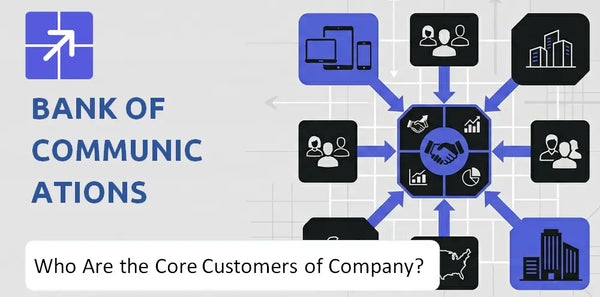
Focus on affluent urban savers, mid-market corporates, and fintech partners; expand wealth-management products and green finance to capture fee growth. See Bank of Communications BCG Matrix Analysis
Who Is Bank of Communications Trying to Win?
Bank of Communications tries to win institutional leaders in strategic industries and mass-affluent urban clients; corporate loans make up about 60 percent of the loan book, while retail focuses on Go – Wealth urban professionals and retirees in Tier 1 – 2 cities.
 Primary corporate customers: SOEs and Little Giant firms
Bank of Communications targets State – Owned Enterprises and specialized mid – sized 'Little Giant' manufacturers in high – tech and green energy because they drive large, long – dated corporate lending and transaction banking revenues; strategic emerging industries account for a large share of corporate exposure as of early 2026.
Secondary corporate and trade clients
Secondary targets include international trade firms needing cross – border settlement and SMEs embedded in digital supply chains; trade finance and cross – border services support fee income and international footprints.
Retail customers: Go – Wealth mass – affluent segment
Retail efforts concentrate on urban professionals and retirees in Tier 1 and Tier 2 cities – wealth management, mortgage, and deposit products for high net worth and mass – affluent clients drive retail revenue growth and cross – sell metrics.
Customer mix: mixed institutional and retail base
Bank of Communications serves a mixed base: institutional and government relationships plus retail banking customers; this mix explains the 60 percent corporate loan weighting and a simultaneous push into wealth management and online banking for affluent and millennial users.
Most important segment by revenue and scale
The corporate client segment – SOEs and Little Giants – appears most important by loan volume and strategic relevance, comprising roughly 60 percent of total loans in early 2026; retail Go – Wealth is prioritized for higher margins and fee income growth.
For more on strategic positioning and growth metrics see Growth Outlook of Bank of Communications Company
Bank of Communications SWOT Analysis
- Complete SWOT Breakdown
- Fully Customizable
- Editable in Excel & Word
- Professional Formatting
- Investor-Ready Format

What Do Bank of Communications's Customers Care About Most?
Corporate and retail customers of Bank of Communications care most about low-cost capital, reliable digital treasury services, capital preservation, and diversified yield; both demand near-instant digital reliability and AI-driven advice to support international growth and wealth goals.

Funding and liquidity efficiency
Corporate clients Bank of Communications prioritize low-cost capital and advanced liquidity management to fund R&D and cross-border expansion; they need integrated treasury flows into ERP systems for working capital optimization.
Practical buying drivers: price, integration, speed
Clients choose Bank of Communications for competitive lending spreads, seamless ERP-to-treasury connectivity, and fast FX and trade finance execution that reduce cash conversion cycles.
Emotional and aspirational appeal
High net worth clients Bank of Communications and affluent retail customers value prestige and trust in the Hui Feng wealth management brand for curated private equity, insurance, and pension access.
What customers value most
Retail banking customers Bank of Communications prioritize capital preservation and diversified yield; personal AUM exceeded RMB 5.4 trillion by start of 2026, signaling demand for curated alternative access and stable returns.
Loyalty and repeat demand drivers
Reliable digital experiences, near-instant transactions, AI-driven financial advisory, and consistent product performance drive retention across core customers Bank of Communications and repeat business from SMEs and corporates.
Why customers choose Bank of Communications
Bank of Communications wins with a mix of competitive corporate financing, integrated digital treasury solutions, and the Hui Feng wealth platform that serves high net worth clients Bank of Communications and retail investors seeking yield; see Sales and Marketing Strategy of Bank of Communications Company for target-market context: Sales and Marketing Strategy of Bank of Communications Company
Bank of Communications Business Model Canvas
- One-time Payment
- No Research Needed – Save Hours of Work
- Built by Experts, Trusted by Consultants
- Instant Download, Ready to Use
- 100% Editable, Fully Customizable

Where Is Demand Strongest for Bank of Communications?
Demand is strongest in the Yangtze River Delta, the bank's high-margin hub, with the region contributing over 30 percent of Bank of Communications Company's total profit; activity is also concentrated in the Greater Bay Area and the Beijing-Tianjin-Hebei cluster where infrastructure projects drive lending.
Primary Market: Yangtze River Delta
The Yangtze River Delta is the main market for Bank of Communications customer segments, supplying more than 30 percent of profit and anchoring high-end manufacturing lending and corporate banking relationships.
Secondary Markets: Greater Bay Area and Beijing-Tianjin-Hebei
Demand in the Greater Bay Area and Beijing-Tianjin-Hebei cluster is rising, driven by cross-border trade, infrastructure connectivity, and corporate clients seeking project and trade finance.
Channel Strength: Mobile Banking Leadership
BoCom Mobile Banking app 8.0 is the primary demand driver; monthly active users (MAU) exceeded 110 million by 2026, pushing retail banking customers Bank of Communications toward digital-first engagement and higher fee income.
Fastest-Growing Sectors: The New Three
Industry-specific demand is fastest growing in electric vehicles, lithium batteries, and solar products; Bank of Communications Company's green loan balance grew at a compound annual rate above 25 percent over the past two years, fueling SME lending and corporate green financing.
For a deeper look at ownership and strategic positioning that shapes these demand patterns see Ownership and Control of Bank of Communications Company
Bank of Communications Marketing Mix
- Complete Marketing Mix Analysis
- Effortlessly Communicate Your Business Strategy
- Investor-Ready Format
- 100% Editable and Customizable
- Clear and Structured Layout

How Does Bank of Communications Keep Its Audience Growing?
Bank of Communications keeps its audience growing by embedding financial services into digital and industrial platforms, converting savers into investors via wealth-management offers, and scaling card and retail acquisition through data-driven personalization and ecosystem partnerships.
Platform plus Ecosystem Acquisition
Bank of Communications expands its customer base by integrating banking APIs and payments into e-commerce, travel, and utility platforms across China's top economic corridors, capturing retail banking customers Bank of Communications and SME inflows from digital partners.
Retention via Benefit-for-All and Cards
Retention relies on the Benefit-for-All loyalty program and a credit card fleet exceeding 78,000,000 active accounts, using big-data signals to personalize rewards and credit limits for millennial and Gen Z banking users demographics.
Wealth Management-First Transition
Bank of Communications converts traditional depositors into high net worth clients Bank of Communications and affluent customer acquisition tactics by prioritizing fee-based investment products; wealth-management AUM growth has driven fee income increases despite narrower net interest margins in 2025.
Key Growth Lever in 2025/2026
The strongest lever is digital-first acquisition tied to regional franchise strength – deep penetration in China's wealthy corridors plus platform partnerships supports sustainable asset growth and risk-adjusted returns, keeping core customers Bank of Communications and corporate clients Bank of Communications engaged.
Further reading on the bank's origins and strategic evolution is available at History and Background of Bank of Communications Company
Bank of Communications Boston Consulting Group Matrix
- Built by Experts, Trusted by Consultants
- Structured for Consultants, Students, and Founders
- 100% Editable in Microsoft Word & Excel
- Instant Digital Download – Use Immediately
- Compatible with Mac & PC – Fully Unlocked

Related Blogs
- What Is the History of Bank of Communications Company and How Did It Evolve?
- What Is the Competitive Landscape of Bank of Communications Company and How Does It Compete?
- What Is the Growth Outlook of Bank of Communications Company and Where Is It Heading?
- How Does Bank of Communications Company Work and What Drives Its Business Model?
- How Does Bank of Communications Company Reach Customers and Turn Demand into Sales?
- What Do the Mission, Vision, and Core Values of Bank of Communications Company Reveal?
- Who Owns Bank of Communications Company Today and Who Holds Control?
Frequently Asked Questions
Bank of Communications's core customers are institutional leaders in strategic industries and mass-affluent urban clients. The blog highlights State-Owned Enterprises, specialized mid-sized Little Giant manufacturers, international trade firms, SMEs in digital supply chains, and retail Go-Wealth customers in Tier 1 and Tier 2 cities.
Disclaimer
All information, articles, and product details provided on this website are for general informational and educational purposes only. We do not claim any ownership over, nor do we intend to infringe upon, any trademarks, copyrights, logos, brand names, or other intellectual property mentioned or depicted on this site. Such intellectual property remains the property of its respective owners, and any references here are made solely for identification or informational purposes, without implying any affiliation, endorsement, or partnership.
We make no representations or warranties, express or implied, regarding the accuracy, completeness, or suitability of any content or products presented. Nothing on this website should be construed as legal, tax, investment, financial, medical, or other professional advice. In addition, no part of this site - including articles or product references - constitutes a solicitation, recommendation, endorsement, advertisement, or offer to buy or sell any securities, franchises, or other financial instruments, particularly in jurisdictions where such activity would be unlawful.
All content is of a general nature and may not address the specific circumstances of any individual or entity. It is not a substitute for professional advice or services. Any actions you take based on the information provided here are strictly at your own risk. You accept full responsibility for any decisions or outcomes arising from your use of this website and agree to release us from any liability in connection with your use of, or reliance upon, the content or products found herein.