
Who are Diamondback Energy's core customers in the Permian Basin and global crude markets?
Diamondback Energy serves refiners, petrochemical firms, and institutional investors focused on low-cost Permian crude; this matters because its 2025 production mix and export capacity drive margin resilience amid mid-2025 price volatility and rising takeaway constraints.
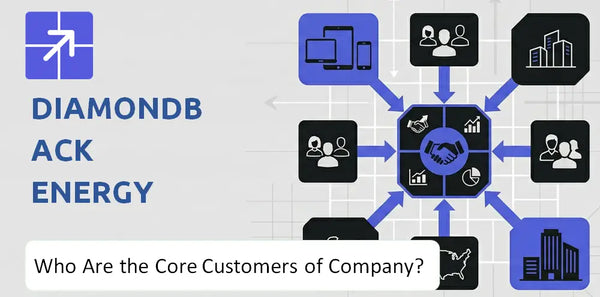
Refiners and midstream partners seek consistent API gravity and low transport cost; investors value predictable free cash flow. See product analysis: Diamondback Energy BCG Matrix Analysis
Who Is Diamondback Energy Trying to Win?
Diamondback Energy tries to win large-scale downstream refiners, midstream marketers, and integrated majors that need steady volumes of light sweet crude and natural gas; secondary wins include international trading houses that export Permian production.
 Main buyer: Tier-1 refiners and integrated majors
Diamondback Energy customer segments center on Tier-1 US Gulf Coast refiners such as Valero and Marathon and integrated majors that integrate Permian light sweet crude into global supply chains because they need consistent, high-quality barrels to run complex refinery units and meet product slate targets.
Secondary buyers: trading houses and exporters
Secondary customer groups include international trading houses and commodity marketers that buy Permian volumes for export to Europe and Asia, and midstream partners that take custody and market barrels and associated gas across Gulf Coast hubs.
Customer type and market role
Diamondback Energy mainly serves business and institutional customers (refiners, integrated oil companies, midstream firms, and trading houses) rather than end consumers, matching wholesale supply needs with logistics and contract terms.
Most important segment by scale
The most important segment is Tier-1 refiners and integrated majors, which account for the bulk of offtake and revenue under long-term and high-volume commercial contracts; post-merger pro-forma production is roughly 830,000 – 850,000 BOE/d in 2025, underpinning negotiation leverage and contract scale.
For tactical detail on sales and channel strategy see Sales and Marketing Strategy of Diamondback Energy Company
Diamondback Energy SWOT Analysis
- Complete SWOT Breakdown
- Fully Customizable
- Editable in Excel & Word
- Professional Formatting
- Investor-Ready Format

What Do Diamondback Energy's Customers Care About Most?
Industrial buyers care most about secure supply, low delivered cost, and consistent hydrocarbon quality; increasingly they also demand low-carbon feedstock and verifiable emissions metrics. Price, reliability, and carbon intensity drive purchase decisions across Diamondback Energy customer segments.

Supply security and resilience
Buyers need uninterrupted barrels for refinery runs and petrochemical feedstock; disruptions force expensive spot buys. Diamondback Energy keeps production scale in the Permian and logistics tied to midstream partners to reduce downtime risk.
Practical buying drivers: price and breakeven
Price competitiveness is paramount for refineries and traders. Diamondback Energy sustains one of the lowest cash flow breakeven points in the E&P peer set, at about $40 per barrel in 2025, which supports attractive delivered pricing.
Carbon intensity and regulatory fit
Climate-conscious buyers and regulated markets prioritize low methane and low lifecycle emissions. Diamondback Energy reports a methane intensity below 0.05% and has ended routine flaring, making its Permian barrels preferable to ESG-sensitive refineries and corporate buyers.
Quality and consistency of hydrocarbon feedstock
Refiners and petrochemical firms need predictable API gravity and sulfur content for process efficiency. Diamondback Energy's Permian crude profile and centralized quality controls support steady refinery yields and lower processing variability.
Loyalty and repeat contracts
Long-term offtake and preferred supplier status come from reliability, price stability, and low carbon attributes. Institutional buyers, midstream partners, and refineries renew contracts when supply and ESG metrics remain consistent.
Why customers choose Diamondback Energy
Customers pick Diamondback Energy for secure Permian volumes, a $40 per barrel breakeven that underpins competitive pricing, and verifiable low methane intensity that meets regulatory and corporate ESG requirements. See Mission, Vision, and Values of Diamondback Energy Company for linked corporate context: Mission, Vision, and Values of Diamondback Energy Company
Diamondback Energy Business Model Canvas
- One-time Payment
- No Research Needed – Save Hours of Work
- Built by Experts, Trusted by Consultants
- Instant Download, Ready to Use
- 100% Editable, Fully Customizable

Where Is Demand Strongest for Diamondback Energy?
Diamondback Energy finds the strongest demand in the US Gulf Coast PADD 3 refining corridor and export hubs, driven by Permian Basin crude flows and growing LNG/crude exports; activity concentrates around coastal terminals and midstream takeaway corridors serving Gulf Coast refineries and ports.
PADD 3 Gulf Coast: Primary Processing Hub
Gulf Coast refineries in PADD 3 process the bulk of Permian barrels; in 2025 Gulf Coast crude receipts exceeded 6.5 million barrels per day, making this region Diamondback Energy customer segments most concentrated and critical for crude offtake.
Coastal Export Corridor: Secondary Demand
Corpus Christi and Houston export facilities have lifted Permian access to global markets; crude exports via these ports rose to about 3.0 million b/d in 2025, attracting buyers across Europe and Asia diversifying toward stable North American suppliers.
Where Diamondback Energy Is Strongest
Diamondback Energy is strongest in West Texas production-to-market integration; over 70% of 2025 volumes flowed into Permian-linked pipelines and coastal export trunks, supporting a mix of direct refinery sales, midstream contracts, and export cargoes.
Fastest-Growing Demand Areas in 2025 – 2026
Demand is accelerating for long-term throughput from midstream partners building takeaway capacity; committed pipeline capacity additions and LNG/C Corpus Christi capacity expansions pushed institutional investor interest in Diamondback Energy and midstream partners Diamondback Energy relationships in 2025.
Growth Outlook of Diamondback Energy Company
Diamondback Energy Marketing Mix
- Complete Marketing Mix Analysis
- Effortlessly Communicate Your Business Strategy
- Investor-Ready Format
- 100% Editable and Customizable
- Clear and Structured Layout

How Does Diamondback Energy Keep Its Audience Growing?
Diamondback Energy keeps its audience growing by expanding high-quality drilling inventory and executing capital-efficient operations, reaching industrial buyers and investors while strengthening retention through disciplined cash returns and long-term supply visibility.
Inventory expansion as a customer acquisition engine
Extending drilling inventory to over 15 years at current production rates after integrating the Endeavor assets increases appeal to buyers of Permian Basin oil and midstream partners Diamondback Energy by guaranteeing multi-year volumes and enabling long-term offtake contracts.
Customer Retention Drivers
Retention rests on a disciplined financial strategy that delivered a free cash flow yield near 10 percent in 2025, plus predictable production and pipeline access that keep royalty owners and refineries returning for steady supply.
Loyalty, repeat demand, and partner depth
Repeat demand comes from contracted sales to refineries, petrochemical buyers, and energy traders plus multi-year midstream agreements; suppliers and contractors also deepen ties through sustained field activity in the Permian Basin.
Strongest customer-base growth lever
Capital efficiency and synergy capture – targeting over $550 million in annual cost savings – position Diamondback Energy as the preferred partner for institutional investors Diamondback Energy and commercial buyers, sustaining market share in 2025 and 2026.
History and Background of Diamondback Energy Company
Diamondback Energy Boston Consulting Group Matrix
- Built by Experts, Trusted by Consultants
- Structured for Consultants, Students, and Founders
- 100% Editable in Microsoft Word & Excel
- Instant Digital Download – Use Immediately
- Compatible with Mac & PC – Fully Unlocked

Related Blogs
- What Is the History of Diamondback Energy Company and How Did It Evolve?
- What Is the Competitive Landscape of Diamondback Energy Company and How Does It Compete?
- What Is the Growth Outlook of Diamondback Energy Company and Where Is It Heading?
- How Does Diamondback Energy Company Work and What Drives Its Business Model?
- How Does Diamondback Energy Company Reach Customers and Turn Demand into Sales?
- What Do the Mission, Vision, and Core Values of Diamondback Energy Company Reveal?
- Who Owns Diamondback Energy Company Today and Who Holds Control?
Frequently Asked Questions
Diamondback Energy's core customers are Tier-1 refiners and integrated majors. The blog says these large industrial buyers need steady volumes of light sweet crude and natural gas, and they account for most offtake and revenue through long-term, high-volume commercial contracts.
Disclaimer
All information, articles, and product details provided on this website are for general informational and educational purposes only. We do not claim any ownership over, nor do we intend to infringe upon, any trademarks, copyrights, logos, brand names, or other intellectual property mentioned or depicted on this site. Such intellectual property remains the property of its respective owners, and any references here are made solely for identification or informational purposes, without implying any affiliation, endorsement, or partnership.
We make no representations or warranties, express or implied, regarding the accuracy, completeness, or suitability of any content or products presented. Nothing on this website should be construed as legal, tax, investment, financial, medical, or other professional advice. In addition, no part of this site - including articles or product references - constitutes a solicitation, recommendation, endorsement, advertisement, or offer to buy or sell any securities, franchises, or other financial instruments, particularly in jurisdictions where such activity would be unlawful.
All content is of a general nature and may not address the specific circumstances of any individual or entity. It is not a substitute for professional advice or services. Any actions you take based on the information provided here are strictly at your own risk. You accept full responsibility for any decisions or outcomes arising from your use of this website and agree to release us from any liability in connection with your use of, or reliance upon, the content or products found herein.