
Who are Dycom Industries, Inc.'s core customers among North American telecom carriers and cable operators?
Dycom Industries, Inc. serves Tier 1 carriers and large cable operators as a mission-critical outsourcing partner for network build and maintenance. This matters because multi-year Master Service Agreements drive predictable revenue; in 2025 Dycom reported sizable backlog tied to carrier CAPEX cycles.
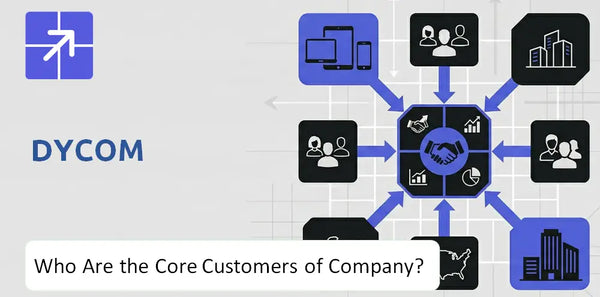
Focus on securing long-term MSAs with major carriers to stabilize revenue; see detailed strategic context in Dycom BCG Matrix Analysis.
Who Is Dycom Trying to Win?
Dycom Industries, Inc. primarily targets the Big Five telecommunications giants and major MSOs, plus a growing set of municipal and utility customers driven by federal broadband buildouts.
 Main customer group: National carriers and MSOs
Dycom core customers are AT&T, Lumen, Comcast, Verizon, and Charter Communications, which together account for roughly 60 – 65% of contract revenues in 2025, making major carriers the primary revenue engine for Dycom target market efforts.
Secondary groups: Municipalities, co-ops, and utilities
Municipal and utility customers, including rural electric cooperatives, became crucial in 2025 – 2026 as BEAD and other federal subsidies moved into construction, increasing Dycom customer segments tied to public broadband projects.
Customer type and market role
Dycom serves a mixed B2B base: telecommunications contractors customers and broadband service provider clients dominate, while municipal and utility customers add public-sector project work and recurring locating/maintenance services.
Most important segment by revenue
The most important segment remains national carriers and MSOs for scale and revenue: major carriers that hire Dycom for fiber deployment and cable operators as Dycom target market customers drive the majority of backlog and 2025 contract income; public-sector BEAD work is the fastest-growing revenue line.
Competitive Landscape of Dycom Company
Dycom SWOT Analysis
- Complete SWOT Breakdown
- Fully Customizable
- Editable in Excel & Word
- Professional Formatting
- Investor-Ready Format

What Do Dycom's Customers Care About Most?
Dycom Industries, Inc. customers prioritize execution certainty and speed-to-market for FTTH and 5G densification projects; they buy partners who can run end-to-end programs reliably, safely, and at multi-state scale to avoid outages, penalties, and schedule slippage.

Execution certainty and speed-to-market
Carriers and broadband service provider clients need contractors that deliver tight schedules for Fiber-to-the-Home (FTTH) and 5G densification rollouts; missed milestones cost millions in lost revenue and regulatory exposure.
Practical buying drivers: turnkey capability
Procurement teams favor vendors who manage engineering, permitting, site acquisition, construction, and maintenance so enterprises can consolidate suppliers and reduce coordination overhead.
Emotional and aspirational appeal: confidence and reputation
Major carriers hire partners to protect brand and market promises; working with a reputed national contractor reassures investors and executive teams that network launches will uphold service commitments.
What customers value most: reliability and safety
Safety records, low incident rates, and consistent uptime matter because outages and OSHA or environmental violations produce steep financial and reputational costs for carriers and municipal customers.
Loyalty and repeat demand drivers
Repeat contracts come from demonstrated on-time delivery, transparent reporting, and the ability to scale across states; customers prefer fewer vendors to simplify vendor management and billing.
Why customers choose Dycom Industries, Inc.
Customers select Dycom core customers for geographic scale and integrated services – Dycom target market clients include major carriers, cable operators, wireless carriers, regional ISPs, municipalities, and utilities that need consistent national execution.
Recent indicators: as of fiscal 2025 Dycom Industries, Inc. reported consolidated revenue of $6.2 billion and backlog that supports multi-year fiber and wireless projects, underscoring capacity to serve large carrier contracts and municipal programs across states; this financial scale reduces counterparty risk for procurement teams. For context and company history see History and Background of Dycom Company.
Dycom Business Model Canvas
- One-time Payment
- No Research Needed – Save Hours of Work
- Built by Experts, Trusted by Consultants
- Instant Download, Ready to Use
- 100% Editable, Fully Customizable

Where Is Demand Strongest for Dycom?
Demand for Dycom Industries, Inc. is strongest in the Southeastern and Western United States where rapid population growth, suburban expansion, and federal funding spur large fiber build-outs and recurring underground locating work.
Main market: Southeastern and Western U.S. fiber build-outs
Dycom core customers cluster in fast-growing metro and suburban corridors of Florida, Texas, Georgia, Arizona, Nevada, and California where BEAD-driven projects and private carrier expansions concentrate spending. These regions matter because they combine high unserved/underserved populations with aggressive carrier capex.
Secondary markets: Rural BEAD and municipal projects
Significant demand exists in rural counties across the Southeast and West due to the $42.45 billion BEAD program entering peak construction in 2025 – 2026; municipalities and utilities also procure underground & aerial services for resiliency and broadband grants.
Where Dycom is strongest: fiber deployment and locating
Dycom target market strength shows in fiber-optic deployment, which now represents the largest share of its multi-billion dollar backlog and revenue mix, plus a steady underground facility locating business driven by Call Before You Dig rules across all 50 states.
Fastest-growing demand areas in 2025 – 2026
The fastest growth is in BEAD-funded rural builds and suburban fiber-to-the-home (FTTH) projects for major carriers and regional ISPs; tower maintenance for wireless carriers and municipal broadband rollouts also expanded in 2025, lifting recurring-service revenue.
Key buyer types: broadband service provider clients (national carriers and regional ISPs), telecommunications contractors customers (outsourced construction), municipal and utility customers, and commercial telecom companies needing maintenance; these segments drive Dycom customer segments and procurement decisions. See Sales and Marketing Strategy of Dycom Company for related context: Sales and Marketing Strategy of Dycom Company
Dycom Marketing Mix
- Complete Marketing Mix Analysis
- Effortlessly Communicate Your Business Strategy
- Investor-Ready Format
- 100% Editable and Customizable
- Clear and Structured Layout

How Does Dycom Keep Its Audience Growing?
Dycom Industries, Inc. grows its audience by locking in long-term MSAs, expanding capacity through targeted M&A, and converting legacy relationships into higher – value engineering work; these steps broaden reach into adjacent Dycom customer segments and deepen retention via integrated service offerings.
Expanding Footprint into Adjacent Markets
Dycom grows its addressable market by acquiring regional telecommunications contractors customers and specialized firms, which instantly add local contracts with broadband service provider clients and municipal and utility customers; in 2025 acquisitions raised engineering headcount and enabled capture of higher – margin upstream projects, increasing revenue mix from engineered construction services by a material percentage.
Customer Retention Drivers
Multi – year MSAs create high switching costs and steady baseline demand – many relationships span decades – while scale in project management and safety compliance reduces churn among major carriers that hire Dycom for fiber deployment and wireless carriers contracting with Dycom for tower services.
Loyalty, Repeat Demand, and Customer Depth
Repeat demand stems from integrated service bundles (aerial, underground, engineering) and prioritization in procurement by cable operators as Dycom target market customers and internet service providers that use Dycom for network construction; renewals and add – on scopes lift lifetime value and boost backlog visibility.
Strongest Customer – Base Growth Lever
The largest growth lever is long – term MSAs plus strategic M&A: in 2025 integration of targeted buys expanded capabilities, pushing Dycom's service mix toward higher – margin engineered work and positioning the company to capture a projected 8% – 11% revenue growth in 2026 as the industry enters a broadband infrastructure super – cycle; see Growth Outlook of Dycom Company for context.
Dycom Boston Consulting Group Matrix
- Built by Experts, Trusted by Consultants
- Structured for Consultants, Students, and Founders
- 100% Editable in Microsoft Word & Excel
- Instant Digital Download – Use Immediately
- Compatible with Mac & PC – Fully Unlocked

Related Blogs
- What Is the History of Dycom Company and How Did It Evolve?
- What Is the Competitive Landscape of Dycom Company and How Does It Compete?
- What Is the Growth Outlook of Dycom Company and Where Is It Heading?
- How Does Dycom Company Work and What Drives Its Business Model?
- How Does Dycom Company Reach Customers and Turn Demand into Sales?
- What Do the Mission, Vision, and Core Values of Dycom Company Reveal?
- Who Owns Dycom Company Today and Who Holds Control?
Frequently Asked Questions
Dycom's core customers are major national telecommunications carriers and MSOs. The blog highlights AT&T, Lumen, Comcast, Verizon, and Charter Communications as the main revenue drivers, accounting for roughly 60-65% of contract revenues in 2025.
Disclaimer
All information, articles, and product details provided on this website are for general informational and educational purposes only. We do not claim any ownership over, nor do we intend to infringe upon, any trademarks, copyrights, logos, brand names, or other intellectual property mentioned or depicted on this site. Such intellectual property remains the property of its respective owners, and any references here are made solely for identification or informational purposes, without implying any affiliation, endorsement, or partnership.
We make no representations or warranties, express or implied, regarding the accuracy, completeness, or suitability of any content or products presented. Nothing on this website should be construed as legal, tax, investment, financial, medical, or other professional advice. In addition, no part of this site - including articles or product references - constitutes a solicitation, recommendation, endorsement, advertisement, or offer to buy or sell any securities, franchises, or other financial instruments, particularly in jurisdictions where such activity would be unlawful.
All content is of a general nature and may not address the specific circumstances of any individual or entity. It is not a substitute for professional advice or services. Any actions you take based on the information provided here are strictly at your own risk. You accept full responsibility for any decisions or outcomes arising from your use of this website and agree to release us from any liability in connection with your use of, or reliance upon, the content or products found herein.