
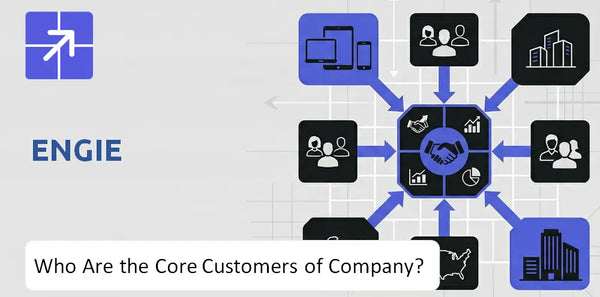
Who are ENGIE's core customers in its regulated and renewable energy target market?
ENGIE serves utilities, large industrials, and government/regulatory bodies focused on decarbonization and energy security. This matters because ENGIE's €22 – 25 billion 2024 – 2026 capex plan ties capacity additions to long-term contracts and regulated returns, lowering merchant exposure in 2025 – 2026.
Prioritize long-term contracts with utilities and industrials; pursue managed services for corporate sustainability buyers. See product insight: ENGIE BCG Matrix Analysis
Who Is ENGIE Trying to Win?
ENGIE tries to win long-term, high-volume institutional and industrial partners plus municipal authorities; retail (about 20 million European customers) is retained but not the strategic focus.
 Industrial and Large Commercial Energy Buyers
ENGIE targets large industrial and commercial energy clients in chemicals, heavy manufacturing, data centers and mining that need multi-year Power Purchase Agreements (PPAs) and on-site decarbonization. These industrial energy customers drive predictable revenue and often sign contracts exceeding 5 – 15 years.
Public Sector and Municipal Partners
Municipal governments and public authorities buy integrated district heating, cooling and smart-grid projects; ENGIE wins long-term concessions and regulated grid contracts that increase revenue visibility and lower churn risk. Public sector energy partners account for a substantial share of infrastructure-backed revenues.
Customer Type and Market Role
ENGIE primarily serves businesses and institutions (B2B and B2G) with a smaller but material residential footprint; the mix favors institutional counterparties over retail. This aligns ENGIE target market strategy toward corporate sustainability and decarbonization partners.
Most Important Segment by Revenue and Strategy
The highest-value segment is large-scale PPAs and regulated grid operations for industrial customers and municipalities, which deliver the largest contracts and most stable cash flow; ENGIE reported increasing group investments in renewables and networks in 2025 to serve these clients. See Mission, Vision, and Values of ENGIE Company for more context.
ENGIE SWOT Analysis
- Complete SWOT Breakdown
- Fully Customizable
- Editable in Excel & Word
- Professional Formatting
- Investor-Ready Format

What Do ENGIE's Customers Care About Most?
ENGIE target customers prioritize predictable energy costs, regulatory compliance, and uninterrupted operations; industrial and public-sector buyers demand fixed-price renewables, Scope 1/2 emissions reductions, and infrastructure modernization to protect budgets and reputations.

Price predictability and hedging
Industrial energy customers seek long-term fixed-price contracts and PPAs to hedge against volatility after the early 2020s; fixed contracts often span 10 – 20 years and can lock savings of 5 – 15% versus spot-exposed costs depending on market conditions.
Regulatory compliance and emissions targets
Commercial energy clients and multinationals prioritize meeting Scope 1 and 2 targets to satisfy ESG mandates and avoid carbon taxes; customers expect audited, verifiable renewable attribute certificates and reporting aligned with standards like GHG Protocol.
Operational resilience and reliability
Public sector energy partners demand grid stability and uptime for critical services; resilience measures include on-site backup, microgrids, and SLAs often guaranteeing 99.9% availability for key assets.
Energy efficiency and cost reduction
Municipal and institutional buyers focus on retrofits and efficiency to lower lifecycle costs; typical retrofit projects target 10 – 30% energy savings and paybacks of 3 – 7 years.
Reputation and ESG signaling
Large corporations use renewable procurement to signal sustainability to investors and customers; reputational risk drives preference for tier-one partners with global project delivery and compliance track records.
Repeat demand and long-term partnerships
Retention hinges on predictable pricing, transparent reporting, and integrated offerings (PPA, O&M, energy management); clients often renew or expand contracts, with enterprise customers spending 5 – 15% of OPEX on energy services annually.
Why customers choose ENGIE
ENGIE target market segments explained: buyers prefer a partner that combines renewable generation, PPAs, smart-grid tech, and retrofit services to balance sustainability, affordability, and reliability – especially for industrial energy customers and public sector energy procurement clients. Read the Sales and Marketing Strategy of ENGIE Company for more context.
ENGIE Business Model Canvas
- One-time Payment
- No Research Needed – Save Hours of Work
- Built by Experts, Trusted by Consultants
- Instant Download, Ready to Use
- 100% Editable, Fully Customizable

Where Is Demand Strongest for ENGIE?
ENGIE finds the most demand in Europe and North America, driven by policy support and large-scale electrification; France is the single strongest domestic market while the fastest growth is in the United States and Brazil.
Main Market: Europe and North America
ENGIE target market concentrates in the EU and North America where the EU Green Deal and the US Inflation Reduction Act boost renewables, regulated networks, and decarbonization contracts; France anchors regulated gas networks and flexible power.
Secondary Markets: US, Brazil, and Digital Infrastructure
The fastest growth is in the United States and Brazil as ENGIE target customers expand renewables and PPAs; data centers and AI-driven digital infrastructure now account for a growing share of new capacity bookings – estimated at over 20% of 2025 commercial capacity commitments.
Where ENGIE Is Strongest: France and 20 Core Countries
ENGIE customers and clients in France deliver large regulated revenues and stable cash flows; overall, ENGIE concentrates capital deployment across 20 essential countries to maximize risk-adjusted returns and tariff visibility, supporting commercial energy clients and public sector energy partners.
Where Demand Is Growing Fastest: Data Centers, US, Brazil (2025 – 2026)
In 2025 – 2026 demand surges for energy for AI-heavy data centers, industrial energy customers, and corporate PPAs; ENGIE commercial energy contracts for businesses and district heating customers are expanding, with renewables capacity additions accelerating in the US and Brazil.
For competitive context see Competitive Landscape of ENGIE Company
ENGIE Marketing Mix
- Complete Marketing Mix Analysis
- Effortlessly Communicate Your Business Strategy
- Investor-Ready Format
- 100% Editable and Customizable
- Clear and Structured Layout

How Does ENGIE Keep Its Audience Growing?
ENGIE keeps its audience growing by investing in renewable capacity, selling long-term indexed contracts, and offering flexible firming services like battery storage; it reaches adjacent industrial, commercial, and public-sector segments while locking customers into multi-year contracts to boost retention and deepen relationships.
Expanding ENGIE target customers and segments
ENGIE expands its ENGIE target market by scaling renewables – > 50 GW operational by 2025 and targeting 80 GW by 2030 – then cross-selling to industrial energy customers, commercial energy clients, and public sector energy partners via PPAs, grid services, and green-molecule supply.
Customer Retention Drivers in ENGIE customer segments
Retention hinges on long-term, inflation-indexed contracts in Networks and 10 – 20 year agreements in Renewables, plus service-level integrated offerings (energy management, district heating). These reduce churn for commercial and municipal ENGIE target customers.
Loyalty, repeat demand, and customer depth
Repeat demand comes from multiyear PPAs, O&M bundles, and green molecules (biomethane) supplying corporate sustainability and decarbonization partners; infrastructure complexity creates high switching costs for large corporations and multinationals.
Strongest customer-base growth lever for 2025/2026
The key lever is capital allocation to high-barrier infrastructure and flexible generation (battery storage, pumped hydro) that provides firming services to intermittent renewable buyers; management projects Net Recurring Income Group Share of €5.0 – 5.6 billion for 2025/2026, supporting customer-focused investments and long-term contracts.
For more on ENGIE target market strategy and revenue models see How ENGIE Company Works and Makes Money
ENGIE Boston Consulting Group Matrix
- Built by Experts, Trusted by Consultants
- Structured for Consultants, Students, and Founders
- 100% Editable in Microsoft Word & Excel
- Instant Digital Download – Use Immediately
- Compatible with Mac & PC – Fully Unlocked

Related Blogs
- What Is the History of ENGIE Company and How Did It Evolve?
- What Is the Competitive Landscape of ENGIE Company and How Does It Compete?
- What Is the Growth Outlook of ENGIE Company and Where Is It Heading?
- How Does ENGIE Company Work and What Drives Its Business Model?
- How Does ENGIE Company Reach Customers and Turn Demand into Sales?
- What Do the Mission, Vision, and Core Values of ENGIE Company Reveal?
- Who Owns ENGIE Company Today and Who Holds Control?
Frequently Asked Questions
ENGIE's core customer groups are industrial and large commercial energy buyers, plus public sector and municipal partners. The company mainly serves B2B and B2G clients, while retail customers remain part of the mix but are not the strategic focus. This makes institutional counterparties the center of ENGIE's target market.
Disclaimer
All information, articles, and product details provided on this website are for general informational and educational purposes only. We do not claim any ownership over, nor do we intend to infringe upon, any trademarks, copyrights, logos, brand names, or other intellectual property mentioned or depicted on this site. Such intellectual property remains the property of its respective owners, and any references here are made solely for identification or informational purposes, without implying any affiliation, endorsement, or partnership.
We make no representations or warranties, express or implied, regarding the accuracy, completeness, or suitability of any content or products presented. Nothing on this website should be construed as legal, tax, investment, financial, medical, or other professional advice. In addition, no part of this site - including articles or product references - constitutes a solicitation, recommendation, endorsement, advertisement, or offer to buy or sell any securities, franchises, or other financial instruments, particularly in jurisdictions where such activity would be unlawful.
All content is of a general nature and may not address the specific circumstances of any individual or entity. It is not a substitute for professional advice or services. Any actions you take based on the information provided here are strictly at your own risk. You accept full responsibility for any decisions or outcomes arising from your use of this website and agree to release us from any liability in connection with your use of, or reliance upon, the content or products found herein.