
How does ENGIE convert leads into long-term contracted sales through its sales and marketing model?
ENGIE shifts from volume utility sales to service-led contracts, using GEMS to bundle generation, optimization, and decarbonization services. This model matters because it secures long-term cash flows; in 2025 ENGIE emphasized PPAs and multi-year energy-as-a-service deals to stabilize revenue.
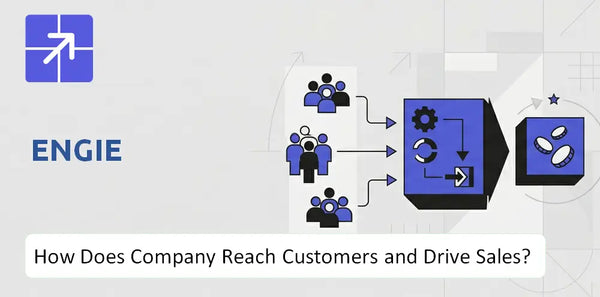
Practical insight: prioritize bundled offers and PPAs to lock demand; see ENGIE's strategic positioning in ENGIE BCG Matrix Analysis for portfolio actions.
Who Does ENGIE Want to Sell To?
ENGIE targets three high-value segments: large industrial and commercial (I&C) customers with complex decarbonization needs, municipalities and public entities seeking Energy-as-a-Service, and a broad B2C retail base of ~20 million customers across Europe and South America. The company wins them by selling integrated technical solutions, project delivery, and scaled retail channels.
 Primary focus: Large Industrial & Commercial (I&C)
ENGIE prioritizes Transition-Hard sectors – chemicals, steel, data centers – that need Green corporate PPAs and bespoke decarbonisation projects to meet 2030 net-zero targets; these clients drive high-margin, multi-year contracts and integrated service demand. ENGIE customer acquisition here emphasizes direct sales, industrial engineering teams, and long RFP pipelines.
Secondary targets: Municipalities & Public Entities
Municipalities seek Energy-as-a-Service for district heating, cooling, and urban infrastructure upgrades; ENGIE sells turnkey project finance, operation, and maintenance contracts, often structured as performance-based agreements. Public-sector deals favor bundled solutions and long-term service contracts that stabilize recurring revenue.
Mass retail base: B2C across Europe & South America
ENGIE serves approximately 20 million residential customers with gas, electricity, and energy services using retail channels: digital onboarding, call centers, door-to-door in select markets, and partner networks. Digital channels for energy sales and CRM/data analytics drive conversion and retention in the B2C sales process.
Market positioning: Integrated decarbonization partner
ENGIE positions itself as an end-to-end decarbonization and energy services provider rather than a commodity supplier, leaning on renewables, CCUS pilot projects, and energy efficiency services to capture high-value contracts. This ENGIE sales strategy targets solution complexity over pure volume.
Why this positioning works
Large I&C and public customers have urgent 2030 targets and prefer integrated delivery, so ENGIE demand generation focuses on engineered offers, Green PPAs, and Energy-as-a-Service to secure multi-year revenue; retail scale provides cash flow and cross-sell opportunities. See History and Background of ENGIE Company for context: History and Background of ENGIE Company
Operational and financial signals
In 2025 ENGIE reported increased contracted renewables capacity and recurring energy services revenue, with the B2C base near 20 million customers and B2B project pipelines driven by Green PPA wins and district energy contracts; ENGIE marketing channels blend direct sales, digital marketing, partnerships, and targeted advertising to convert complex leads into paid customers.
ENGIE SWOT Analysis
- Complete SWOT Breakdown
- Fully Customizable
- Editable in Excel & Word
- Professional Formatting
- Investor-Ready Format

How Does ENGIE Get in Front of Customers?
ENGIE gets in front of customers via a decentralized, expert-led distribution network: GEMS-driven B2B account teams, digital storefronts and apps for B2C/SMEs, plus strategic industrial partnerships and green hydrogen hubs to seed demand.

GEMS consultative selling for institutional accounts
GEMS deploys specialized account managers who act as energy architects, embedding ENGIE into clients' capital plans through consultative selling and long-term contracting; by 2025 GEMS supported contracts totaling €18.4bn of backlog across industrial and municipal customers.
Digital marketing and AI-driven SME storefronts
ENGIE expanded digital storefronts for SMEs by March 2026, using AI analytics to offer tailored energy-efficiency audits as lead magnets; digital channels (search, paid media, apps, email) now account for an estimated 30% of SME leads.
Sales channels: direct, partners, and marketplaces
ENGIE uses direct sales for large customers, retailer and installer partnerships for distributed generation, and platform marketplaces for SME offers; channel mix reduced sales cycle by ~15% in 2025 for rooftop solar and efficiency contracts.
Demand generation: audits, hubs, and events
Primary tactics include AI energy-efficiency audits, participation in global green hydrogen hubs, industry roadshows, and co-funded pilot projects; hydrogen and green mobility partnerships created early-stage demand pipeline worth > €2.1bn by 2025.
Customer acquisition efficiency and metrics
ENGIE measures acquisition by LTV/CAC and time-to-contract; reported improvements in 2025 show a 25% rise in conversion from AI-audit leads and a 20% drop in CAC for SME offers after storefront rollout.
Most important reach advantage: decentralized experts + digital scale
The strongest reach advantage in 2025/2026 is the blend of localized expert account teams (GEMS) and scalable digital channels; this hybrid model drives both large-contract wins and high-volume SME traction – see Growth Outlook of ENGIE Company for context: Growth Outlook of ENGIE Company
ENGIE Business Model Canvas
- One-time Payment
- No Research Needed – Save Hours of Work
- Built by Experts, Trusted by Consultants
- Instant Download, Ready to Use
- 100% Editable, Fully Customizable

How Does ENGIE Turn Attention Into Sales?
ENGIE turns attention into sales by converting commodity buyers into long-term strategic partners via bundled supply-plus-service contracts; initial interest becomes revenue through 10 – 15 year PPAs, Risk Management as a Service, and staged upsells into storage, EV charging, and O&M.
Core sales model: Supply-plus-Service contracting
ENGIE uses direct B2B sales and partner-led deals to sell long-term power purchase agreements (PPAs), bundled with trading-led price hedging and on-site services; digital channels and corporate origination teams target corporate and industrial buyers.
Pricing and monetization logic: price certainty plus service fees
Revenue mixes include fixed-price energy under 10 – 15 year PPAs, recurring O&M and service contracts, and trading spreads from Risk Management as a Service; ENGIE captures margin via bundled fees and optional CapEx financing.
Conversion and purchase drivers: certainty, risk reduction, and flexibility
Clients convert when ENGIE offers price certainty (hedges executed by its trading desk), regulatory-compliant PPAs, and monetizable flexibility services that let customers sell demand response or battery capacity back to markets; trust in trading execution and credit terms accelerates signings.
Repeat revenue and expansion: staged upsell and circular value
Starts with a solar or supply contract then upsells to on-site batteries, EV chargers, and long-term O&M; flexibility services turn customer assets into recurring revenue streams, increasing retention and average contract value over time.
ENGIE customer acquisition mixes corporate origination, digital demand generation, and partner channels; in 2025 ENGIE reported locked-in contracted capacity and PPA exposure that support recurring revenue and margin visibility (see company disclosures for exact 2025 PPA backlog and trading volumes). For deeper context on ENGIE's commercial model and monetization, read How ENGIE Company Works and Makes Money
ENGIE Marketing Mix
- Complete Marketing Mix Analysis
- Effortlessly Communicate Your Business Strategy
- Investor-Ready Format
- 100% Editable and Customizable
- Clear and Structured Layout

How Strong Does ENGIE's Commercial Engine Look Going Forward?
ENGIE's commercial engine enters 2025/2026 with clear momentum: a pivot toward contracted, regulated activities and a fast-growing renewable fleet that should sustain sales and margin stability. Strengths include scale in renewables and flexibility services; headwinds are lower spot power prices and execution risk on large project pipelines.
What Supports Future Demand
Installed renewables capacity targeting 50 GW by end-2025 and an 80 GW pipeline to 2030 anchors ENGIE customer acquisition for green offerings; contracted revenues and PPAs improve predictability and support ENGIE demand generation.
Channel and Marketing Effectiveness
Digital channels, B2C platforms, and industrial sales teams target residential and corporate buyers; CRM and data analytics bolster lead conversion and long-tail acquisition such as how ENGIE reaches residential customers and community engagement strategies used by ENGIE.
Risks to Commercial Performance
Main risks: lower wholesale power prices versus 2022 highs reducing merchant margin, delays on project delivery for the 2030 pipeline, and regulatory changes affecting tariffs or renewables incentives; customer churn if onboarding or pricing slips.
The Overall Sales and Marketing Outlook
Outlook is high performance: guidance for 2025 shows net recurring income group share of between 5.0 billion and 5.6 billion euros, and management expects regulated/contracted activities to exceed 75 percent of EBIT by 2026, supporting defensive sales performance and pricing power for green electrons and flexibility.
For context on market positioning and competitors see Competitive Landscape of ENGIE Company
ENGIE Boston Consulting Group Matrix
- Built by Experts, Trusted by Consultants
- Structured for Consultants, Students, and Founders
- 100% Editable in Microsoft Word & Excel
- Instant Digital Download – Use Immediately
- Compatible with Mac & PC – Fully Unlocked

Related Blogs
- What Is the History of ENGIE Company and How Did It Evolve?
- What Is the Competitive Landscape of ENGIE Company and How Does It Compete?
- What Is the Growth Outlook of ENGIE Company and Where Is It Heading?
- How Does ENGIE Company Work and What Drives Its Business Model?
- What Do the Mission, Vision, and Core Values of ENGIE Company Reveal?
- Who Are the Core Customers in ENGIE Company's Target Market?
- Who Owns ENGIE Company Today and Who Holds Control?
Frequently Asked Questions
ENGIE focuses on large industrial and commercial customers, municipalities and public entities, and a broad B2C retail base. For industrial and public clients, it sells integrated technical solutions, project delivery, and long-term service contracts. For residential customers, it uses scaled retail channels across Europe and South America.
Disclaimer
All information, articles, and product details provided on this website are for general informational and educational purposes only. We do not claim any ownership over, nor do we intend to infringe upon, any trademarks, copyrights, logos, brand names, or other intellectual property mentioned or depicted on this site. Such intellectual property remains the property of its respective owners, and any references here are made solely for identification or informational purposes, without implying any affiliation, endorsement, or partnership.
We make no representations or warranties, express or implied, regarding the accuracy, completeness, or suitability of any content or products presented. Nothing on this website should be construed as legal, tax, investment, financial, medical, or other professional advice. In addition, no part of this site - including articles or product references - constitutes a solicitation, recommendation, endorsement, advertisement, or offer to buy or sell any securities, franchises, or other financial instruments, particularly in jurisdictions where such activity would be unlawful.
All content is of a general nature and may not address the specific circumstances of any individual or entity. It is not a substitute for professional advice or services. Any actions you take based on the information provided here are strictly at your own risk. You accept full responsibility for any decisions or outcomes arising from your use of this website and agree to release us from any liability in connection with your use of, or reliance upon, the content or products found herein.