
Who are Equifax's core customers among financial institutions and identity-reliant businesses?
Equifax serves banks, fintechs, card issuers, and large retailers that need real-time credit and identity data. This matters because Equifax's shift to cloud analytics supports its 8 – 10% long-term revenue growth target and reported stronger cloud product adoption in 2025.
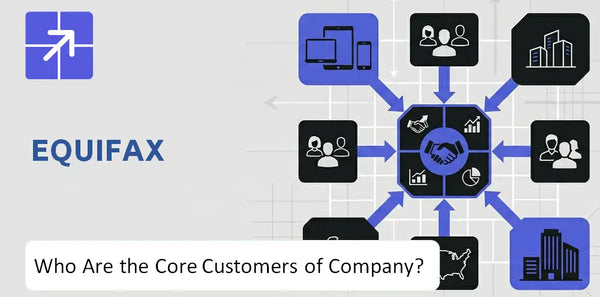
Focus on banks and fintechs for recurring B2B revenue; prioritize products tied to identity verification and fraud prevention. See Equifax BCG Matrix Analysis for product-level positioning.
Who Is Equifax Trying to Win?
Equifax tries to win large institutional clients – banks, mortgage lenders, fintechs – and HR and government customers for Workforce Solutions, while also retaining individual consumers via identity protection and credit monitoring.
 Main customer group: Institutional financial clients
Equifax target customers are primarily large financial institutions, mortgage lenders, and fintech disruptors that integrate credit reports and analytics into lending and underwriting. These clients drive recurring contracts and product integration across credit risk, fraud, and decisioning platforms.
Secondary groups: HR, government, and telecom
Workforce Solutions (EWS) serves employers, HR departments, and government agencies with employment and income verification from a database exceeding 670 million records. US Information Solutions targets telecommunications firms and other commercial buyers needing identity and portfolio data.
Customer type and market role: Mixed B2B and B2C focus
Equifax core customers are mainly institutional and enterprise clients (B2B) plus direct-to-consumer subscribers for credit monitoring and identity theft protection. Business clients of Equifax account for the majority of product usage and long-term contracts.
Most important segment: Institutional B2B (revenue driver)
Over 80 percent of total revenue in 2026 comes from institutional B2B customers, making financial institutions using Equifax data the primary revenue engine and priority for capital allocation and product development. For more context see History and Background of Equifax Company.
Equifax SWOT Analysis
- Complete SWOT Breakdown
- Fully Customizable
- Editable in Excel & Word
- Professional Formatting
- Investor-Ready Format

What Do Equifax's Customers Care About Most?
Equifax core customers prioritize data accuracy, decisioning speed, and regulatory compliance to reduce credit risk and friction; lenders and enterprises also demand advanced fraud defenses and API reliability to scale underwriting and customer onboarding.

Data accuracy and alternative signals
Lenders and financial institutions using Equifax data want precise, up-to-date files and alternative data – utility payments and real-time employment – to extend credit to thin-file borrowers and lower default rates.
Speed of decisioning and integration
Business clients of Equifax require sub-second decisioning and seamless API integration into underwriting systems to cut approval times and reduce abandonment during onboarding.
Regulatory compliance and auditability
Financial institutions using Equifax services insist on traceable models, explainability for adverse-action notices, and vendor controls to meet CFPB and EU/UK regulatory expectations.
Fraud prevention and identity assurance
Enterprise clients value Equifax advanced fraud suites with AI behavioral biometrics to detect synthetic identities; spend on fraud solutions rose by 15 percent in the last fiscal year.
Operational reliability and SLAs
Institutions expect 99.9 percent uptime and predictable latency; uptime SLAs and redundant APIs reduce business interruption risk for mortgage lenders and creditors.
Value and repeat demand drivers
Retention hinges on data breadth, model performance, and integration ease; customers – from landlords and property managers to insurers – renew when hit rates and false-positive reductions improve economic outcomes.
Why these customers choose Equifax
Equifax target customers pick the firm for proprietary datasets and enterprise-grade fraud tools that improve approval rates and lower loss rates – see Growth Outlook of Equifax Company for context on strategic investments and product demand.
Equifax Business Model Canvas
- One-time Payment
- No Research Needed – Save Hours of Work
- Built by Experts, Trusted by Consultants
- Instant Download, Ready to Use
- 100% Editable, Fully Customizable

Where Is Demand Strongest for Equifax?
Demand for Equifax is most concentrated in the United States, which contributes roughly 75 percent of revenue, while fastest growth is in international markets like Brazil and Australia as digital transformation accelerates.
Main geographic market: United States dominance
The United States remains the primary market for Equifax target customers, driving about 75 percent of total revenue in fiscal 2025; this matters because large financial institutions, mortgage lenders that rely on Equifax, and major employers are concentrated there.
Secondary markets: Brazil and Australia
International growth is strongest in Brazil and Australia where digital ID and credit-data adoption rose over 20 percent year-over-year in 2025, expanding Equifax core customers among financial institutions using Equifax data and business clients of Equifax.
Where Equifax is strongest: government, payroll, and large lenders
Equifax Workforce Solutions anchors demand in government and social services – critical for benefits administration and talent management – while large creditors and insurers provide steady revenue and high usage among consumers and lenders served by Equifax.
Fastest-growing demand: cloud analytics and SMEs
After completing a cloud-native platform in late 2024, Equifax saw surging demand for cloud-based analytics; pay-as-you-go offerings lifted small business customers of Equifax, capturing scalable SME risk-management spend and increasing market share in 2025.
For further detail on market positioning and sales channels, see Sales and Marketing Strategy of Equifax Company
Equifax Marketing Mix
- Complete Marketing Mix Analysis
- Effortlessly Communicate Your Business Strategy
- Investor-Ready Format
- 100% Editable and Customizable
- Clear and Structured Layout

How Does Equifax Keep Its Audience Growing?
Equifax keeps its audience growing by embedding proprietary data into client decisioning engines and launching products on Equifax Cloud, reaching adjacent segments via targeted acquisitions and new AI-augmented offerings while preserving high retention.
Product-led expansion into adjacent markets
Equifax adds customers by releasing over 100 new products annually on Equifax Cloud, including AI-augmented credit scores in early 2026, and by acquiring niche data providers in insurance and talent acquisition to broaden the Equifax target market.
Customer retention drivers
Embedding data directly into client decisioning engines creates high switching costs; Equifax maintained a 95 percent client retention rate through 2025 by becoming non-discretionary for financial institutions using Equifax data and business clients of Equifax.
Loyalty, repeat demand, and ecosystem stickiness
Recurring subscriptions, integrated APIs, and embedded employment and identity signals drive renewals and upsells to consumers and lenders served by Equifax; long-tail buyers such as mortgage lenders that rely on Equifax and insurance companies using Equifax data increase share of wallet.
Strongest customer-base growth lever
The employment-data moat – unique payroll and employment signals – lets Equifax capture counter-cyclical demand in debt collection and government assistance, supporting projected revenue above $6.4 billion for 2025/2026 as operating margins expand after legacy decommissioning.
For more on ownership and governance that shapes strategic moves, see Ownership and Control of Equifax Company
Equifax Boston Consulting Group Matrix
- Built by Experts, Trusted by Consultants
- Structured for Consultants, Students, and Founders
- 100% Editable in Microsoft Word & Excel
- Instant Digital Download – Use Immediately
- Compatible with Mac & PC – Fully Unlocked

Related Blogs
- What Is the History of Equifax Company and How Did It Evolve?
- What Is the Competitive Landscape of Equifax Company and How Does It Compete?
- What Is the Growth Outlook of Equifax Company and Where Is It Heading?
- How Does Equifax Company Work and What Drives Its Business Model?
- How Does Equifax Company Reach Customers and Turn Demand into Sales?
- What Do the Mission, Vision, and Core Values of Equifax Company Reveal?
- Who Owns Equifax Company Today and Who Holds Control?
Frequently Asked Questions
Equifax's core customers are mainly large institutional financial clients such as banks, mortgage lenders, and fintechs. The company also serves HR and government customers through Workforce Solutions, plus some direct-to-consumer users for credit monitoring and identity protection.
Disclaimer
All information, articles, and product details provided on this website are for general informational and educational purposes only. We do not claim any ownership over, nor do we intend to infringe upon, any trademarks, copyrights, logos, brand names, or other intellectual property mentioned or depicted on this site. Such intellectual property remains the property of its respective owners, and any references here are made solely for identification or informational purposes, without implying any affiliation, endorsement, or partnership.
We make no representations or warranties, express or implied, regarding the accuracy, completeness, or suitability of any content or products presented. Nothing on this website should be construed as legal, tax, investment, financial, medical, or other professional advice. In addition, no part of this site - including articles or product references - constitutes a solicitation, recommendation, endorsement, advertisement, or offer to buy or sell any securities, franchises, or other financial instruments, particularly in jurisdictions where such activity would be unlawful.
All content is of a general nature and may not address the specific circumstances of any individual or entity. It is not a substitute for professional advice or services. Any actions you take based on the information provided here are strictly at your own risk. You accept full responsibility for any decisions or outcomes arising from your use of this website and agree to release us from any liability in connection with your use of, or reliance upon, the content or products found herein.