
Who are Fossil Group's core customers in the global accessories and mid-price fashion market?
Fossil Group targets style-conscious consumers aged 25 – 45 who seek affordable-luxury watches and jewelry that signal fashion relevance. This matters because by 2025 Fossil Group reported $1.4 billion in revenue and shifted back toward high-margin heritage products to stabilize margins.
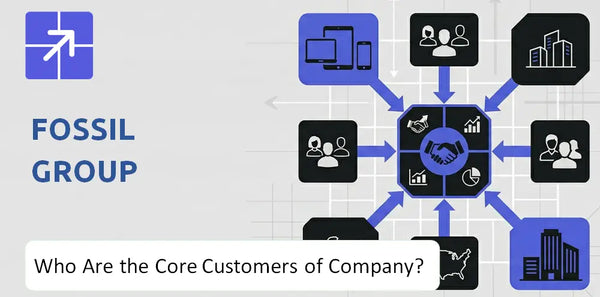
Focus on urban professionals and gift buyers; fast design cycles and licensed-brand partnerships drive repeat purchases. See product context in Fossil Group BCG Matrix Analysis.
Who Is Fossil Group Trying to Win?
Fossil Group tries to win style-conscious Millennials and Gen Z trend-seekers aged roughly 20 – 45, plus seasonal gift buyers; these groups treat watches and accessories as outfit components and seek accessible luxury in the $150 – $500 range.
 Main customer: Style-Conscious Millennial
Style-Conscious Millennials drive repeat purchases for fashion and function; they prefer brand-name prestige at mid-market prices and account for a large share of online and mall-based sales.
Secondary: Gen Z Trend-Seekers and Gift Buyers
Gen Z trend-seekers favor smart/hybrid watches and social-driven styles; holiday and corporate gift buyers create a quarterly spike, contributing to an estimated 35% revenue surge in Q4.
Customer type and market role
Fossil Group target customers are mainly consumers (retail) with significant wholesale and retail-partner channels; revenue mix includes direct-to-consumer online sales and partner distribution globally.
Most important segment by revenue
The Accessible Luxury segment – buyers seeking Michael Kors, Emporio Armani prestige at mid-market prices – appears most important by revenue and margin, driving both branded license sales and Fossil flagship durability-focused purchases; online shoppers and affluent professionals boost average order value.
How Fossil Group Company Works and Makes Money
Fossil Group SWOT Analysis
- Complete SWOT Breakdown
- Fully Customizable
- Editable in Excel & Word
- Professional Formatting
- Investor-Ready Format

What Do Fossil Group's Customers Care About Most?
Fossil Group customers prioritize visible style and brand signaling over technical watch complexity, seeking New Vintage and slim analog looks with durable materials, recognizable logos, and frictionless omnichannel buying. Emotional Instagrammability and affordable pricing that permits multiple purchases per year drive demand.

Aesthetic Currency and Brand Signaling
Fossil Group target customers buy watches as visible style cues; New Vintage and slim analog designs are primary drivers, countering wearable-screen saturation.
Practical Buying Drivers: Materials and Price
Buyers demand 316L stainless steel, eco-tanned leathers, and reliable gold plating at accessible price points so they can purchase multiple units annually; retail price bands around $125 – $275 capture the core market.
Emotional and Aspirational Appeal
Instagrammability, licensed logos, and instant recognition drive purchases – customers seek watches that signal taste and affiliation rather than horological pedigree.
What Customers Value Most
Durable materials, slim vintage aesthetics, and personalization (engraving) rank highest; buyers trade deep technical specs for perceived style and lasting finish.
Loyalty and Repeat Demand
Affordable price points, seasonal drops, licensed collaborations, and personalization drive repeat purchases; average active buyers purchase 2 – 3 items per year in target segments.
Why Customers Choose Fossil Group
Fossil Group wins by offering recognizable design language, reliable mid-tier materials, omnichannel convenience, and strong licensed-brand partnerships that boost shelf and social visibility; see Sales and Marketing Strategy of Fossil Group Company for context.
Fossil Group Business Model Canvas
- One-time Payment
- No Research Needed – Save Hours of Work
- Built by Experts, Trusted by Consultants
- Instant Download, Ready to Use
- 100% Editable, Fully Customizable

Where Is Demand Strongest for Fossil Group?
Fossil Group finds the most demand in North America and fast-growing pockets in Asia-Pacific, with DTC e-commerce and travel retail as the most active environments.
Main Market: North America
North America drives roughly 42% of Fossil Group total sales in fiscal 2025, reflecting concentrated demand from affluent professionals and fashion-conscious consumers who choose Fossil across watches and accessories.
Secondary Markets: Asia-Pacific (India, Mainland China)
Asia-Pacific, led by India and Mainland China, shows the fastest growth as a burgeoning middle class buys Fossil watches as status items; regional market differences in Fossil customer base favor mid-priced fashion timepieces and hybrid smartwatches.
Where Fossil Group Is Strongest
Fossil Group is strongest in direct-to-consumer channels and travel retail: DTC e-commerce constitutes nearly 40% of sales mix in 2025, while airport boutiques and duty-free remain high-margin outlets for licensed brands like Armani and Diesel.
Fastest-Growing Demand Areas (2025 – 2026)
Jewelry outperformed wholesale watch sell-through by 12% year-over-year by early 2026; Gen Z interest in smartwatches and tech-savvy consumers buying hybrid smartwatches are accelerating online shoppers looking for Fossil watches and smartwatches.
Growth Outlook of Fossil Group Company
Fossil Group Marketing Mix
- Complete Marketing Mix Analysis
- Effortlessly Communicate Your Business Strategy
- Investor-Ready Format
- 100% Editable and Customizable
- Clear and Structured Layout

How Does Fossil Group Keep Its Audience Growing?
Fossil Group keeps its audience growing by prioritizing jewelry SKUs and pruning low-performing licenses, expanding into adjacent fashion and Gen Z streetwear spaces, and using data-driven loyalty triggers to boost purchase frequency and retention.
How Fossil Group Expands Its Customer Base
Fossil Group grows customers by a Jewelry-First push that targets fashion-conscious consumers who choose Fossil jewelry quarterly, plus limited-edition artist and streetwear collaborations that attract Gen Z interest in Fossil smartwatches and accessories. It also converts licensed-brand buyers into Fossil brand advocates via cross-sell assortments and retail partner promotions.
Customer Retention Drivers
Retention relies on a data-centric loyalty ecosystem using predictive modeling to send personalized offers based on past fashion preferences; higher SKU velocity in jewelry raises purchase frequency vs. watches bought biennially. Scarcity Marketing – limited drops – keeps churn low among trend-sensitive segments.
Loyalty, Repeat Demand, or Customer Depth
Fossil Group's loyalty program and CRM drive repeat demand: predictive triggers lift average purchase frequency from ~0.5 watch buys/year to quarterly jewelry buys for engaged customers. Focused assortments and targeted promotions deepen customer lifetime value (LTV) across Fossil Group target customers and Fossil customer segments.
The Strongest Customer-Base Growth Lever
The key lever is sustaining a 53 percent gross margin while converting licensed-brand fans to long-term Fossil brand buyers; stabilizing margins in 2025 lets investment in loyalty and limited-edition drops scale customer acquisition and retention.
For context on corporate strategy and brand evolution see History and Background of Fossil Group Company.
Fossil Group Boston Consulting Group Matrix
- Built by Experts, Trusted by Consultants
- Structured for Consultants, Students, and Founders
- 100% Editable in Microsoft Word & Excel
- Instant Digital Download – Use Immediately
- Compatible with Mac & PC – Fully Unlocked

Related Blogs
- What Is the History of Fossil Group Company and How Did It Evolve?
- What Is the Competitive Landscape of Fossil Group Company and How Does It Compete?
- What Is the Growth Outlook of Fossil Group Company and Where Is It Heading?
- How Does Fossil Group Company Work and What Drives Its Business Model?
- How Does Fossil Group Company Reach Customers and Turn Demand into Sales?
- What Do the Mission, Vision, and Core Values of Fossil Group Company Reveal?
- Who Owns Fossil Group Company Today and Who Holds Control?
Frequently Asked Questions
Fossil Group mainly targets style-conscious Millennials and Gen Z trend-seekers aged roughly 20-45, along with seasonal gift buyers. These shoppers treat watches and accessories as outfit pieces and look for accessible luxury in the $150-$500 range, with brand-name style and mid-market pricing driving interest.
Disclaimer
All information, articles, and product details provided on this website are for general informational and educational purposes only. We do not claim any ownership over, nor do we intend to infringe upon, any trademarks, copyrights, logos, brand names, or other intellectual property mentioned or depicted on this site. Such intellectual property remains the property of its respective owners, and any references here are made solely for identification or informational purposes, without implying any affiliation, endorsement, or partnership.
We make no representations or warranties, express or implied, regarding the accuracy, completeness, or suitability of any content or products presented. Nothing on this website should be construed as legal, tax, investment, financial, medical, or other professional advice. In addition, no part of this site - including articles or product references - constitutes a solicitation, recommendation, endorsement, advertisement, or offer to buy or sell any securities, franchises, or other financial instruments, particularly in jurisdictions where such activity would be unlawful.
All content is of a general nature and may not address the specific circumstances of any individual or entity. It is not a substitute for professional advice or services. Any actions you take based on the information provided here are strictly at your own risk. You accept full responsibility for any decisions or outcomes arising from your use of this website and agree to release us from any liability in connection with your use of, or reliance upon, the content or products found herein.