
Who are Franklin Covey Company's core customers in the enterprise training and leadership market?
Franklin Covey Company targets HR and L&D leaders at mid-to-large enterprises seeking scalable leadership and productivity systems. This matters because the All Access Pass drove ~75% of 2025 revenue, signaling a shift to subscription-driven enterprise contracts and predictable ARR.
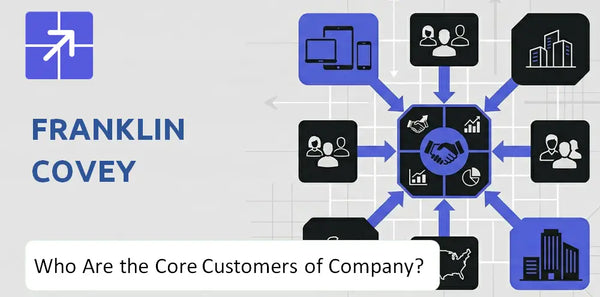
Focus on decision-makers who buy enterprise-wide AAP licenses; they renew at higher rates and expand into new business units. See the Franklin Covey BCG Matrix Analysis for product positioning details.
Who Is Franklin Covey Trying to Win?
Franklin Covey Company targets large enterprises and government agencies needing systemic behavioral change, primarily selling to CHROs and CLOs at Fortune 1000 firms; secondary targets are mid-market firms (500 – 2,000 employees) and educational institutions.
 Enterprise HR and Learning Leaders
Franklin Covey customers are chiefly CHROs and Chief Learning Officers at Fortune 1000 companies who manage decentralized workforces and seek scalable leadership development to close execution gaps; these buyers prioritize solutions that can be rolled out to thousands of employees under a single contract.
Mid – market Firms and Educational Partners
Secondary segments include mid – market corporate training buyers with 500 – 2,000 staff and educational institutions partnering for curriculum and staff development; these groups drive steady recurring revenue but smaller average contract value than enterprise accounts.
Business and Institutional Market Role
Franklin Covey target market is mainly B2B and institutional: government agencies leadership development needs and corporate HR decision makers dominate spend, with a smaller direct – to – consumer channel for individual professionals buying Franklin Covey courses online.
Most Important Revenue Segment
The most important segment by revenue and scale is enterprise accounts sold to CHROs/CLOs: in fiscal 2025, enterprise and government contracts accounted for roughly ~68% of institutional service revenue, with average enterprise contract sizes often covering thousands of users and multi – year terms.
History and Background of Franklin Covey Company
Franklin Covey SWOT Analysis
- Complete SWOT Breakdown
- Fully Customizable
- Editable in Excel & Word
- Professional Formatting
- Investor-Ready Format

What Do Franklin Covey's Customers Care About Most?
Franklin Covey customers care most about measurable execution and consistent global delivery that turns strategy into frontline results; they buy to close the execution gap, reduce organizational friction, and build a principles-based leadership culture that improves productivity and retention.

Execution gap closure
Enterprise clients want programs that convert strategy into repeatable frontline behaviors and measurable outcomes; Franklin Covey customers prioritize solutions that drive daily execution across dispersed teams and geographies.
Practical buying drivers
Corporate training buyers and HR decision makers choose based on proven impact, scalability, and measurable ROI – price and convenience matter but 92 percent of 2025 AAP subscribers cited consistency of global delivery and principles-based leadership for renewal.
Emotional and aspirational appeal
Executives seek a winning culture that attracts and retains top talent; leadership development participants and C-suite executives view Franklin Covey as a safeguard against cultural fragmentation and a signal of serious people investment.
What customers value most
Clients value reduced friction via Speed of Trust, increased productivity from the 4 Disciplines of Execution, and consistent principles-based leadership that yields trackable performance improvements at scale.
Loyalty and repeat demand
Retention hinges on measurable impact and global consistency; HR managers evaluating Franklin Covey programs renew when they see improved execution metrics, lower turnover, and sustained behavior change across cohorts.
Why customers choose Franklin Covey Company
Franklin Covey customers pick the company because it delivers repeatable, principles-based leadership and execution systems with demonstrated renewal rates; see the Growth Outlook of Franklin Covey Company for related context and 2025 client-impact figures.
Franklin Covey Business Model Canvas
- One-time Payment
- No Research Needed – Save Hours of Work
- Built by Experts, Trusted by Consultants
- Instant Download, Ready to Use
- 100% Editable, Fully Customizable

Where Is Demand Strongest for Franklin Covey?
Demand is strongest in North American corporate accounts, where subscription growth drives revenue; international pockets in the United Kingdom and Japan are gaining momentum as organizations upskill to counter productivity headwinds.
Primary market: North American corporate sector
North American corporate buyers, especially HR decision makers and corporate training buyers, account for the largest share of subscriptions and recurring revenue; in 2025 North America represented about ~72% of enterprise subscription usage for Franklin Covey customers.
Secondary markets: UK and Japan; tech and healthcare verticals
The United Kingdom and Japan show accelerating adoption among executives and HR managers evaluating Franklin Covey programs, while technology and healthcare industries led purchases in 2026, together comprising roughly 45% of new enterprise deals.
Where Franklin Covey is strongest: hybrid delivery and enterprise reach
Franklin Covey is strongest in large accounts for leadership development participants and C-suite executives choosing executive coaching services; over 65% of content consumption is now digital or micro-learning, boosting per-user engagement and renewals.
Fastest-growing demand: digital micro-learning and international direct offices
Demand grew fastest in 2025 – 2026 for hybrid and remote teams leadership and collaboration training, with international direct-office bookings up double digits in the UK and Japan; small business owners seeking leadership training and nonprofit organizations staff development programs also form a growing long tail.
For deeper context on commercial positioning and go-to-market moves see Sales and Marketing Strategy of Franklin Covey Company
Franklin Covey Marketing Mix
- Complete Marketing Mix Analysis
- Effortlessly Communicate Your Business Strategy
- Investor-Ready Format
- 100% Editable and Customizable
- Clear and Structured Layout

How Does Franklin Covey Keep Its Audience Growing?
Franklin Covey Company grows its audience by landing small departmental pilots that scale enterprise-wide, refreshing content with AI coaching, and expanding into adjacent segments like HR decision makers and small business leaders to improve retention and deepen relationships.
How Franklin Covey Expands Its Customer Base
Franklin Covey customers are acquired via a land-and-expand model: a departmental pilot converts into enterprise licensing within about 18 months. The company broadens its Franklin Covey target market by targeting corporate training buyers, HR managers evaluating Franklin Covey programs, and small business owners seeking leadership training, plus online channels for individual professionals buying Franklin Covey courses online.
Customer Retention Drivers
Retention hinges on content relevance and delivery: annual subscription renewal rates hold at 93 percent, supported by continuous AAP library updates and the 2025 Agile Leadership series. AI-enabled coaching increases engagement for leadership development participants and frontline managers needing leadership skills, reducing churn among HR decision makers and training procurement officers.
Loyalty, Repeat Demand, and Customer Depth
Renewals and multi-year enterprise licenses drive repeat demand; ecosystem stickiness rises as executives looking for time management workshops and teams adopt multiple programs (The 7 Habits, leadership, sales training). Customer success teams and tailored content for remote teams leadership and collaboration training deepen account penetration and lifetime value.
The Strongest Customer-Base Growth Lever
The primary growth lever is retention combined with land-and-expand conversions: high-value subscribers plus a fixed-cost content library drive margin expansion. For 2025/2026 Franklin Covey Company is projected to see a 12 – 15 percent increase in Adjusted EBITDA as subscriber base grows and content costs remain largely fixed; see Ownership and Control of Franklin Covey Company for ownership context.
Franklin Covey Boston Consulting Group Matrix
- Built by Experts, Trusted by Consultants
- Structured for Consultants, Students, and Founders
- 100% Editable in Microsoft Word & Excel
- Instant Digital Download – Use Immediately
- Compatible with Mac & PC – Fully Unlocked

Related Blogs
- What Is the History of Franklin Covey Company and How Did It Evolve?
- What Is the Competitive Landscape of Franklin Covey Company and How Does It Compete?
- What Is the Growth Outlook of Franklin Covey Company and Where Is It Heading?
- How Does Franklin Covey Company Work and What Drives Its Business Model?
- How Does Franklin Covey Company Reach Customers and Turn Demand into Sales?
- What Do the Mission, Vision, and Core Values of Franklin Covey Company Reveal?
- Who Owns Franklin Covey Company Today and Who Holds Control?
Frequently Asked Questions
Franklin Covey's core customers are large enterprises and government agencies, especially CHROs and Chief Learning Officers at Fortune 1000 companies. The company also serves mid-market firms with 500-2,000 employees and educational institutions, but enterprise accounts are the main revenue segment.
Disclaimer
All information, articles, and product details provided on this website are for general informational and educational purposes only. We do not claim any ownership over, nor do we intend to infringe upon, any trademarks, copyrights, logos, brand names, or other intellectual property mentioned or depicted on this site. Such intellectual property remains the property of its respective owners, and any references here are made solely for identification or informational purposes, without implying any affiliation, endorsement, or partnership.
We make no representations or warranties, express or implied, regarding the accuracy, completeness, or suitability of any content or products presented. Nothing on this website should be construed as legal, tax, investment, financial, medical, or other professional advice. In addition, no part of this site - including articles or product references - constitutes a solicitation, recommendation, endorsement, advertisement, or offer to buy or sell any securities, franchises, or other financial instruments, particularly in jurisdictions where such activity would be unlawful.
All content is of a general nature and may not address the specific circumstances of any individual or entity. It is not a substitute for professional advice or services. Any actions you take based on the information provided here are strictly at your own risk. You accept full responsibility for any decisions or outcomes arising from your use of this website and agree to release us from any liability in connection with your use of, or reliance upon, the content or products found herein.