
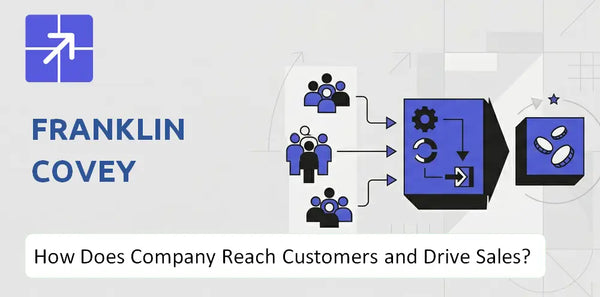
How does Franklin Covey's sales and marketing model convert training demand into recurring All Access Pass revenue?
Franklin Covey scales IP via subscriptions, shifting revenue from one-off workshops to recurring All Access Pass sales, which improves cash flow predictability and operating leverage. In 2025 the subscription mix rose, cutting cost of sales and lifting margins.
Track cohort retention and upsell rates: a 1% retention improvement in 2025 materially boosts lifetime value, so prioritize digital engagement and enterprise renewals. See Franklin Covey BCG Matrix Analysis
Who Does Franklin Covey Want to Sell To?
Franklin Covey targets large enterprises – especially Fortune 500 and Global 2000 – plus growing mid-market firms (500 – 5,000 employees). It wins buyers by selling measurable leadership, execution, and cultural-change programs to HR, learning leaders, and business unit heads using scalable digital solutions.
 Main Customer Group: Enterprise HR and Learning Leaders
Franklin Covey primarily sells to Chief Human Resources Officers, Chief Learning Officers, and senior people leaders at Fortune 500 and Global 2000 firms who budget for enterprise-wide leadership and culture programs. These buyers value measurable ROI in trust, execution, and productivity, and typically sign multi-year contracts worth from $500,000 to several million dollars for global deployments as of 2025.
Additional Target Segments: Mid-Market and Business Units
Since 2025 Franklin Covey has expanded into mid-market organizations with 500 – 5,000 employees that need scalable, digital-first leadership and behavior-change programs. Business unit leaders and functional heads also buy targeted interventions – typically $50,000 – $250,000 engagements – that prioritize speed of adoption and measurable productivity lifts.
Market Positioning: Enterprise-Grade, Practitioner-Focused Solutions
Franklin Covey positions itself as a proven provider of leadership and execution systems that combine in-person facilitation, digital courses, and tools for sustained behavior change. The firm leans on enterprise sales, reseller/licensing agreements, and a hybrid delivery model to capture large deals and recurring subscription revenue – contributing to reported service-led bookings growth in recent fiscal periods.
Why the Positioning Works: Measurable Outcomes and Scalable Delivery
Decision-makers choose Franklin Covey because programs link to KPIs – employee engagement, retention, and execution metrics – and because digital platforms scale across geographies. The sales approach – combining Franklin Covey marketing, Franklin Covey sales strategy, and targeted Franklin Covey customer acquisition tactics – drives high average contract values and multi-year renewals; case evidence and results are discussed in the Competitive Landscape of Franklin Covey Company article.
Franklin Covey SWOT Analysis
- Complete SWOT Breakdown
- Fully Customizable
- Editable in Excel & Word
- Professional Formatting
- Investor-Ready Format

How Does Franklin Covey Get in Front of Customers?
Franklin Covey gets in front of customers through a multi-channel mix: a specialized direct sales force of about 300 account executives, a digital marketing engine anchored by The 7 Habits brand, content-led demand generation, and a global network of exclusive licensees in over 150 countries.

Direct enterprise sales as the primary acquisition channel
Franklin Covey marketing centers on a direct B2B sales strategy: roughly 300 account executives target HR, L&D, and C-suite buyers to close enterprise training and consulting deals, driving most high-value contract revenue.
Digital marketing and online reach
Franklin Covey digital marketing strategy uses search, paid social, email, webinar funnels, podcast distribution (On Leadership) and content SEO to feed the sales funnel; digital lead generation and ecommerce (planners, courses) complement enterprise sales.
Sales channels and distribution access
Distribution channels combine direct enterprise sales, ecommerce for planners and courses, and exclusive licensees in over 150 countries – letting Franklin Covey scale internationally without heavy capital spend.
Demand generation tactics
Demand generation relies on executive webinars, research white papers, the On Leadership podcast as a top-of-funnel tool, targeted paid campaigns, and event-based promotions to fill pipelines for account executives.
Customer acquisition efficiency
Combining branded content and a field sales force raises conversion rates on enterprise leads; public filings and investor materials indicate higher average contract values from direct sales versus ecommerce, improving CAC payback periods.
Most important reach advantage in 2025/2026
The broad global licensing network plus the enduring The 7 Habits intellectual property gives Franklin Covey a scalable, low-capex reach advantage – licensees and digital channels amplify reach while the direct sales team converts enterprise demand.
For ownership and strategic context see Ownership and Control of Franklin Covey Company
Franklin Covey Business Model Canvas
- One-time Payment
- No Research Needed – Save Hours of Work
- Built by Experts, Trusted by Consultants
- Instant Download, Ready to Use
- 100% Editable, Fully Customizable

How Does Franklin Covey Turn Attention Into Sales?
Franklin Covey turns attention into sales primarily via its All Access Pass subscription, using a land-and-expand approach and the Franklin Covey Impact Platform to convert trials into enterprise-wide licenses and recurring revenue.
Subscription-led enterprise sales model
Franklin Covey sales strategy centers on the All Access Pass subscription sold through direct enterprise sales and channel partners; initial pilots in single departments expand to organization-wide contracts through account management and professional services.
Pricing and monetization logic
Pricing is recurring subscription-based with per-user or seat tiers and enterprise licenses; professional services, coaching hours, and assessment bundles add one-time and usage-linked revenue that lift ARPU.
Conversion and purchase drivers
Conversion relies on measurable outcomes: pilot ROI, behavior-change metrics from the Franklin Covey Impact Platform, and case studies; sales execution, executive sponsorship, and integration into annual training cycles speed procurement.
Repeat revenue and expansion mechanics
Over 85 percent of corporate sales come from All Access Pass subscriptions; renewal rates exceed 90 percent, and land-and-expand selling plus add-on coaching drives upsell and multi-year renewals.
The Franklin Covey Impact Platform stitches assessments, coaching, and micro-learning together to increase engagement and measurable behavior change, turning marketing attention from Franklin Covey marketing and digital campaigns into qualified enterprise pilots and closed contracts; account-level expansion then converts those into long-term subscription revenue. Read more on the company mission and approach in this article: Mission, Vision, and Values of Franklin Covey Company
Franklin Covey Marketing Mix
- Complete Marketing Mix Analysis
- Effortlessly Communicate Your Business Strategy
- Investor-Ready Format
- 100% Editable and Customizable
- Clear and Structured Layout

How Strong Does Franklin Covey's Commercial Engine Look Going Forward?
Franklin Covey's commercial engine looks solid entering 2025/2026, with adjusted EBITDA margins tracking toward 20 percent and fully recurring revenue driving predictable cash flow; subscription growth and high LTV:CAC support upside, while macro pressures and EdTech competition could temper expansion.
What Supports Future Demand
Brand strength in leadership development and a completed shift to a fully recurring model underpin demand; subscription services are expected to grow double digits in 2025, helping total revenue target between $315,000,000 and $330,000,000.
Channel and Marketing Effectiveness
Franklin Covey marketing uses an omnichannel approach – direct B2B sales, digital subscriptions, and retail/distribution partners – yielding efficient customer acquisition and strong conversion in enterprise training deals; digital marketing strategy and email campaigns drive recurring enrollments.
Risks to Commercial Performance
Macroeconomic slowdowns could reduce corporate training budgets, and large EdTech platforms could pressure pricing and share of voice; retention sensitivity (if onboarding lengthens beyond two weeks) can raise churn and hurt LTV:CAC dynamics.
The Overall Sales and Marketing Outlook
Outlook for 2025/2026 is highly positive: with recurring revenue complete, adjusted EBITDA expanding toward 20 percent and projected free cash flow improvements, the sales and marketing engine appears strong and adaptable, though vigilance on pricing and channel mix is needed.
For background on the company and historical go-to-market evolution, see History and Background of Franklin Covey Company
Franklin Covey Boston Consulting Group Matrix
- Built by Experts, Trusted by Consultants
- Structured for Consultants, Students, and Founders
- 100% Editable in Microsoft Word & Excel
- Instant Digital Download – Use Immediately
- Compatible with Mac & PC – Fully Unlocked

Related Blogs
- What Is the History of Franklin Covey Company and How Did It Evolve?
- What Is the Competitive Landscape of Franklin Covey Company and How Does It Compete?
- What Is the Growth Outlook of Franklin Covey Company and Where Is It Heading?
- How Does Franklin Covey Company Work and What Drives Its Business Model?
- What Do the Mission, Vision, and Core Values of Franklin Covey Company Reveal?
- Who Are the Core Customers in Franklin Covey Company's Target Market?
- Who Owns Franklin Covey Company Today and Who Holds Control?
Frequently Asked Questions
Franklin Covey mainly targets large enterprises, especially Fortune 500 and Global 2000 companies, along with mid-market firms with 500-5,000 employees. It sells leadership, execution, and culture-change programs to HR leaders, learning leaders, and business unit heads who want measurable ROI and scalable digital solutions.
Disclaimer
All information, articles, and product details provided on this website are for general informational and educational purposes only. We do not claim any ownership over, nor do we intend to infringe upon, any trademarks, copyrights, logos, brand names, or other intellectual property mentioned or depicted on this site. Such intellectual property remains the property of its respective owners, and any references here are made solely for identification or informational purposes, without implying any affiliation, endorsement, or partnership.
We make no representations or warranties, express or implied, regarding the accuracy, completeness, or suitability of any content or products presented. Nothing on this website should be construed as legal, tax, investment, financial, medical, or other professional advice. In addition, no part of this site - including articles or product references - constitutes a solicitation, recommendation, endorsement, advertisement, or offer to buy or sell any securities, franchises, or other financial instruments, particularly in jurisdictions where such activity would be unlawful.
All content is of a general nature and may not address the specific circumstances of any individual or entity. It is not a substitute for professional advice or services. Any actions you take based on the information provided here are strictly at your own risk. You accept full responsibility for any decisions or outcomes arising from your use of this website and agree to release us from any liability in connection with your use of, or reliance upon, the content or products found herein.