
Who are FutureFuel Corp.'s core customers in industrial biofuel and specialty chemicals?
FutureFuel Corp. serves industrial manufacturers needing regulatory-compliant biofuels and custom specialty chemicals. This matters because long-term tolling contracts stabilize revenue amid biodiesel price swings; in 2025 the company reported increased contract backlog tied to decarbonization mandates.
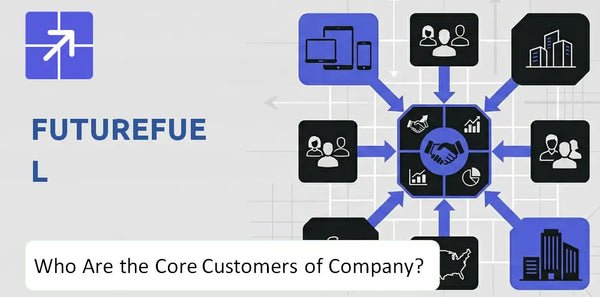
Focus on large manufacturers, petrochemical firms, and logistics companies aiming to cut Scope 3 emissions; prioritize firms near production sites to reduce supply-chain risk. See FutureFuel BCG Matrix Analysis.
Who Is FutureFuel Trying to Win?
FutureFuel Corp. targets two core customer clusters: multinational agrochemical and consumer product firms needing complex, proprietary chemical synthesis, and major fuel blenders, refiners, and integrated oil companies obligated under the Renewable Fuel Standard. These B2B customers drive recurring, high-value contracts and shape the FutureFuel target market.
 Main customers: multinational chemical and consumer-product partners
FutureFuel core customers are large agrochemical and consumer-product corporations that outsource multi-step active-ingredient and specialty-chemistry synthesis. These buyers value intellectual property protection, specialized infrastructure, and long-term supply agreements; they often represent >50% of Chemical Technologies segment revenue in comparable contract-manufacturing peers.
Secondary customers: renewable fuel buyers and regional industrials
In Biofuels, FutureFuel customer segments include major renewable fuel buyers – fuel blenders, refiners, and integrated oil companies – securing volumetric RIN (renewable identification number) compliance under the Renewable Fuel Standard. Secondary targets are regional agricultural cooperatives and industrial manufacturers sourcing bio-based solvents and lubricants to meet evolving environmental standards.
Customer type and market role: B2B contract manufacturers and commodity buyers
FutureFuel primarily serves businesses (B2B): pharmaceutical manufacturer customers and B2B chemical purchasers for specialty synthesis, plus renewable fuel buyers for commodity-scale biofuel offtake. The mix is transactional (biofuel volumes) and strategic (long-term chemical contracts).
Most important segment: Chemical Technologies for margin stability
The Chemical Technologies segment appears most important by margin and strategic value; specialized contract synthesis yields higher gross margins and stickier revenue versus commodity biofuels. As of fiscal 2025 peers and sector benchmarks, specialty contract services can command gross margins in the mid-20s to 30s percent range versus low-single-digit margins on commodity biofuels.
See operational and revenue context in this primer: How FutureFuel Company Works and Makes Money
FutureFuel SWOT Analysis
- Complete SWOT Breakdown
- Fully Customizable
- Editable in Excel & Word
- Professional Formatting
- Investor-Ready Format

What Do FutureFuel's Customers Care About Most?
FutureFuel core customers prioritize reliability, technical precision, and regulatory compliance; they buy to avoid supply interruptions, meet tight purity specs, and optimize economics tied to carbon credits and bio-preferred labeling.

Scale without heavy capital
B2B chemical purchasers and pharmaceutical manufacturer customers need outsourced production of specialty intermediates so they can scale volumes quickly without building plants; timely ramping preserves global pesticide and detergent supply chains.
Economics and compliance
Renewable fuel buyers focus on Renewable Identification Numbers (RINs) value and carbon intensity (CI) scores; in 2025 RIN volatility and lower CI translate directly into margins for biofuel customers.
Brand and regulatory reputation
Consumer-facing brands buying ingredients want 'bio-preferred' status to remove petroleum-derived components; this reduces regulatory risk and helps marketing claims in retail channels.
Quality and operational stickiness
Customers value consistent purity and low batch variability; a single supply disruption can cost partners millions and trigger downstream shortages – so quality control and on-time delivery matter most.
Repeat demand drivers
Long-term contracts, JIT logistics, and documented GMP-like controls create sticky relationships; retention rises when CI improvements and RIN allocation sustain customer margins.
Why customers pick FutureFuel Corp.
FutureFuel target market chooses the company for proven scale-up capability, integrated quality processes, and sulfur/impurity specifications that meet regulatory thresholds; that combination wins B2B chemical purchasers and renewable fuel buyers.
2025 indicators: chemical offtake contracts commonly specify ±0.5% purity tolerance; renewable buyers target CI reductions of 10 – 30% to improve RIN economics; third-party audits and batch traceability drive >90% retention in key accounts cited in the Competitive Landscape of FutureFuel Company.
FutureFuel Business Model Canvas
- One-time Payment
- No Research Needed – Save Hours of Work
- Built by Experts, Trusted by Consultants
- Instant Download, Ready to Use
- 100% Editable, Fully Customizable

Where Is Demand Strongest for FutureFuel?
Demand is heaviest in North America, concentrated in the U.S. Midwest where proximity to feedstock and distribution hubs drives volumes; specialty chemical exports and household/personal care buyers show the strongest growth and activity.
Main Market Location – U.S. Midwest
The Midwest hosts the densest cluster of FutureFuel core customers due to feedstock access and logistics near river and rail corridors; this region accounted for roughly 45% of North American sales in fiscal 2025.
Secondary Markets – Export and Specialty Chemicals
Specialty chemical exports, especially advanced crop protection intermediates, grew about 14% in fiscal 2025 and now represent a rapidly expanding portion of the FutureFuel target market outside North America.
Where FutureFuel Is Strongest – Household & Personal Care
Demand is strongest in household and personal care for bio-based surfactants; this product group captured the fastest uptake through 2025 as customers seek drop-in replacements in regulated environments, contributing an estimated 28% of product revenue that year.
Fastest-Growing Demand Areas – Specialty Exports & Regulated Markets
Growth is fastest in specialty chemical export markets and highly regulated sectors where drop-in bio-based alternatives displace traditional chemistries; pharmaceutical manufacturer customers and B2B chemical purchasers in Europe and Asia are notable pick-up points in 2025/2026.
History and Background of FutureFuel Company
FutureFuel Marketing Mix
- Complete Marketing Mix Analysis
- Effortlessly Communicate Your Business Strategy
- Investor-Ready Format
- 100% Editable and Customizable
- Clear and Structured Layout

How Does FutureFuel Keep Its Audience Growing?
FutureFuel Corp. grows its audience by locking customers into long-term cost-plus chemical contracts and expanding biofuel offerings into sustainable aviation fuel and non-food feedstocks, reaching ESG-focused buyers and adjacent renewable fuel buyers while using client-dedicated lines to boost retention.
How FutureFuel Expands Its Customer Base
FutureFuel targets renewable fuel buyers and B2B chemical purchasers by adding sustainable aviation fuel (SAF) capacity and non-food grade feedstock processing, widening FutureFuel target market reach into airlines and institutional ESG buyers; dedicated production lines also open pharma and specialty chemicals accounts.
Customer Retention Drivers
Long-term cost-plus contracts create predictable margins and multi-year revenue streams, while high switching costs from client-dedicated lines keep churn low; Chemical Technologies provides a steady cash buffer with expected 35 percent of 2025 revenue at margins above 25 percent, stabilizing relationships against biodiesel spot volatility.
Loyalty, Repeat Demand, and Customer Depth
Repeat demand comes from contract renewals and refill cycles with pharmaceutical manufacturer customers and specialty chemicals procurement managers; FutureFuel's processing for non-food feedstocks increases stickiness among renewable fuel buyers and long-term commercial partners.
Strongest Customer-Base Growth Lever
The top lever is contract structure plus product diversification: cost-plus, multi-year Chemical Technologies deals plus expansion into SAF and non-food feedstocks capture ESG demand and secure B2B buyers, driving acquisition in 2026 and protecting margins in cyclic biodiesel markets; see Ownership and Control of FutureFuel Company for corporate context: Ownership and Control of FutureFuel Company.
FutureFuel Boston Consulting Group Matrix
- Built by Experts, Trusted by Consultants
- Structured for Consultants, Students, and Founders
- 100% Editable in Microsoft Word & Excel
- Instant Digital Download – Use Immediately
- Compatible with Mac & PC – Fully Unlocked

Related Blogs
- What Is the History of FutureFuel Company and How Did It Evolve?
- What Is the Competitive Landscape of FutureFuel Company and How Does It Compete?
- What Is the Growth Outlook of FutureFuel Company and Where Is It Heading?
- How Does FutureFuel Company Work and What Drives Its Business Model?
- How Does FutureFuel Company Reach Customers and Turn Demand into Sales?
- What Do the Mission, Vision, and Core Values of FutureFuel Company Reveal?
- Who Owns FutureFuel Company Today and Who Holds Control?
Frequently Asked Questions
FutureFuel's core customers are large agrochemical and consumer-product companies, plus major fuel blenders, refiners, and integrated oil companies. The company serves these B2B buyers through specialty chemical synthesis and renewable fuel supply, which creates recurring contracts and supports both its Chemical Technologies and Biofuels businesses.
Disclaimer
All information, articles, and product details provided on this website are for general informational and educational purposes only. We do not claim any ownership over, nor do we intend to infringe upon, any trademarks, copyrights, logos, brand names, or other intellectual property mentioned or depicted on this site. Such intellectual property remains the property of its respective owners, and any references here are made solely for identification or informational purposes, without implying any affiliation, endorsement, or partnership.
We make no representations or warranties, express or implied, regarding the accuracy, completeness, or suitability of any content or products presented. Nothing on this website should be construed as legal, tax, investment, financial, medical, or other professional advice. In addition, no part of this site - including articles or product references - constitutes a solicitation, recommendation, endorsement, advertisement, or offer to buy or sell any securities, franchises, or other financial instruments, particularly in jurisdictions where such activity would be unlawful.
All content is of a general nature and may not address the specific circumstances of any individual or entity. It is not a substitute for professional advice or services. Any actions you take based on the information provided here are strictly at your own risk. You accept full responsibility for any decisions or outcomes arising from your use of this website and agree to release us from any liability in connection with your use of, or reliance upon, the content or products found herein.