
Who are Kawasaki Kisen Kaisha's core industrial and corporate customers in global shipping?
Kawasaki Kisen Kaisha serves heavy industry shippers, automakers, energy firms, and large traders that need contract-backed, low-volatility logistics. This matters as the company shifted toward contract shipping and decarbonization, evidenced by its 2025 capital allocation and emissions targets aligned with client ESG demands.
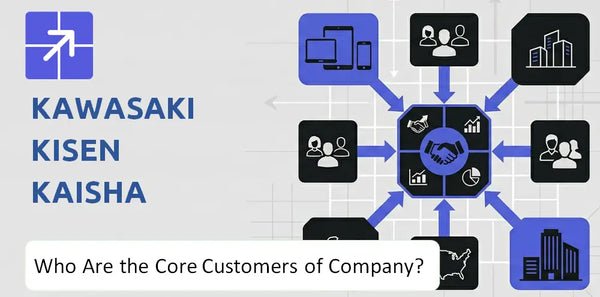
Kawasaki Kisen Kaisha targets long-term contracts with industrial clients needing predictable capacity and lower carbon footprints; demand from automakers and energy sectors drives fleet renewals. See its strategic portfolio review: Kawasaki Kisen Kaisha BCG Matrix Analysis
Who Is Kawasaki Kisen Kaisha Trying to Win?
Kawasaki Kisen Kaisha tries to win large industrial shippers and energy providers that need high-volume, regular maritime transport, plus auto OEMs that require specialized RoRo capacity.
 Main customer group: global automotive OEMs
Automotive manufacturers using K Line shipping services form the core: Pure Car and Truck Carriers (PCTCs) move finished vehicles across Asia, Europe, and the Americas, accounting for a substantial share of the company's car-carrier revenue; OEM contracts provide predictable, high-utilization voyages and higher per-voyage yields.
Secondary customer groups: commodity and retail shippers
Commodity traders contracting K Line bulk carriers, major steel producers, and utility companies rely on dry bulk / LNG and tanker services to move iron ore, coal, and LNG; retailers and electronics firms use container and bulk cargo shippers via the ONE consortium for supply-chain flows.
Customer type and market role: B2B industrial partnerships
Kawasaki Kisen Kaisha core customers are businesses and institutions: long-term contracts with manufacturers, commodity traders, and energy companies dominate, while freight forwarders and importers/exporters use liner services for scheduled trades.
Most important segment by revenue: bulk and car-carrier contracts
For fiscal 2025 Kawasaki Kisen Kaisha reported shipping revenues concentrated in car-carrier and dry/energy bulk divisions, with PCTC and bulk chartering driving fleet utilization; long-term charters and energy transport contracts represented the largest share of voyage revenues – see Growth Outlook of Kawasaki Kisen Kaisha Company for contextual figures and orderbook details.
Kawasaki Kisen Kaisha SWOT Analysis
- Complete SWOT Breakdown
- Fully Customizable
- Editable in Excel & Word
- Professional Formatting
- Investor-Ready Format

What Do Kawasaki Kisen Kaisha's Customers Care About Most?
Kawasaki Kisen Kaisha core customers prioritize low-emission, reliable shipping and specialized handling that protect supply chains and reduce buyers' Scope 3 emissions. Automotive, industrial, and commodity clients choose carriers offering compliant fuels, EV-safe RoRo services, and long-term Contracts of Affreightment to manage volatility.

Low-carbon, compliant transport
Customers seek vessels with LNG or ammonia readiness and wind-assist tech to meet IMO CII (carbon intensity indicator) rules introduced through 2025 – 2026; buyers often require carriers to report emissions to validate Scope 3 reductions.
Practical buying drivers: cost predictability and capacity
Shippers weigh freight rates versus emissions premiums; industrials favor long-term COAs to lock nominal rates and guaranteed liftings, while spot-sensitive traders buy short-term to exploit rate swings.
Safety and specialized handling for automotive OEMs
Automotive manufacturers using K Line shipping services demand EV-specific fire suppression, certified stowage for high-voltage batteries, and controlled weight distribution to prevent deck stress and insurance disputes.
What customers value most
Clients value measurable emissions intensity, schedule reliability (on-time delivery rates), and cargo integrity – especially for RoRo, tanker, and bulk cargo shippers where a single loss can cost millions.
Loyalty and repeat demand drivers
Repeat demand stems from consistent CII performance, transparent emissions reporting, stable contract terms, and integrated logistics services that reduce total landed cost for retailers and importers.
Why customers choose Kawasaki Kisen Kaisha
Clients select K Line target market offerings for combined liner and tramp flexibility, specialized RoRo and car-carrier expertise, and investments in low-carbon technologies that help meet corporate ESG targets; see Competitive Landscape of Kawasaki Kisen Kaisha Company for context.
Kawasaki Kisen Kaisha Business Model Canvas
- One-time Payment
- No Research Needed – Save Hours of Work
- Built by Experts, Trusted by Consultants
- Instant Download, Ready to Use
- 100% Editable, Fully Customizable

Where Is Demand Strongest for Kawasaki Kisen Kaisha?
Demand for Kawasaki Kisen Kaisha core customers is strongest in the Asia-Pacific, centered on trade lanes between resource exporters (Australia, Brazil) and industrial hubs in Japan, China, and India; ASEAN routes and LNG and car-carrier flows show the highest activity.
Main Market Location: Asia-Pacific trade lanes
Asia-Pacific trade lanes drive the K Line target market, with concentrated volumes on Japan – China – India corridors; resource exports from Australia and Brazil feed industrial demand and sustain container, bulk, and tanker utilization.
Secondary Markets: ASEAN and Europe/North America corridors
ASEAN manufacturing diversification lifted volumes by mid-2025; Europe and North America are secondary demand centers for car carriers and finished-goods container flows as EV exports rise and trade normalizes.
Where Kawasaki Kisen Kaisha Is Strongest: Car carriers and LNG/tanker segments
Kawasaki Kisen Kaisha customer segments show peak strength in roll on roll off (RoRo) car-carrier services – export routes from China and Japan to Europe/North America – and in LNG/tanker contracts to North Asia and Europe, comprising a material share of 2025 freight revenue mix.
Where Demand May Be Growing Fastest: ASEAN manufacturing and LNG to Europe
By early 2026, demand accelerated in ASEAN as firms shift production; LNG transport volumes expanded with several long-term contracts signed in 2025, pushing spot and contract rates up and increasing utilization for Kawasaki Kisen Kaisha's tanker and LNG fleet.
Key numbers: global car-carrier exports to Europe/North America rose roughly 12 – 18% year-on-year in 2025 on major China/Japan routes; LNG seaborne trade grew about 6 – 9% in 2025 with Europe and North Asia as primary importers; ASEAN container throughput increases averaged 4 – 7% in 2025, boosting demand for maritime shipping clients, container and bulk cargo shippers, and freight forwarders partnering with K Line for global transport. Read more on company context in the History and Background of Kawasaki Kisen Kaisha Company.
Kawasaki Kisen Kaisha Marketing Mix
- Complete Marketing Mix Analysis
- Effortlessly Communicate Your Business Strategy
- Investor-Ready Format
- 100% Editable and Customizable
- Clear and Structured Layout

How Does Kawasaki Kisen Kaisha Keep Its Audience Growing?
Kawasaki Kisen Kaisha keeps its audience growing by investing in zero-emission fleet upgrades, offering reliable high-margin niche services, and using digital tools for transparent emissions reporting and voyage efficiency to win and retain ESG-conscious maritime shipping clients.
Expanding Reach into Adjacent Segments
Kawasaki Kisen Kaisha expands into adjacent segments by targeting automotive manufacturers using K Line shipping services and energy-sector clients with specialized tankers and bulk carriers, leveraging a ¥1.2 trillion investment plan through FY2026 focused on eco-friendly vessels to win new logistics and supply chain customers.
Customer Retention Drivers
Retention relies on high service reliability, long-term contracts (often >70% in key dry bulk and energy segments), and digital twin technology that optimizes voyage efficiency and provides transparent emissions reporting for container and bulk cargo shippers and freight forwarders.
Loyalty, Repeat Demand, and Customer Depth
Repeat demand is driven by multi-year contracts with importers and exporters relying on Kawasaki Kisen Kaisha, ecosystem stickiness from integrated terminal and RoRo services for OEMs, and renewals from commodity traders contracting K Line bulk carriers.
Strongest Growth Lever in 2025/2026
The primary growth lever is disciplined capital allocation into low-emission vessels plus digital service offerings that secure premium rates in specialized energy and automotive sectors, supporting a professional judgment of stable, high-margin growth for 2025/2026; see further commercial details in Sales and Marketing Strategy of Kawasaki Kisen Kaisha Company.
Kawasaki Kisen Kaisha Boston Consulting Group Matrix
- Built by Experts, Trusted by Consultants
- Structured for Consultants, Students, and Founders
- 100% Editable in Microsoft Word & Excel
- Instant Digital Download – Use Immediately
- Compatible with Mac & PC – Fully Unlocked

Related Blogs
- What Is the History of Kawasaki Kisen Kaisha Company and How Did It Evolve?
- What Is the Competitive Landscape of Kawasaki Kisen Kaisha Company and How Does It Compete?
- What Is the Growth Outlook of Kawasaki Kisen Kaisha Company and Where Is It Heading?
- How Does Kawasaki Kisen Kaisha Company Work and What Drives Its Business Model?
- How Does Kawasaki Kisen Kaisha Company Reach Customers and Turn Demand into Sales?
- What Do the Mission, Vision, and Core Values of Kawasaki Kisen Kaisha Company Reveal?
- Who Owns Kawasaki Kisen Kaisha Company Today and Who Holds Control?
Frequently Asked Questions
Kawasaki Kisen Kaisha mainly serves B2B customers. Its core customers are global automotive OEMs, along with commodity traders, steel producers, utility companies, and other industrial shippers that need regular maritime transport and specialized cargo handling.
Disclaimer
All information, articles, and product details provided on this website are for general informational and educational purposes only. We do not claim any ownership over, nor do we intend to infringe upon, any trademarks, copyrights, logos, brand names, or other intellectual property mentioned or depicted on this site. Such intellectual property remains the property of its respective owners, and any references here are made solely for identification or informational purposes, without implying any affiliation, endorsement, or partnership.
We make no representations or warranties, express or implied, regarding the accuracy, completeness, or suitability of any content or products presented. Nothing on this website should be construed as legal, tax, investment, financial, medical, or other professional advice. In addition, no part of this site - including articles or product references - constitutes a solicitation, recommendation, endorsement, advertisement, or offer to buy or sell any securities, franchises, or other financial instruments, particularly in jurisdictions where such activity would be unlawful.
All content is of a general nature and may not address the specific circumstances of any individual or entity. It is not a substitute for professional advice or services. Any actions you take based on the information provided here are strictly at your own risk. You accept full responsibility for any decisions or outcomes arising from your use of this website and agree to release us from any liability in connection with your use of, or reliance upon, the content or products found herein.