
How does Kawasaki Kisen Kaisha's sales and marketing model convert long-term contracts and specialized services into recurring revenue?
Kawasaki Kisen Kaisha targets contract logistics and specialized cargo under Vision 2030, shifting away from volatile spot markets. This matters because by 2025 the firm reported ¥980 billion revenue and ≈430 vessels, signaling scale to win multi-year contracts and support decarbonization claims.
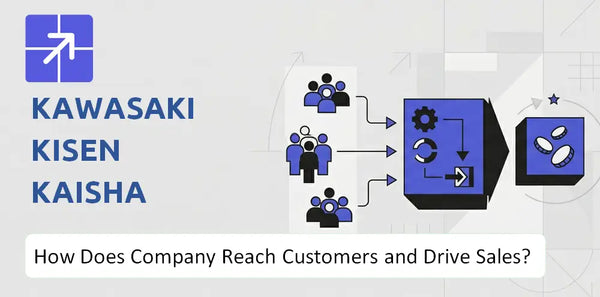
Kawasaki Kisen Kaisha leans on account-based sales, strategic partnerships, and fleet allocation to lock demand into contracts. Track renewals and specialist cargo win rates; higher renewal rates predict steadier cash flow and lower spot exposure. Kawasaki Kisen Kaisha BCG Matrix Analysis
Who Does Kawasaki Kisen Kaisha Want to Sell To?
Kawasaki Kisen Kaisha targets large B2B shippers: global automotive OEMs and industrial manufacturers for finished-vehicle and dry-bulk logistics, plus energy majors and national utilities for long-term LNG and ammonia transport. The company wins by offering low-emission, contract-backed capacity and integrated logistics that fit high-volume, sustainability-driven buyers.
 Primary customers: Automotive OEMs and Industrial Manufacturers
Global OEMs such as Toyota and major industrial producers need precise finished-vehicle logistics and bulk raw-material shipping; Kawasaki Kisen Kaisha secures multi-year contracts – often 15 – 20 year charters – for guaranteed, large-scale capacity. In 2025 Kawasaki Kisen Kaisha reported freight contract backlog and time-charter commitments that underpin stable revenue from these clients.
Secondary customers: Energy majors and Utilities
National utilities and oil & gas supermajors require secure LNG and ammonia transport; Kawasaki Kisen Kaisha targets these buyers with specialized carriers and long-term supply security, capturing premium pricing and lower churn through dedicated tonnage and emissions-focused solutions.
Market positioning: Premium, decarbonized logistics partner
Kawasaki Kisen Kaisha positions itself as a high-value partner offering integrated logistics services and low-emission shipping solutions; this supports higher contract durations and yields versus spot-market providers, and improves customer acquisition via sustainability requirements in procurement.
Why the positioning works: Contract length, emissions, and reliability
Buyers pay premiums for long-term security and decarbonized supply chains; Kawasaki Kisen Kaisha converts demand into sales through dedicated fleets, long-term charters (15 – 20 years), and account management that reduces procurement friction and strengthens retention.
See company context in History and Background of Kawasaki Kisen Kaisha Company
Kawasaki Kisen Kaisha SWOT Analysis
- Complete SWOT Breakdown
- Fully Customizable
- Editable in Excel & Word
- Professional Formatting
- Investor-Ready Format

How Does Kawasaki Kisen Kaisha Get in Front of Customers?
Kawasaki Kisen Kaisha reaches customers via a global sales network in maritime hubs, consultative B2B selling embedded in client planning cycles, and digital tools that show operational transparency to convert demand into bookings.

Consultative Field Sales in Key Hubs
Kawasaki Kisen Kaisha customer acquisition depends on specialized sales offices and regional HQs in London, Singapore, and Richmond that run consultative engagements with energy, auto, and bulk shippers; sales teams embed in clients' supply chain planning to influence annual procurement cycles.
Digital Platforms and Operational Transparency
Kawasaki Kisen Kaisha digital marketing centers on K-ASSIST and operational dashboards to show on-time performance, safety, and emissions metrics; this online visibility supports RFP wins for energy and specialized cargo by reducing perceived logistics risk.
Direct Technical Tenders and Strategic Partnerships
Direct sales focus on technical tenders for energy and car carrier segments; the firm also leverages its equity position in Ocean Network Express for containerized visibility and uses agency and partner networks to extend distribution into regional markets.
Demand Generation via Targeted Outreach
Demand generation uses RFP targeting, client workshops, trade-show presence, and account-based marketing to drive pipeline; selling cycles are long – often 6 – 18 months for high-value energy contracts – so events and executive meetings matter.
Customer Acquisition Efficiency and KPIs
Sales efficiency leans on repeat business: Kawasaki Kisen Kaisha reported stable contract renewal rates across core segments in 2025 and emphasizes lifetime contract value over low-cost acquisition; major KPIs include contract win rate, on-time delivery, and incident-free sailing.
Most Important Reach Advantage in 2025
The strongest reach advantage is a global specialist sales footprint plus demonstrable safety and environmental metrics that win high-stakes energy charters; see Ownership and Control of Kawasaki Kisen Kaisha Company for related governance context: Ownership and Control of Kawasaki Kisen Kaisha Company
Kawasaki Kisen Kaisha Business Model Canvas
- One-time Payment
- No Research Needed – Save Hours of Work
- Built by Experts, Trusted by Consultants
- Instant Download, Ready to Use
- 100% Editable, Fully Customizable

How Does Kawasaki Kisen Kaisha Turn Attention Into Sales?
Kawasaki Kisen Kaisha turns attention into sales by converting short-term spot interest into multi-year Contracts of Affreightment and time charters, and by co-investing with cargo owners to lock recurring demand; pricing power comes from tech differentiation and green fuel assets that command premiums in procurement. Over 75 percent of 2025/2026 energy and car carrier revenue is under multi-year commitments, reducing volatility and improving predictability.
Core sales model: Contract-led B2B shipping and JV asset sales
Kawasaki Kisen Kaisha customer acquisition centers on direct B2B sales to charterers and cargo owners, moving prospects from spot bookings to long-term COAs and time charters; joint ventures (JV) with customers create aligned incentives and repeat cargo flows.
Pricing and monetization logic: premium for green tech and multi-year contracts
Revenue mixes include fixed-rate time charters, volume-guaranteed COAs, and asset-level JV returns; Kawasaki Kisen Kaisha leverages Seawing automated kite systems and LNG-fueled car carriers to secure price premiums in green-conscious tenders and long-term procurement.
Conversion and purchase drivers: tech, reliability, and co-investment
Conversion is driven by demonstrable fuel and emissions savings from technologies, guaranteed capacity under COAs, and trust built via JV structures and long-standing account management; digital quotes and targeted RFP responses shorten procurement cycles.
Repeat revenue and customer expansion: asset partnerships and contract rollovers
Retention comes from multi-year renewals, upsells to integrated logistics services, and equity sharing in vessel JVs – these mechanisms converted >75 percent of segment revenue into contracted streams in 2025/2026, increasing forward revenue visibility.
Operationally, Kawasaki Kisen Kaisha sales strategy ties commercial teams, technical operations, and finance: chartering desks price COAs using forward fuel-cost assumptions; JV proposals bundle capital allocation with long-term offtake; CRM and targeted digital marketing support account growth – see Competitive Landscape of Kawasaki Kisen Kaisha Company for context Competitive Landscape of Kawasaki Kisen Kaisha Company.
Kawasaki Kisen Kaisha Marketing Mix
- Complete Marketing Mix Analysis
- Effortlessly Communicate Your Business Strategy
- Investor-Ready Format
- 100% Editable and Customizable
- Clear and Structured Layout

How Strong Does Kawasaki Kisen Kaisha's Commercial Engine Look Going Forward?
Kawasaki Kisen Kaisha's commercial engine enters 2025/2026 with clear strengths: a solid balance sheet, disciplined 40 percent dividend payout, and equity earnings from Ocean Network Express (ONE) that smooth container volatility. Growth focus on ammonia and hydrogen shipping supports demand expansion, while Red Sea and Panama Canal risks could pressure short-term volumes.
What Supports Future Demand
Equity income from ONE provides predictable cash, enabling Kawasaki Kisen Kaisha customer acquisition in new segments while capital targets energy-commodity shipping. The strategic pivot to ammonia and hydrogen transport aligns with projected fuel-market growth to 2030 and strengthens product-market fit for high-margin routes.
Channel and Marketing Effectiveness
K Line leverages a global agency network and direct B2B sales teams to convert demand into bookings, supported by CRM-driven account management and targeted digital channels for corporate shippers. Online booking and conversion optimization remain secondary but growing, improving Kawasaki Kisen Kaisha marketing channels efficiency.
Risks to Commercial Performance
Geopolitical disruption in the Red Sea and Panama Canal can raise voyage times and costs, hurting Kawasaki Kisen Kaisha logistics services volumes. Market cyclicality for containers persists despite ONE earnings; slower-than-expected adoption of ammonia/hydrogen or capex overruns would weaken sales strategy execution.
The Overall Sales and Marketing Outlook
Overall, the Kawasaki Kisen Kaisha sales strategy looks strong and adaptable for 2025/2026: projected operating margin above 11 percent, robust cash flow, and targeted demand-generation strategies for shipping. Continued investment in B2B account management, partnerships, and niche cargo marketing should sustain growth through 2030. Read more on corporate direction in Mission, Vision, and Values of Kawasaki Kisen Kaisha Company.
Kawasaki Kisen Kaisha Boston Consulting Group Matrix
- Built by Experts, Trusted by Consultants
- Structured for Consultants, Students, and Founders
- 100% Editable in Microsoft Word & Excel
- Instant Digital Download – Use Immediately
- Compatible with Mac & PC – Fully Unlocked

Related Blogs
- What Is the History of Kawasaki Kisen Kaisha Company and How Did It Evolve?
- What Is the Competitive Landscape of Kawasaki Kisen Kaisha Company and How Does It Compete?
- What Is the Growth Outlook of Kawasaki Kisen Kaisha Company and Where Is It Heading?
- How Does Kawasaki Kisen Kaisha Company Work and What Drives Its Business Model?
- What Do the Mission, Vision, and Core Values of Kawasaki Kisen Kaisha Company Reveal?
- Who Are the Core Customers in Kawasaki Kisen Kaisha Company's Target Market?
- Who Owns Kawasaki Kisen Kaisha Company Today and Who Holds Control?
Frequently Asked Questions
Kawasaki Kisen Kaisha mainly sells to large B2B shippers. Its core buyers are global automotive OEMs and industrial manufacturers, plus energy majors and national utilities that need LNG and ammonia transport. The company fits these customers by offering contract-backed capacity, integrated logistics, and low-emission shipping solutions.
Disclaimer
All information, articles, and product details provided on this website are for general informational and educational purposes only. We do not claim any ownership over, nor do we intend to infringe upon, any trademarks, copyrights, logos, brand names, or other intellectual property mentioned or depicted on this site. Such intellectual property remains the property of its respective owners, and any references here are made solely for identification or informational purposes, without implying any affiliation, endorsement, or partnership.
We make no representations or warranties, express or implied, regarding the accuracy, completeness, or suitability of any content or products presented. Nothing on this website should be construed as legal, tax, investment, financial, medical, or other professional advice. In addition, no part of this site - including articles or product references - constitutes a solicitation, recommendation, endorsement, advertisement, or offer to buy or sell any securities, franchises, or other financial instruments, particularly in jurisdictions where such activity would be unlawful.
All content is of a general nature and may not address the specific circumstances of any individual or entity. It is not a substitute for professional advice or services. Any actions you take based on the information provided here are strictly at your own risk. You accept full responsibility for any decisions or outcomes arising from your use of this website and agree to release us from any liability in connection with your use of, or reliance upon, the content or products found herein.