
Who are KONE's core customers in urban property and facility management?
KONE serves building owners, facility managers, and real estate developers in cities, focusing on lifecycle services for elevators and escalators. This matters as KONE maintained service on 1.6 million units in 2025 while shifting to value-led modernization over volume in China.
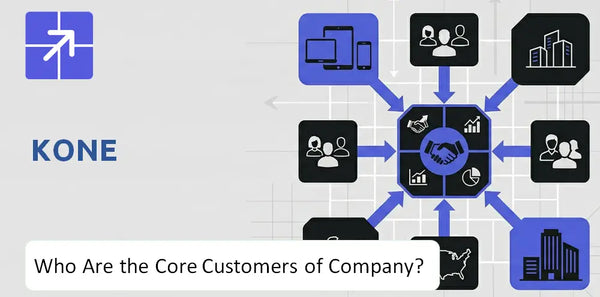
KONE's core buyers prioritize uptime, digital maintenance, and ESG compliance; target segments include commercial offices, residential high-rises, and transit hubs. See Kone BCG Matrix Analysis for product-position insights.
Who Is Kone Trying to Win?
KONE tries to win large-scale developers and general contractors, facility managers and institutional property owners, and public infrastructure authorities managing airports and metros; the priority has shifted toward installed-base owners as service and modernization now exceed 50% of total revenue and drive margins.
 Primary: Developers and General Contractors
Property developers and contractors for high-rise residential, commercial office, and mixed-use projects are Kone target market priorities because complex People Flow needs set specifications and large ticket new-equipment sales.
Secondary: Facility Managers and Institutional Owners
Facility managers and commercial building owners comprise the most profitable Kone customer segments; they favor lifecycle value, modernization, and service contracts that now represent a disproportionate share of operating profit.
Customer Type and Market Role
KONE serves a mixed B2B and institutional base: businesses (developers, building owners), public institutions (airport and transit authorities), and facility management firms. Sales mix has tilted from new equipment to services and modernization.
Most Important Segment by Revenue
The installed base – facility managers and institutional property owners – appears most important: service and modernization exceed 50% of KONE revenue in 2025 and contribute a higher operating margin, making retrofit and maintenance clients strategically critical.
Growth Outlook of Kone Company
Kone SWOT Analysis
- Complete SWOT Breakdown
- Fully Customizable
- Editable in Excel & Word
- Professional Formatting
- Investor-Ready Format

What Do Kone's Customers Care About Most?
Kone core customers prioritize reliability plus integration: they want elevators that cut downtime, lower lifecycle costs, and support sustainability targets while connecting to building systems and mobile apps to boost asset value and tenant experience.

Shift to integrated building intelligence
Property developers and contractors and commercial building owners now demand solutions that do more than move people; they want elevators as part of smart building platforms that feed BMS (building management systems) and mobile apps for real-time control and analytics.
Practical buying drivers: TCO and uptime
Facility managers and building operators choose based on Total Cost of Ownership (TCO), energy efficiency, and service that reduces downtime. KONE 24/7 Connected Services with AI predictive analytics lowers equipment downtime by up to 25%, directly reducing maintenance spend and lost productivity.
Emotional or aspirational appeal: prestige and tenant experience
Owners of office towers, hotels, and high-end residential buildings value elevators that signal quality and modernity, raising rental yields and tenant satisfaction through smooth rides, digital interfaces, and branded app experiences.
What customers value most: sustainability and certification support
Financial stakeholders prioritize energy-saving regenerative drives and carbon-neutral installation options that contribute to LEED or BREEAM credits; investors quantify this as lower operating costs and higher asset pricing on sale or refinance.
Loyalty or repeat demand drivers
Long-term service contracts, demonstrable uptime improvements, and integration with facility management workflows drive retention among facility management companies and large property owners who prefer predictable OPEX and centralized vendor relationships.
Why customers choose Kone
Kone target market buyers pick a supplier that combines proven reliability with digital services and sustainability credentials; KONE 24/7 Connected Services plus energy-efficient hardware deliver measurable gains in uptime and TCO, making Kone customers in commercial real estate and residential high-rise buildings confident buyers. Read more in How Kone Company Works and Makes Money.
Kone Business Model Canvas
- One-time Payment
- No Research Needed – Save Hours of Work
- Built by Experts, Trusted by Consultants
- Instant Download, Ready to Use
- 100% Editable, Fully Customizable

Where Is Demand Strongest for Kone?
Demand is strongest in rapidly urbanizing India and Southeast Asia for new equipment, while North America and Europe lead modernization and digital upgrade needs for aging stock.
Main Growth Corridor: Emerging Urban Hubs
India and Southeast Asia are the primary Kone target market for new elevators and escalators, driven by urban construction; India's urban construction sector is forecast to sustain high single-digit growth through 2026, supporting strong orders from property developers and contractors and commercial building owners.
Secondary Market: Aging Western Infrastructure
North America and Europe are the main Kone customers seeking modernization services; roughly 50 percent of the elevator base in these regions is over 20 years old, creating demand for digital upgrades, safety retrofits, and energy-efficiency projects for facility managers and building operators.
Where Kone Is Strongest: Service and Modernization Mix
Kone's revenue mix shows resilience from its services and modernization segments, where recurring maintenance contracts and retrofit work in office towers, hospitals, and transit hubs generate steady cash flows; this aligns with Kone core customers such as facility management companies and hospital and healthcare facilities.
Fastest-Growing Demand in 2025 – 2026
Demand appears to be growing fastest in India, Southeast Asia, and airport/public transit systems where mass-transit expansion and new terminal builds are planned in 2025 – 2026; meanwhile, China's residential market has stabilized and shifted toward service and replacement, enlarging the long tail for modernization-focused Kone customer segments. Read more on corporate structure in this piece: Ownership and Control of Kone Company
Kone Marketing Mix
- Complete Marketing Mix Analysis
- Effortlessly Communicate Your Business Strategy
- Investor-Ready Format
- 100% Editable and Customizable
- Clear and Structured Layout

How Does Kone Keep Its Audience Growing?
KONE keeps its audience growing by embedding DX Class elevators as a building's digital backbone, selling modernization packages, and leveraging a global service network to reach adjacent segments and boost renewals.
Expanding KONE's Customer Base
KONE targets Kone target market segments such as commercial building owners, property developers and contractors, and facility managers by bundling hardware with cloud services. DX Class installs create platform sales to office towers, hospitals, airports, residential high-rises, and shopping centers, enabling cross-sell of IoT services and modernization offers that broaden reach into adjacent construction and retrofit projects.
Customer Retention Drivers
High switching costs from embedded software, predictable SaaS-like updates, and a global service footprint sustain renewals. KONE's service contracts – backed by a contract renewal rate that management reports as high and stable – deliver recurring revenue and reduce churn among Kone core customers and facility managers.
Loyalty, Repeat Demand, and Customer Depth
Modernization packages capture customers once equipment reaches the 15 to 20-year lifecycle, driving repeat demand. Service agreements and cloud features deepen customer relationships, turning single-install buyers into long-term partners – especially among property developers, building operators, and hospital and airport clients.
Strongest Growth Lever in 2025/2026
The primary lever is digital lock-in via DX Class combined with modernization growth. Modernization is forecast to grow at a 5 to 7 percent CAGR through 2026, while KONE's adjusted EBIT margin near 11.5 to 12.5 percent in 2025/2026 funds R&D to shift the market from mechanical hardware to service-oriented software solutions. See Competitive Landscape of Kone Company for context: Competitive Landscape of Kone Company
Kone Boston Consulting Group Matrix
- Built by Experts, Trusted by Consultants
- Structured for Consultants, Students, and Founders
- 100% Editable in Microsoft Word & Excel
- Instant Digital Download – Use Immediately
- Compatible with Mac & PC – Fully Unlocked

Related Blogs
- What Is the History of Kone Company and How Did It Evolve?
- What Is the Competitive Landscape of Kone Company and How Does It Compete?
- What Is the Growth Outlook of Kone Company and Where Is It Heading?
- How Does Kone Company Work and What Drives Its Business Model?
- How Does Kone Company Reach Customers and Turn Demand into Sales?
- What Do the Mission, Vision, and Core Values of Kone Company Reveal?
- Who Owns Kone Company Today and Who Holds Control?
Frequently Asked Questions
Kone's primary customers are large-scale developers and general contractors, especially for high-rise residential, commercial office, and mixed-use projects. The company also focuses on facility managers, institutional property owners, and public infrastructure authorities such as airport and metro operators. The biggest strategic shift is toward installed-base owners who buy service and modernization.
Disclaimer
All information, articles, and product details provided on this website are for general informational and educational purposes only. We do not claim any ownership over, nor do we intend to infringe upon, any trademarks, copyrights, logos, brand names, or other intellectual property mentioned or depicted on this site. Such intellectual property remains the property of its respective owners, and any references here are made solely for identification or informational purposes, without implying any affiliation, endorsement, or partnership.
We make no representations or warranties, express or implied, regarding the accuracy, completeness, or suitability of any content or products presented. Nothing on this website should be construed as legal, tax, investment, financial, medical, or other professional advice. In addition, no part of this site - including articles or product references - constitutes a solicitation, recommendation, endorsement, advertisement, or offer to buy or sell any securities, franchises, or other financial instruments, particularly in jurisdictions where such activity would be unlawful.
All content is of a general nature and may not address the specific circumstances of any individual or entity. It is not a substitute for professional advice or services. Any actions you take based on the information provided here are strictly at your own risk. You accept full responsibility for any decisions or outcomes arising from your use of this website and agree to release us from any liability in connection with your use of, or reliance upon, the content or products found herein.