
How does KONE Company generate steady revenue by selling elevators and decades of maintenance services?
KONE blends elevator and escalator sales with long-term maintenance contracts, shifting profits toward recurring service annuities. This matters as KONE reported strong service-margin expansion in 2025, showing resilience versus construction cycles.
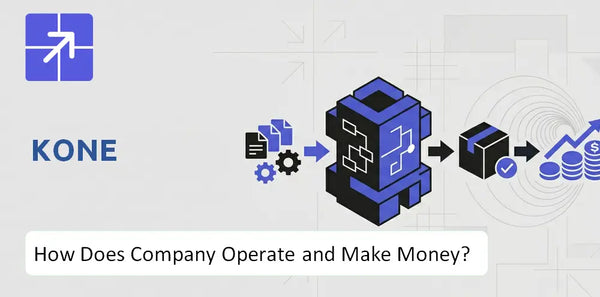
KONE's model rests on install-plus-service: initial equipment sale, then multi-decade maintenance. Focus on uptime and digital monitoring drives renewals and higher lifetime value; see Kone BCG Matrix Analysis.
What Does Kone Actually Sell?
KONE sells the physical and digital systems that move people within buildings: elevators, escalators, and automatic doors, plus software and services that guarantee uptime and availability via connected monitoring and maintenance contracts. Customers pay for equipment, digital features, and predictable service outcomes rather than one-off repairs.
 Core Offerings: People Flow, Hardware, and Digital Services
KONE company sells KONE elevators, escalators, and automatic building doors alongside the KONE DX Class digitally connected elevators. The product stack pairs hardware with KONE technologies: IoT sensors, cloud analytics, and the KONE 24/7 Connected Services subscription for predictive maintenance and remote diagnostics.
Main Buyers: Building Owners, Developers, and Facility Managers
Buyers include commercial real estate owners, residential developers, hospitals, airports, and public transit operators who prioritize uptime and safety. Large property managers buy service contracts and modernization programs; project developers purchase new KONE elevators and installation packages.
Customer Value: Availability, Safety, and Predictable Opex
Customers get guaranteed availability via KONE 24/7 Connected Services, lower downtime from predictive maintenance, energy savings from efficient drive systems, and longer asset life through modernization versus full replacement. Service contracts convert capex uncertainty into predictable opex.
Differentiators: Digital-first Elevators and Outcome Pricing
KONE stands out by bundling KONE smart elevator features and IoT integration with outcome-based offerings – paying for uptime not just parts. The KONE DX Class and KONE 24/7 Connected Services combine real-time fault detection and AI analytics to reduce failures and speed repairs, supporting KONE business model growth driven by recurring service revenue.
In 2025 KONE reported service orders and service revenue growth as key drivers; global service backlog and connected units increased, with service and modernization contributing a rising share of group revenue – customers choosing KONE maintenance and service contract structure for predictable performance. Read more on target customers and market: Target Customers and Market of Kone Company
Kone SWOT Analysis
- Complete SWOT Breakdown
- Fully Customizable
- Editable in Excel & Word
- Professional Formatting
- Investor-Ready Format

How Does Kone Run Its Business Day to Day?
KONE company runs daily through a decentralized service model that coordinates a global field force with a cloud platform; delivery flows from remote diagnostics to on-site technicians, supported by logistics, R&D, and outsourced component suppliers. Core systems – asset-light manufacturing, an IoT-enabled fleet of over 1.6 million units, and route-optimizing scheduling – drive practical mechanics and uptime-focused delivery.

Decentralized service-led operating model
KONE business model centers on local service units that own customer relations and dispatch more than 60,000 technicians globally, while regional hubs manage spare parts and SLAs. Central R&D and cloud analytics feed predictive maintenance signals to field teams every day.
How customers access KONE elevators and services
Customers buy equipment or service contracts via direct B2B sales and channel partners; contracts cover preventative, predictive, and emergency service tiers. Digital portals and mobile apps allow building managers to schedule visits, track ticket status, and review energy reports.
Production, sourcing, and technical development
KONE elevators are developed by in-house engineering and manufactured through an asset-light model that outsources many components to global suppliers; final assembly and quality control occur in regional plants. R&D focuses on smart elevator features and energy-efficient motors to support modernization sales.
Sales channels and distribution mechanisms
Direct sales to property developers and facility managers make up core equipment revenue, while long-term service contracts and modernization form recurring revenue. Field networks, partner installers, and digital quoting tools shorten the installation process timeline and clarify pricing.
Key assets, systems, and partnerships
Critical assets include the IoT platform monitoring 1.6 million units, logistics hubs for spare parts, and partnerships with component suppliers and construction firms. Cloud analytics and centralized R&D enable predictive maintenance and product upgrades that drive KONE revenue model toward services.
Why the model works in practice
Predictive maintenance reduces unplanned downtime and optimizes technician routes, cutting service cost per ticket and increasing uptime. The combination of service contracts, modernization sales, and IoT-enabled diagnostics creates stable recurring revenue and scales across global markets; see History and Background of Kone Company for context: History and Background of Kone Company
Kone Business Model Canvas
- One-time Payment
- No Research Needed – Save Hours of Work
- Built by Experts, Trusted by Consultants
- Instant Download, Ready to Use
- 100% Editable, Fully Customizable

How Does Revenue Flow Through Kone?
Revenue at KONE company flows through three linked channels: new equipment sales, recurring maintenance services, and modernization projects. Demand converts to revenue via one-off equipment contracts, multi-year maintenance agreements, and upgrade projects that tap aging building stock.
New equipment sales as customer acquisition
New equipment sales – KONE elevators and escalators – account for roughly 42% of revenue in early 2026, often priced competitively to win projects and establish a service footprint in new developments across commercial and residential segments.
Maintenance services: recurring profit engine
Maintenance services deliver about 38% of revenue via multi-year, inflation-indexed contracts that create high-margin recurring cash flow and strong lifetime value per installation for KONE services.
Modernization and upgrade projects
Modernization contributes near 20% of revenue; in 2025 – 2026 KONE modernization grew an estimated 6% – 8% in mature markets (North America, Europe) as owners replace or digitally upgrade aging systems.
Pricing and monetization model
KONE revenue model mixes one-time equipment sales, long-term service contracts (subscription-style recurring fees), and project-based modernization fees; many maintenance contracts include indexation and tiered SLAs to protect margins.
What drives revenue most
Recurring maintenance contracts drive profitability most by delivering predictable cash flow and margins; growth in modernization and digital KONE technologies (IoT-enabled predictive maintenance) boosts aftermarket revenue and retention. See Mission, Vision, and Values of Kone Company
Kone Marketing Mix
- Complete Marketing Mix Analysis
- Effortlessly Communicate Your Business Strategy
- Investor-Ready Format
- 100% Editable and Customizable
- Clear and Structured Layout

What Makes Kone's Model Sustainable or Fragile?
KONE company's model is sustained by a massive installed base and high switching costs from proprietary systems, but it is exposed to China real – estate slowdown, skilled labour shortages, and wage inflation. Structural strengths include regulatory-mandated maintenance and digital upsells; key risks are geographic concentration and cyclic OEM sales.
Installed base and recurring service cash flows
KONE elevators generate predictable annuity-like revenue from maintenance and modernization contracts tied to a global installed base exceeding 1.5 million units (2025 estimate). Mandatory safety regulations keep utilization rates and service renewals high, supporting margin stability.
Digital services and data-driven upsells
KONE technologies – IoT sensors and predictive maintenance analytics – enable higher-value service tiers and remote diagnostics, increasing average contract revenue and lowering unplanned maintenance. Digitalization helps convert equipment sales into recurring KONE services revenue streams.
Dependence on Chinese construction cycle
Revenue concentration risk remains: China contributed a material share of equipment orders in prior years and has shifted from new-build growth to a replacement/modernization market, compressing OEM unit growth and pressuring top-line expansion.
Labour, parts supply, and margin sensitivity
Operations require skilled technicians; wage inflation and technician shortages increase service costs and can erode margins. Global parts sourcing and logistics disruptions also pose supply-side fragility for installations and modernizations.
How durable the model looks in 2025/2026
Professional judgment for 2025/2026: high stability. KONE's target operating margin band of 13% to 14% reflects defensive service revenue strength and efficiency gains from digitalization, despite slower equipment growth in China. The business is durable but not immune to regional property cycles and labour cost shocks. Read more on go-to-market execution in the company's sales strategy Sales and Marketing Strategy of Kone Company.
Net assessment: sustainable core, conditional fragility
The model's sustainability rests on recurring KONE services and regulatory stickiness; fragility stems from geographic concentration, wage-driven cost pressure, and reliance on maintaining technical headcount. If digital upsell penetration rises and China replacement revenues stabilize, resilience increases; if not, growth and margins could feel prolonged pressure.
Kone Boston Consulting Group Matrix
- Built by Experts, Trusted by Consultants
- Structured for Consultants, Students, and Founders
- 100% Editable in Microsoft Word & Excel
- Instant Digital Download – Use Immediately
- Compatible with Mac & PC – Fully Unlocked

Related Blogs
- What Is the History of Kone Company and How Did It Evolve?
- What Is the Competitive Landscape of Kone Company and How Does It Compete?
- What Is the Growth Outlook of Kone Company and Where Is It Heading?
- How Does Kone Company Reach Customers and Turn Demand into Sales?
- What Do the Mission, Vision, and Core Values of Kone Company Reveal?
- Who Are the Core Customers in Kone Company's Target Market?
- Who Owns Kone Company Today and Who Holds Control?
Frequently Asked Questions
Kone sells elevators, escalators, automatic building doors, and connected digital services. Its offering combines hardware with software, IoT sensors, cloud analytics, and maintenance subscriptions so customers pay for uptime, availability, and predictable service outcomes rather than only one-off repairs.
Disclaimer
All information, articles, and product details provided on this website are for general informational and educational purposes only. We do not claim any ownership over, nor do we intend to infringe upon, any trademarks, copyrights, logos, brand names, or other intellectual property mentioned or depicted on this site. Such intellectual property remains the property of its respective owners, and any references here are made solely for identification or informational purposes, without implying any affiliation, endorsement, or partnership.
We make no representations or warranties, express or implied, regarding the accuracy, completeness, or suitability of any content or products presented. Nothing on this website should be construed as legal, tax, investment, financial, medical, or other professional advice. In addition, no part of this site - including articles or product references - constitutes a solicitation, recommendation, endorsement, advertisement, or offer to buy or sell any securities, franchises, or other financial instruments, particularly in jurisdictions where such activity would be unlawful.
All content is of a general nature and may not address the specific circumstances of any individual or entity. It is not a substitute for professional advice or services. Any actions you take based on the information provided here are strictly at your own risk. You accept full responsibility for any decisions or outcomes arising from your use of this website and agree to release us from any liability in connection with your use of, or reliance upon, the content or products found herein.