
Who are L.B. Foster Company's core customers in the rail and infrastructure market?
L.B. Foster Company sells engineering, safety systems, and services to railroads, transit agencies, and infrastructure contractors; this matters as the firm shifted toward recurring services and tech-led contracts in 2025, boosting higher-margin revenue streams.
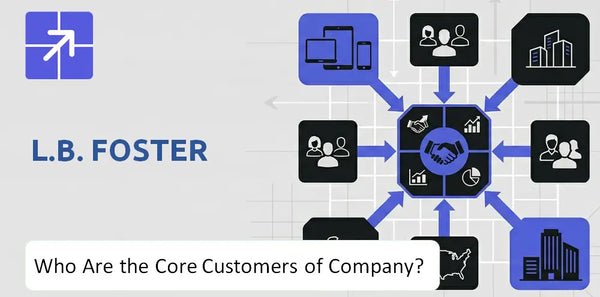
Core customers are Class I and regional rail operators plus government transit agencies; winning multi-year safety contracts underpins revenue predictability and margin recovery. See L.B. Foster BCG Matrix Analysis.
Who Is L.B. Foster Trying to Win?
L.B. Foster Company targets three high-value customer tiers: Class I railroads and major transit agencies, heavy civil contractors and state DOTs, plus industrial rail users and port authorities; transit agencies have risen materially in importance by early 2026.
 Main customer group: Class I railroads and major transit agencies
Class I railroad procurement teams and large transit authorities such as the MTA and Network Rail require mission-critical rail technologies, friction management systems, and signaling components; these clients drive large, multiyear contracts and account for the largest average contract size in the L.B. Foster target market.
Secondary groups: infrastructure contractors and state DOTs
Heavy civil engineering contractors and state departments of transportation buy precast concrete, piling, and structural steel for bridges and road projects; these customers provide steady project-based revenue and procurement cycles tied to public capital spending.
Customer type and market role
L.B. Foster primarily serves institutional and business buyers: railroad companies and operators, transit agencies and authorities, infrastructure contractors and builders, plus port authorities and industrial manufacturers – procurement officers and engineering firms are the main buyers.
Most important segment by 2025 – early 2026
The Rail, Technologies & Services (RTS) segment shifted toward transit agencies, which by early 2026 represent a significant portion of RTS backlog; transit-related contracts and urban mobility investments now materially boost backlog and revenue visibility for L.B. Foster core customers. Read more in Mission, Vision, and Values of L.B. Foster Company
L.B. Foster SWOT Analysis
- Complete SWOT Breakdown
- Fully Customizable
- Editable in Excel & Word
- Professional Formatting
- Investor-Ready Format

What Do L.B. Foster's Customers Care About Most?
Customers of L.B. Foster Company prioritize lowering total cost of ownership, ensuring operational safety, and meeting regulatory and sustainability targets; they buy solutions that extend asset life, cut maintenance, and speed installation.

Lifecycle extension and cost avoidance
Railroad companies and operators seek technologies that extend track and rolling stock life; friction management systems can cut rail wear by over 30%, saving rail operators millions in deferred maintenance per major corridor.
Practical buying drivers: speed, durability, TCO
Infrastructure contractors and transit agencies favor precast and modular products that reduce onsite labor and project delays; customers of L.B. Foster Company often choose solutions that lower lifecycle cost even if upfront spend is higher.
Emotional and aspirational appeal: reliability and reputation
Procurement officers and freight railroad managers want trusted suppliers that signal reliability to stakeholders and communities; using proven rail technologies supports reputational and safety goals.
What customers value most: safety, compliance, sustainability
Transit agencies and utilities prioritize operational safety and regulatory compliance; in 2025 many buyers also weight carbon-reduction benefits – optimized rail efficiency provides measurable emissions savings.
Loyalty and repeat demand drivers
Repeat orders come from consistent performance, long warranties, and integrated service offerings; rail maintenance contractors and short line railroads reorder ties, fasteners, and track materials when uptime improves and TCO falls.
Why customers choose L.B. Foster Company
Customers of L.B. Foster Company pick the firm for proven durability, faster installation, and product breadth across rail, transit, and infrastructure – helping freight railroad procurement managers and commuter rail agencies meet tight budgets and timelines. Read more on the company's market approach in Sales and Marketing Strategy of L.B. Foster Company.
L.B. Foster Business Model Canvas
- One-time Payment
- No Research Needed – Save Hours of Work
- Built by Experts, Trusted by Consultants
- Instant Download, Ready to Use
- 100% Editable, Fully Customizable

Where Is Demand Strongest for L.B. Foster?
L.B. Foster Company finds strongest demand in North America and the UK, concentrated in rail and bridge infrastructure projects where public capital spending and urban rail density drive purchases; demand is especially active in high-density urban corridors and late-stage IIJA-funded US projects.
North America: Primary market and public spending
North America generates roughly 75 percent of L.B. Foster Company revenue; IIJA (Infrastructure Investment and Jobs Act) late-stage deployment continues to fuel large orders for bridge products, rail ties, fasteners, and structural steel across federal and state programs.
UK and Europe: Fastest growth via CP7
Growth is fastest in the UK and European markets as Network Rail Control Period 7 (CP7) investment cycles accelerate procurement for rail modernization, digital track monitoring, and automated friction management systems.
Where L.B. Foster is strongest by product mix
L.B. Foster is strongest in bridge and track materials, fabrication, and rail components sales to railroad companies and operators, infrastructure contractors, and transit agencies, supported by repeat procurement from freight and commuter rail customers.
Where demand is growing fastest in 2025 – 2026
Demand is rising fastest for digital track monitoring (remote condition monitoring) and automated friction management in high-density urban corridors where manual maintenance is costlier and riskier; municipal governments and transit agencies increasing spend on safety and asset-management tech amplify this trend. See related context in History and Background of L.B. Foster Company.
L.B. Foster Marketing Mix
- Complete Marketing Mix Analysis
- Effortlessly Communicate Your Business Strategy
- Investor-Ready Format
- 100% Editable and Customizable
- Clear and Structured Layout

How Does L.B. Foster Keep Its Audience Growing?
L.B. Foster Company grows its audience by shifting from one-off capital sales to bundled hardware, proprietary software, and consumable services that lock in repeat business and let it reach adjacent rail and infrastructure segments.
How L.B. Foster Expands Its Customer Base
It targets L.B. Foster core customers by converting project buyers into recurring accounts: bundling track hardware with software and consumables lets the company sell lifecycle solutions to railroad companies and operators, transit agencies and authorities, and infrastructure contractors and builders. Cross-selling into adjacent buyers – port authorities, utilities, and municipal governments – adds new logos while the stabilized backlog above $250,000,000 and a 2025 book-to-bill of ~1.10x signal steady demand.
Customer Retention Drivers
Retention hinges on integrated recurring revenue models: software subscriptions, consumable friction modifiers, and long-term service contracts raise switching costs for customers of L.B. Foster Company. Strategic divestitures of low-margin commodity lines freed capital to invest in high-margin rail technologies, improving service depth and reducing churn among freight railroad procurement managers looking for track materials and commuter rail agencies seeking railcar components.
Loyalty, Repeat Demand, and Customer Depth
Repeat demand comes from consumables and software renewals tied to hardware installs; customers renew faster when preventive maintenance and analytics (rail asset management software) cut lifecycle costs. Ecosystem stickiness is reinforced by OEMs requiring custom fabricated metal components for rail equipment and rail maintenance contractors sourcing ties and fasteners – these buyers generate predictable, repeatable spend.
The Strongest Customer-Base Growth Lever
The key lever is product-service bundling: hardware plus proprietary software plus consumables creates recurring revenue and customer lock-in, enabling L.B. Foster target market penetration across public transportation procurement officers evaluating suppliers and construction contractors procuring roadway and bridge expansion materials. Management's 2025 focus on rail technologies positions the company to capture a larger slice of the projected $100,000,000,000 annual global rail infrastructure spend; see the company growth analysis in Growth Outlook of L.B. Foster Company.
L.B. Foster Boston Consulting Group Matrix
- Built by Experts, Trusted by Consultants
- Structured for Consultants, Students, and Founders
- 100% Editable in Microsoft Word & Excel
- Instant Digital Download – Use Immediately
- Compatible with Mac & PC – Fully Unlocked

Related Blogs
- What Is the History of L.B. Foster Company and How Did It Evolve?
- What Is the Competitive Landscape of L.B. Foster Company and How Does It Compete?
- What Is the Growth Outlook of L.B. Foster Company and Where Is It Heading?
- How Does L.B. Foster Company Work and What Drives Its Business Model?
- How Does L.B. Foster Company Reach Customers and Turn Demand into Sales?
- What Do the Mission, Vision, and Core Values of L.B. Foster Company Reveal?
- Who Owns L.B. Foster Company Today and Who Holds Control?
Frequently Asked Questions
L.B. Foster primarily targets Class I railroads, major transit agencies, heavy civil contractors, state DOTs, port authorities, and industrial rail users. The company serves institutional and business buyers, with procurement officers and engineering firms often making the buying decisions. Transit agencies have become especially important by early 2026.
Disclaimer
All information, articles, and product details provided on this website are for general informational and educational purposes only. We do not claim any ownership over, nor do we intend to infringe upon, any trademarks, copyrights, logos, brand names, or other intellectual property mentioned or depicted on this site. Such intellectual property remains the property of its respective owners, and any references here are made solely for identification or informational purposes, without implying any affiliation, endorsement, or partnership.
We make no representations or warranties, express or implied, regarding the accuracy, completeness, or suitability of any content or products presented. Nothing on this website should be construed as legal, tax, investment, financial, medical, or other professional advice. In addition, no part of this site - including articles or product references - constitutes a solicitation, recommendation, endorsement, advertisement, or offer to buy or sell any securities, franchises, or other financial instruments, particularly in jurisdictions where such activity would be unlawful.
All content is of a general nature and may not address the specific circumstances of any individual or entity. It is not a substitute for professional advice or services. Any actions you take based on the information provided here are strictly at your own risk. You accept full responsibility for any decisions or outcomes arising from your use of this website and agree to release us from any liability in connection with your use of, or reliance upon, the content or products found herein.